English | नेपाली
CLASS 02
CANNABIS THROUGH HISTORY
01
An ancient plant.
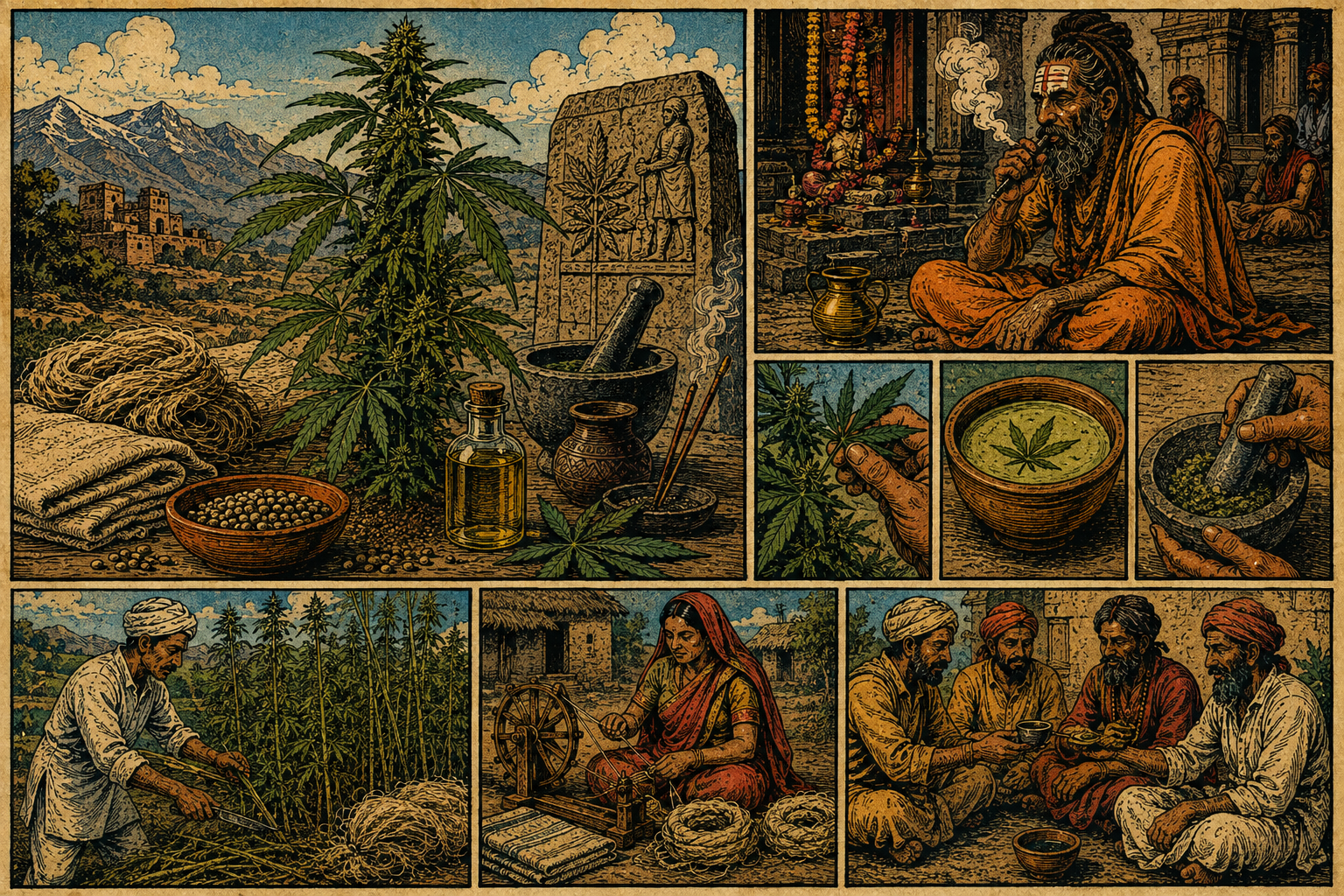
Cannabis history begins thousands of years before modern cannabis law.
Cannabis is not a new crop or a modern invention.
For thousands of years, people have cultivated and used the plant in different parts of the world. Archaeological and historical evidence connects cannabis with fibre, food, medicine, ritual and psychoactive use across different societies and periods.
Some of the earliest evidence comes from Asia, where cannabis was used both as a practical crop and, over time, for medicinal and ceremonial purposes.
Its fibres could become rope and textiles.
Its seeds could provide food and oil.
Its preparations could be used medicinally or culturally.
The important point is not that cannabis had one ancient use.
It is that people discovered different uses for different parts and properties of the same plant.
A plant before a controversy.
Long before cannabis became the subject of criminal law, international treaties, political debate or commercial legalization, it was already part of human agriculture and culture.
The history did not begin when the law changed.
02
Everyday & sacred.
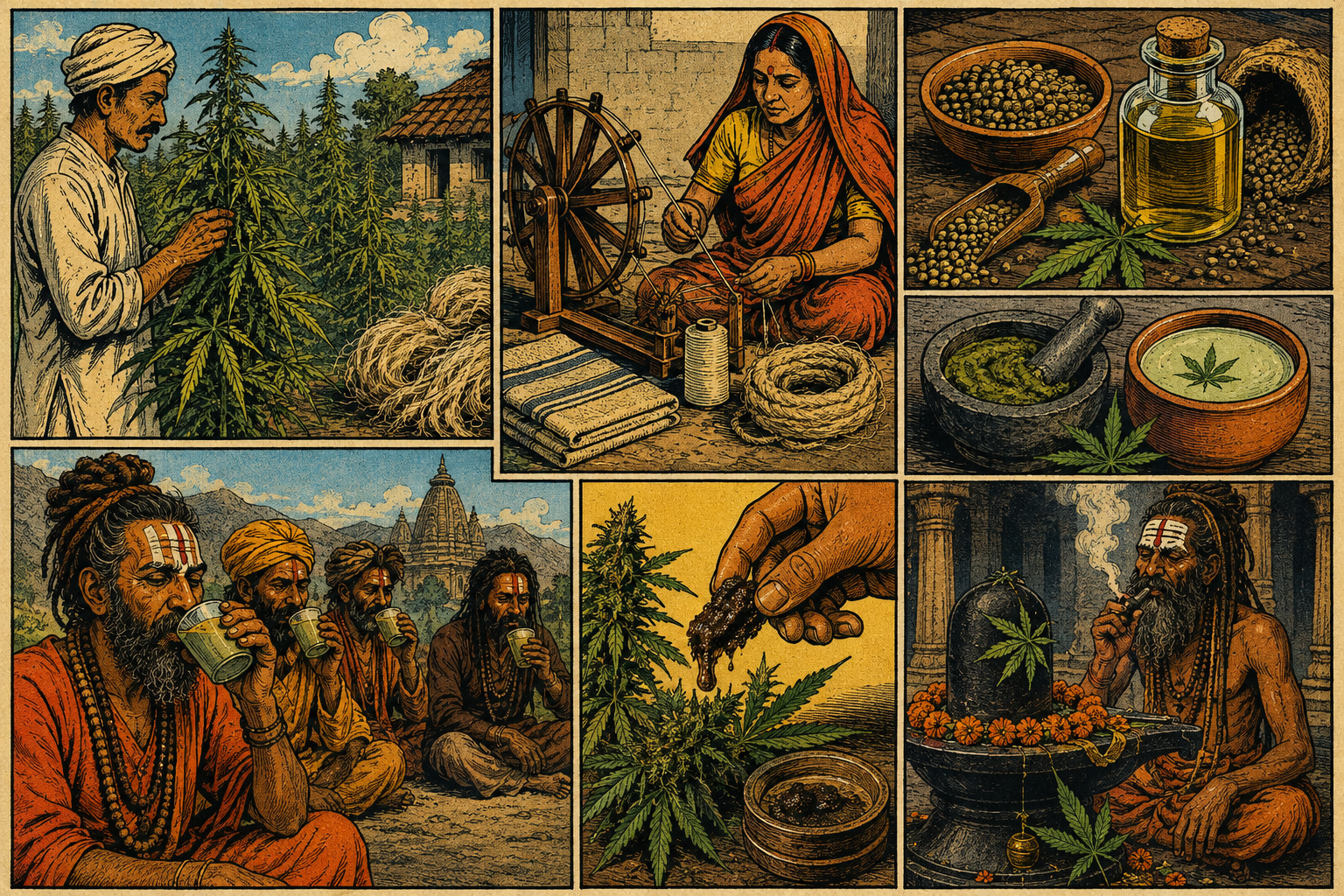
Cannabis became part of ordinary life—and also of culture and tradition.
As cannabis moved through different societies, people did not use it for only one purpose.
In some communities, cannabis was an everyday agricultural crop. Its stalks provided fibre. Its seeds provided food and oil. Different preparations of the plant were used in traditional medicine.
But cannabis also acquired cultural, spiritual and ceremonial roles.
This is particularly important in South Asia, where cannabis has a long and complex history. Preparations including bhang, ganja and charas developed distinct meanings, methods of preparation and patterns of use.
BHANG
Traditionally prepared using cannabis leaves and other plant material, often in drinks or foods. Bhang remains associated with particular cultural and religious traditions in India.
GANJA
A historical South Asian term generally associated with the flowering portions of the cannabis plant.
CHARAS
Cannabis resin traditionally collected from the plant, with a particularly strong historical association with Himalayan regions.
These were not simply three names for the same product. They reflected different plant materials, preparations, uses and traditions.
The same plant could occupy different places in society.
Cannabis could be a crop, food, medicine, intoxicant, traditional preparation or part of a religious practice—sometimes within the same society.
That complexity becomes important later, when governments begin trying to classify and regulate it.
Before cannabis became one legal category, people already understood it in many different ways.
03
Knowledge travels.
Cannabis knowledge moved with people, trade and culture.
Cannabis did not remain confined to one region.
As people travelled, traded and migrated, knowledge about the plant travelled with them. Seeds moved. Agricultural practices moved. Ways of preparing and using the plant moved too.
Across Asia, the Middle East, Africa and eventually Europe, cannabis and hemp became incorporated into different agricultural, medicinal and cultural traditions.
But these traditions were not identical.
Communities selected plants for different purposes. Some valued strong fibres for rope and textiles. Others used seeds and oil as food. Cannabis preparations also appeared in medicinal, cultural and intoxicating practices.
Trade routes helped connect these traditions.
Over centuries, cannabis therefore became not simply a plant that existed across a wide geography, but a plant whose meaning and use changed as it entered different societies.
A plant in motion.
There was no single moment when cannabis "spread around the world."
Its history is better understood as a long movement of plants, seeds, knowledge and practices between people and places.
Where people travelled, plant knowledge travelled with them.
04
Cannabis enters medicine.
Cannabis became part of formal systems of medicine long before modern cannabis science.
Across different medical traditions, preparations made from cannabis were used for a variety of purposes.
In South Asia, cannabis preparations appeared within long-established systems of traditional medicine. Knowledge developed through observation, practice and experience rather than through the laboratory methods used today.
By the 19th century, cannabis also began attracting greater attention within Western medicine.
Physicians working in British India documented local uses of cannabis and experimented with cannabis preparations. One of the best-known was William Brooke O'Shaughnessy, whose work in India helped introduce Indian cannabis preparations into European medicine during the 1800s.
Cannabis extracts and tinctures subsequently appeared in Western medical practice and pharmacopoeias.
This history is important for one reason:
Medical cannabis did not begin with modern legalization.
Modern medicine has very different standards for evidence, dosing, safety and regulation, but people had been exploring the medicinal properties of cannabis for centuries before those systems existed.
Old knowledge. New science.
Historical use does not by itself prove that a treatment is safe or effective.
But it helps explain why cannabis repeatedly appears in the history of medicine—and why modern researchers eventually returned to the plant with scientific tools.
Traditional knowledge raised questions that science is still investigating.
05
Cannabis becomes a commodity.
Cannabis was not only used. It was traded, taxed and regulated.
As trade expanded, cannabis and hemp became economically important commodities.
Hemp fibre supplied rope, sails, textiles and other materials. Seeds and oils had agricultural and household uses. Cannabis preparations were also bought and sold for medicinal, cultural and intoxicating purposes.
Governments increasingly became interested in this trade.
In British India, cannabis products including bhang, ganja and charas were already part of established markets. Rather than simply existing outside government control, their production and sale became subjects of taxation, licensing and regulation.
This created an important shift in the history of cannabis.
The plant was no longer only a matter of agriculture, medicine or culture.
It was also becoming a matter of commerce and government policy.
Regulation before prohibition.
It is easy to assume that cannabis regulation began when governments started prohibiting it.
It did not.
Governments had already been trying to control cannabis through taxes, licences and rules governing production and sale.
Those systems would eventually lead to a much larger question:
Should cannabis be regulated—or prohibited?
That question takes us directly toward one of the most important documents in cannabis history: the Indian Hemp Drugs Commission of 1893–94.
Before prohibition came regulation. Before regulation came use.
06
The 1893-94 Commission
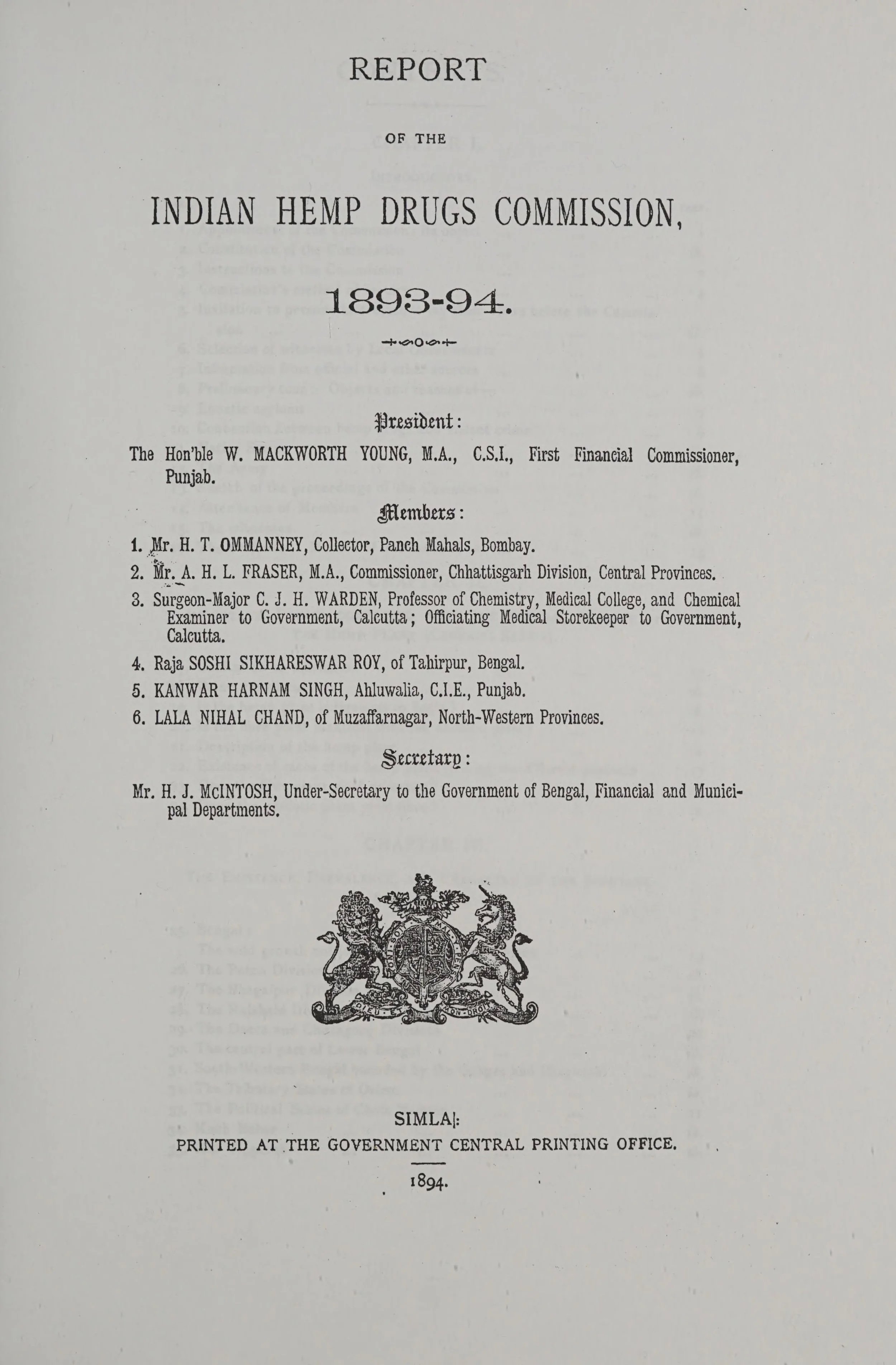
Report of the Indian Hemp Drugs Commission, 1893–94
Source: Wellcome Collection
One of history’s largest investigations of cannabis asked a surprisingly modern question.
In 1893, the Government of India established what became known as the Indian Hemp Drugs Commission.
Its task was not simply to describe cannabis. The Commission investigated its cultivation, production, trade, taxation, patterns of use and possible effects on health and society.
The investigation was unusually extensive.
The Commission gathered testimony from people with very different relationships to cannabis—including government officials, medical practitioners, cultivators, traders, religious figures and people familiar with its everyday use.
It examined the cannabis preparations that were actually being used, including bhang, ganja and charas, rather than treating every form of cannabis as identical.
Evidence before conclusion.
One of the most interesting things about the Commission today is its method.
It asked questions.
It collected testimony.
It compared different kinds and patterns of use.
It considered whether harms were associated with cannabis itself, with excessive use, or with other circumstances.
And only then did it consider what government should do.
The Commission ultimately did not recommend general prohibition. Its conclusions distinguished moderate use from excessive use and supported regulation rather than an outright ban.
That does not mean a report written in the 1890s should determine cannabis policy today.
Its evidence, terminology and scientific methods belong to its time.
But its underlying approach remains remarkably relevant:
Study what people actually do. Examine the evidence. Then regulate accordingly.
A historical document—and a research opportunity.
For Paatsala, the Commission is valuable for another reason.
Its thousands of pages contain observations, testimony and questions about cannabis that modern students and researchers can revisit using today's scientific methods.
Historical knowledge can suggest questions.
Modern research must test the answers.
Evidence should come before assumption.
07
Prohibition changes the story.
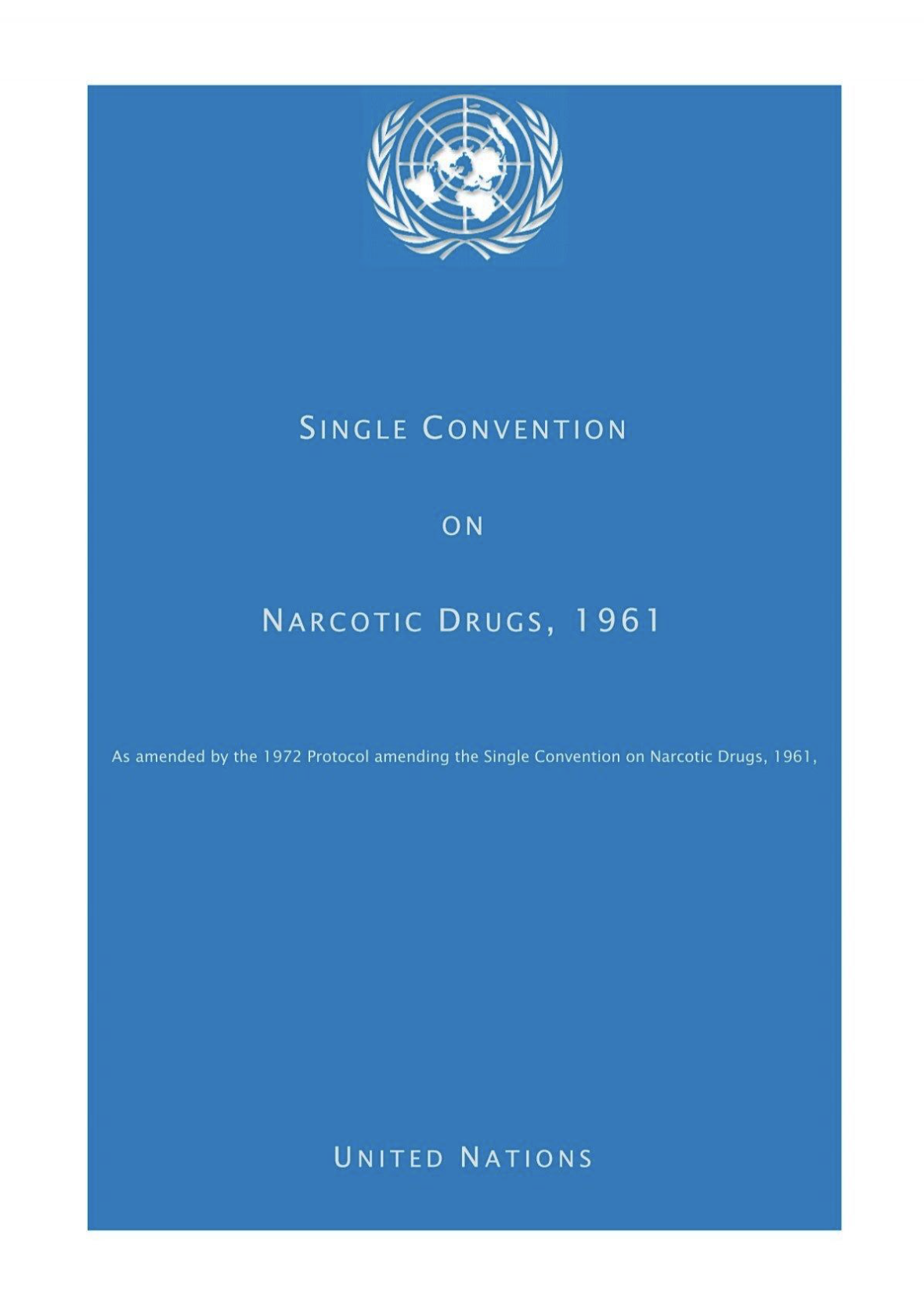
Single Convention on Narcotic Drugs, 1961
United Nations, New York, 30 March 1961
Cannabis moved from everyday regulation toward international control.
For most of history, cannabis existed within local systems of agriculture, medicine, culture and trade.
During the twentieth century, that began to change.
Governments increasingly approached cannabis not simply as a plant or commodity, but as a drug requiring legal control.
Different countries took different paths, but the direction gradually became international.
FROM LOCAL LAWS TO INTERNATIONAL RULES
Early cannabis restrictions were largely national or colonial. Over time, international agreements began bringing cannabis into a common system of drug control.
A major turning point came with the 1961 Single Convention on Narcotic Drugs.
Cannabis was placed within the international narcotics-control framework alongside other controlled substances.
Countries that joined the Convention accepted obligations to control its cultivation, production, possession and trade, except for permitted purposes within the treaty system.
A NEW WAY OF SEEING THE PLANT
This changed more than law.
For centuries, cannabis had been understood differently depending on what part of the plant was used, how it was prepared and why it was used.
Modern prohibition increasingly viewed cannabis through another lens:
What must be controlled?
That distinction still influences cannabis policy today.
History had entered the age of prohibition.
And once cannabis became an international legal question, changing the law would become an international question too.
08
The story changes again.
In 2020, the United Nations reconsidered how cannabis was classified.
For decades, cannabis and cannabis resin had been listed in both Schedule I and Schedule IV of the 1961 Single Convention.
But scientific understanding of cannabis continued to develop.
The World Health Organization conducted a formal review of cannabis and cannabis-related substances and made recommendations to the United Nations Commission on Narcotic Drugs.
On 2 December 2020, countries voted to remove cannabis and cannabis resin from Schedule IV of the 1961 Convention. The decision was close: 27 countries voted in favour, 25 against, with one abstention. India, Nepal and Thailand were among the countries that voted in favour of the change.
A SIGNIFICANT CHANGE
The decision recognized that cannabis has medical and therapeutic value.
But it did not legalize cannabis internationally.
Cannabis remained controlled under Schedule I of the Convention.
That distinction is important.
2020 did not end international cannabis control.
It changed how cannabis was classified within that system.
From assumption back to evidence.
More than a century after the Indian Hemp Drugs Commission investigated cannabis by gathering evidence, international institutions were again reconsidering cannabis in light of scientific evidence.
Cannabis history continues to change as knowledge, evidence and policy change.
09
Evidence, not assumption.
Cannabis history teaches us to ask better questions.
The history of cannabis is not a simple story of acceptance followed by prohibition and legalization.
Across different periods and cultures, cannabis has been understood as a crop, food, fibre, medicine, cultural substance, intoxicant and controlled drug.
What changed was not only the plant.
Society changed.
Science changed.
Law changed.
And the questions people asked changed.
The 1893–94 Indian Hemp Drugs Commission investigated cannabis by gathering evidence from people who grew it, used it, regulated it and understood its place in society.
More than a century later, scientific review again played a role when the World Health Organization reviewed cannabis, leading to the 2020 UN decision to remove cannabis and cannabis resin from Schedule IV while keeping them under Schedule I control.
HISTORY IS STILL BEING WRITTEN
Cannabis policy continues to change around the world.
Understanding that change requires more than choosing whether cannabis is simply “good” or “bad.”
It requires looking at the evidence, understanding the context and asking what purpose a particular law or policy is intended to serve.
The lesson from history is not what to think.
It is to look at the evidence before deciding.
Next, we begin looking at how cannabis is regulated today.
10
You now know the history.
The plant stayed.
The way societies understood it changed.
Cannabis has been part of human societies for thousands of years.
Across that history, people have grown, traded and used it for different purposes — including food, fibre, medicine, cultural practices and intoxication.
What changed over time was the way societies understood and regulated it.
SIX IDEAS TO REMEMBER
AN ANCIENT PLANT
Cannabis existed as a crop and cultural plant long before modern drug laws.
MANY PURPOSES
Different societies used different parts and preparations of cannabis in different ways.
CULTURE MATTERS
Cannabis became connected with traditions and practices, particularly across parts of Asia.
EVIDENCE MATTERS
The 1893–94 Indian Hemp Drugs Commission conducted an extensive investigation rather than treating cannabis as a single simple question. The surviving report itself runs to eight volumes.
INTERNATIONAL CONTROL
The twentieth century brought cannabis into an international system of drug control.
HISTORY KEEPS CHANGING
In 2020, the UN Commission on Narcotic Drugs removed cannabis and cannabis resin from Schedule IV following a WHO scientific review, recognizing therapeutic value while international control continued.
History gives us context. Evidence helps us decide what comes next.
You don't need to memorize every date. You need to understand how we arrived here.
CLASS 02
KNOWLEDGE CHECK
You know the history. Let's check.
10 questions · About 3 minutes · Retake anytime
1. Why is cannabis described as an ancient plant?
A. It was invented for modern medicine
B. People have cultivated and used it for thousands of years
C. It originated after modern drug laws
D. It was originally a pharmaceutical product
2. Historically, cannabis has been used for:
A. Intoxication only
B. Medicine only
C. Fibre only
D. Food, fibre, medicine, cultural purposes and intoxication
3. Why is South Asia important in cannabis history?
A. Cannabis arrived there only recently
B. Cannabis developed longstanding agricultural, medicinal, cultural and traditional uses there
C. Cannabis was used only for fibre
D. Cannabis was unknown before modern prohibition
4. What are bhang, ganja and charas?
A. Three different plant species
B. Modern pharmaceutical products
C. Different traditional cannabis preparations or products
D. International legal classifications
5. What was significant about the Indian Hemp Drugs Commission?
A. It created the 1961 Convention
B. It immediately prohibited cannabis
C. It conducted a broad investigation into cannabis and its use
D. It discovered THC
6. When was the Indian Hemp Drugs Commission established?
A. 1793
B. 1893
C. 1961
D. 2020
7. What major change occurred during the twentieth century?
A. Cannabis disappeared from agriculture
B. Cannabis stopped having cultural uses
C. Cannabis increasingly became subject to national and international drug control
D. Every country adopted identical cannabis laws
8. Why is the 1961 Single Convention important to cannabis history?
A. It legalized cannabis worldwide
B. It ended cannabis regulation
C. It placed cannabis within the modern international narcotics-control framework
D. It established the Indian Hemp Drugs Commission
9. What happened internationally in 2020?
A. Cannabis was legalized worldwide
B. Cannabis was removed from all international control
C. Cannabis and cannabis resin were removed from Schedule IV of the 1961 Convention
D. The 1961 Convention was abolished
10. What is the central lesson of Class 02?
A. History proves cannabis is harmless
B. History proves cannabis should be prohibited
C. Cannabis history can be understood from one event
D. Cannabis should be understood through history, evidence and context
RESULT
For 8–10 correct:
Excellent. You understand the major historical ideas that shaped how cannabis is understood today.
For 5–7 correct:
Almost there. You have the main ideas. Review the questions you missed and try again.
For 0–4 correct:
Take another look. There is no penalty and no limit on attempts. Return to Class 02, review the history and try again when you're ready.
CHECK YOUR ANSWERS
1 B · 2 D · 3 B · 4 C · 5 C · 6 B · 7 C · 8 C · 9 C · 10 D