English | नेपाली
CLASS 03
FROM PROHIBITION TO REGULATION
01
What is prohibition?
Prohibition is a legal decision to forbid certain activities.
When cannabis is prohibited, the law may make activities such as growing, producing, possessing, selling or supplying cannabis illegal, except where specific exemptions exist.
But prohibition is more than simply saying:
“Cannabis is illegal.”
A prohibition system also determines what happens when someone breaks those rules.
Depending on the law and jurisdiction, consequences may include confiscation, fines, arrest, criminal charges or imprisonment.
WHY DO GOVERNMENTS PROHIBIT THINGS?
Prohibition is generally intended to prevent or reduce activities that governments consider harmful or unacceptable.
In cannabis policy, governments have historically used prohibition to try to control production, supply, availability and use.
Whether prohibition achieves those goals—and what other consequences it creates—is a separate question.
That question helped drive the search for different approaches.
Prohibition removes legal permission. Regulation creates rules for permission.
That distinction is the foundation for everything that follows in this class.
To understand legalization, first understand what the law is changing.
02
What is regulation?
Regulation allows an activity—but places rules around it.
When cannabis moves from prohibition toward regulation, it does not mean that anything goes.
Instead, the law decides what is permitted, who may participate, under what conditions and who is responsible for enforcing the rules.
A regulated cannabis system might decide:
WHO
Who may grow, produce, sell, prescribe, purchase or use cannabis.
WHAT
Which plants, products or preparations are permitted.
WHERE
Where cannabis may be cultivated, produced, sold or used.
HOW
How products must be grown, processed, tested, packaged, labelled and distributed.
HOW MUCH
Limits may apply to possession, cultivation, purchasing or production.
LEGAL DOES NOT MEAN UNREGULATED
Many ordinary products and activities are legal but regulated.
Medicines have manufacturing and prescribing rules. Food businesses follow safety standards. Farmers operate under agricultural requirements. Alcohol and tobacco are subject to age limits, licensing and other controls.
Cannabis regulation follows the same basic idea:
Permission comes with rules.
Different governments may choose very different rules, but the fundamental shift is the same.
Prohibition asks:
What must not happen?
Regulation asks:
What may happen—and under what conditions?
Legalization opens a legal pathway. Regulation defines that pathway.
03
From one rule to many rules
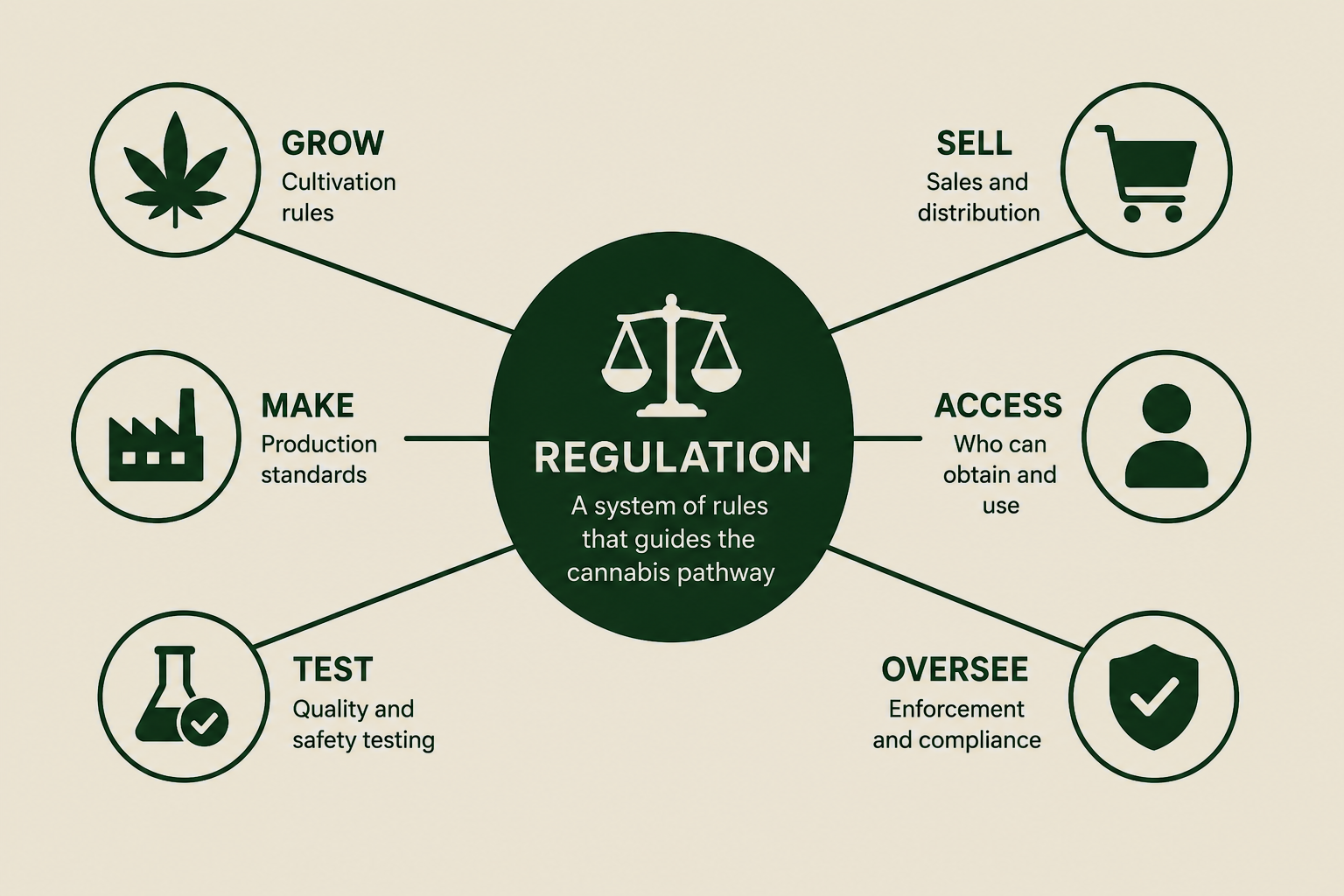
Prohibition can be simple. Regulation requires choices.
Under prohibition, the central rule may be straightforward:
You cannot do this.
Once cannabis is permitted for some purposes, governments have many more questions to answer.
CULTIVATION
Who can grow cannabis? How much? Where?
PRODUCTION
Who can turn the plant into medicines, foods, extracts or other products?
QUALITY & TESTING
What standards should products meet before reaching people?
SALES
Who can sell cannabis, and through what type of outlet?
ACCESS
Who can obtain it—for example, registered patients, adults, businesses or researchers?
PACKAGING & INFORMATION
What must appear on a product label? What claims can be made?
ADVERTISING
How and where can cannabis businesses promote their products?
TAX & FEES
Should businesses, products or transactions be taxed or charged licensing fees?
ENFORCEMENT
What happens when someone operates outside the regulated system?
Regulation is a toolbox.
Different governments choose different combinations of these tools depending on what they are trying to achieve.
A medical cannabis program may need very different rules from an industrial hemp program. A system allowing adult use may require another set of safeguards.
That is why saying “cannabis is legal” tells us very little by itself.
The more useful question is:
What is legal, for whom, and under what rules?
The law may open the door. Regulation decides how people walk through it.
04
Different purposes, different pathways
Cannabis regulation depends partly on what the cannabis is for.
Cannabis is not regulated everywhere as one single product.
As we saw in Class 01, the same plant can have very different uses. Regulation often reflects those differences.
Three pathways appear frequently in modern cannabis policy.
INDUSTRIAL & HEMP
Cannabis may be cultivated for fibre, seed, food, oil and other industrial uses.
Many legal systems distinguish hemp from other cannabis using definitions that may include THC limits, plant varieties or intended use.
The rules may focus on cultivation, seed, processing, testing and trade.
MEDICAL
Medical cannabis systems create a pathway for cannabis or cannabis-derived products to be used for medical purposes.
Depending on the system, rules may cover patients, healthcare professionals, approved products, cultivation, manufacturing, dispensing and quality standards.
Medical access does not necessarily mean cannabis is generally legal for everyone.
ADULT USE
Some jurisdictions permit adults to possess or obtain cannabis for non-medical use.
These systems commonly establish rules around age, possession, cultivation, production, retail sales, products, advertising and public use.
Again, permission comes with limits.
The pathways can exist separately.
A country might permit industrial hemp while prohibiting other cannabis.
Another might allow hemp and medical cannabis but not adult use.
Another may regulate all three.
So when someone says:
“Cannabis is legal there.”
our next question should be:
Legal for what purpose?
That question immediately tells us much more about the regulatory system.
One plant can enter several different legal pathways.
INDUSTRIAL & HEMP
Food · Fibre · Seed · Materials
MEDICAL
Patients · Products · Healthcare
ADULT USE
Adults · Access · Controlled Market
05
Who is responsible?
Regulation works only when different people know their responsibilities.
A regulated cannabis system is not created by government alone.
It involves everyone who participates in the pathway—from cultivation to the person who ultimately uses the product.
GOVERNMENT
Government establishes the legal framework.
It decides what activities are permitted, prohibited or restricted and gives public authorities responsibility for implementing those rules.
REGULATORS
Regulatory bodies turn laws into standards, procedures and oversight.
Depending on the system, they may issue licences, inspect facilities, establish product requirements, collect information and enforce compliance.
GROWERS & PRODUCERS
Those cultivating or producing cannabis must operate within the rules that apply to them.
That may include requirements concerning cultivation, record keeping, processing, testing, storage and movement of products.
BUSINESSES
Businesses have responsibilities for the products they manufacture or sell.
Rules may address quality, packaging, labelling, advertising, sales and consumer information.
HEALTH SYSTEMS
Where cannabis is used medically, healthcare professionals, pharmacies, hospitals or other authorized providers may have specific responsibilities.
Their role depends heavily on the regulatory model.
CONSUMERS
Regulation also creates responsibilities for the person using cannabis.
These can include age restrictions, possession limits, where cannabis may be used, impaired driving laws and rules against supplying it to others.
Regulation is a shared system.
Government makes rules.
Regulators oversee them.
Producers and businesses follow them.
Consumers have responsibilities too.
A regulated market depends on responsibility throughout the chain.
Rules matter only when people understand who is responsible for what.
06
Different places, different models
There is no single model for cannabis regulation.
Countries—and sometimes states or provinces within the same country—have taken very different approaches to cannabis.
The differences reflect law, public health priorities, politics, culture, agriculture and local circumstances.
SOME ALLOW MEDICAL ACCESS
Cannabis may be available to patients under a medical framework while non-medical use remains prohibited.
The rules for who qualifies and how cannabis is supplied vary considerably.
SOME ALLOW ADULT USE
Some jurisdictions permit cannabis for adults beyond medical purposes.
But even here, the models differ.
Cannabis might be sold through licensed private businesses, government-controlled outlets, nonprofit associations or other regulated systems.
SOME HAVE DECRIMINALIZED POSSESSION
Decriminalization is different from legalization.
A jurisdiction may reduce or remove criminal penalties for possessing small amounts of cannabis without creating a legal system for producing and selling it.
SOME PERMIT CULTIVATION
Certain systems allow individuals to grow a limited number of plants.
Others permit cultivation only by licensed producers.
Some allow both.
AND SOME CONTINUE PROHIBITION
Many countries continue to prohibit cannabis outside limited medical, scientific, industrial or other authorized purposes.
Legalization is not a switch.
It is tempting to imagine cannabis policy as:
ILLEGAL → LEGAL
But the reality looks more like:
PROHIBITION → DECRIMINALIZATION → LIMITED ACCESS → REGULATED MARKETS
And even that is only a simplified way of understanding it.
Different places can occupy different points—or create entirely different combinations.
The important question is not simply: “Is cannabis legal?”
It is:
What is permitted?
For whom?
For what purpose?
Under what rules?
There is no universal cannabis model.
07
Regulation is not the end of the story
Changing the law does not solve every cannabis policy question.
Creating a legal pathway is a major change.
But once regulation begins, governments and communities still have to understand what happens in practice.
PUBLIC HEALTH
Regulators may monitor patterns of use, health outcomes and risks—particularly among young people and other vulnerable populations.
Education and responsible-use information can become part of the system.
THE UNREGULATED MARKET
A legal market does not necessarily make an illegal or unregulated market disappear immediately.
Price, accessibility, product availability and the design of regulations can influence whether people move toward regulated sources.
ACCESS
A system can be legal while remaining difficult for some people to access.
For medical cannabis especially, questions of cost, availability and geographic access can matter.
FARMERS & PRODUCERS
Regulation determines who gets to participate in the emerging market.
Rules that are too difficult or expensive for small producers may create very different outcomes from systems designed to include them.
ENFORCEMENT
Even after reform, some cannabis activities may remain prohibited.
Authorities therefore need to distinguish between legal activity, regulated activity and activity that remains outside the law.
EVIDENCE
Perhaps most importantly, regulation creates an opportunity to learn.
Governments can observe what works, what does not, and where rules need to change.
Good regulation can evolve.
Cannabis policy does not end on the day a law is passed.
It becomes an ongoing process of implementation, observation and improvement.
The question moves from “Should we change the law?” to “Is the system working?”
Regulation is not the destination. It is the beginning of implementation.
08
From global idea to local framework
Every regulatory system has to work somewhere.
Around the world, governments have experimented with different approaches to cannabis.
But a model that works in one country cannot simply be copied into another.
Regulation has to respond to local law, institutions, agriculture, culture, public health priorities and economic realities.
START WITH THE PLACE
Before designing cannabis regulation, useful questions include:
What does existing law allow?
What is the local history of the plant?
Who already grows or uses it?
What institutions could regulate it?
What opportunities could regulation create?
What risks need to be managed?
These questions turn the idea of cannabis reform into the practical work of designing a system.
FROM THEORY TO GANDAKI
That brings us to Gandaki Province in Nepal.
Cannabis has historical, cultural and agricultural connections to Nepal and the Himalayan region.
At the same time, any modern regulatory approach must operate within Nepal's existing legal and governmental structure.
So rather than asking only:
“Should cannabis be legal?”
we can ask a more useful question:
What could a responsible cannabis framework look like in Gandaki?
That is the subject of the next class.
CLASS 03 COMPLETE
FROM PROHIBITION TO REGULATION
NEXT → CLASS 04
THE GANDAKI CANNABIS FRAMEWORK
CLASS 03
KNOWLEDGE CHECK
You understand the difference. Let's check.
10 questions · About 3 minutes · Retake anytime
1. What does prohibition generally do?
A. Forbids specified activities ✓
B. Creates a commercial market
C. Establishes product standards
D. Guarantees medical access
2. What does regulation mean?
A. Everything becomes permitted
B. Activities may be permitted under defined rules ✓
C. Cannabis is removed from all laws
D. Only government may grow cannabis
3. Why doesn't “cannabis is legal” tell us enough?
A. Cannabis laws are always temporary
B. Cannabis cannot be regulated
C. Different activities and purposes may have different rules ✓
D. Legalization always means adult use
4. Which could be part of cannabis regulation?
A. Cultivation rules
B. Testing requirements
C. Sales restrictions
D. All of the above ✓
5. Which are three common regulatory pathways discussed in this class?
A. Indoor, outdoor and greenhouse
B. Industrial/hemp, medical and adult use ✓
C. Local, national and international
D. Flower, resin and oil
6. Can a country permit hemp while continuing to prohibit other cannabis activities?
A. Yes ✓
B. No
7. What is decriminalization?
A. Creating a fully regulated commercial market
B. Reducing or removing criminal penalties for certain conduct without necessarily creating legal supply ✓
C. Legalizing every cannabis activity
D. Creating a medical program
8. Who has responsibilities in a regulated system?
A. Government only
B. Cannabis businesses only
C. Consumers only
D. Different participants throughout the system ✓
9. Does regulation solve every cannabis policy problem once a law is passed?
A. Yes
B. No—implementation and evaluation continue ✓
10. What question should we ask when examining a cannabis law?
A. Is cannabis good or bad?
B. Is cannabis simply legal or illegal?
C. What is permitted, for whom, for what purpose and under what rules? ✓
D. How many cannabis businesses exist?
Results
8–10 : EXCELLENT
You understand the basic principles of cannabis regulation.
5–7 : ALMOST THERE
Review the ideas you missed and try again.
0–4 : TAKE ANOTHER LOOK
Return to the class, review the fundamentals and try again when you're ready.
CHECK YOUR ANSWERS
1 A · 2 B · 3 C · 4 D · 5 B · 6 A · 7 B · 8 D · 9 B · 10 C