English | नेपाली
PAATSALA FUNDAMENTALS · CLASS 01
Understanding Cannabis
Start with the plant.
Before we talk about medicine, law, cultivation or business, we need to understand what cannabis actually is.
In this class, you will learn the basic language of the cannabis plant, how it grows and reproduces, and why different parts of the same plant can have very different uses.
Approx. 15–20 minutes · Beginner · Free
01 / 10
01
What is cannabis?
Cannabis is a plant.
That sounds obvious, but it is the most important place to begin.
For thousands of years, people have grown cannabis for different purposes: for fibre, seed and food; for traditional and medical uses; and for its psychoactive effects.
Today, the same plant sits at the intersection of agriculture, medicine, culture, industry and law.
Understanding cannabis begins by separating the plant itself from the many ways humans have chosen to use and regulate it.
One plant. Many uses. Many different systems around it.
02
Cannabis, hemp
and marijuana.
The words matter.
Cannabis is the broader term for the plant and its varieties.
Hemp generally refers to cannabis that meets a legally defined limit for THC. The exact definition depends on the jurisdiction.
Marijuana is a commonly used term for cannabis associated with higher THC levels and psychoactive use. It is widely used in law and everyday language, although its meaning is not a precise botanical classification.
This means hemp and marijuana should not be understood simply as two completely different plants. The distinction is often created by law, chemistry, intended use and cultivation.
One plant genus. Different characteristics. Different uses. Different legal definitions.
03
Meet the plant.
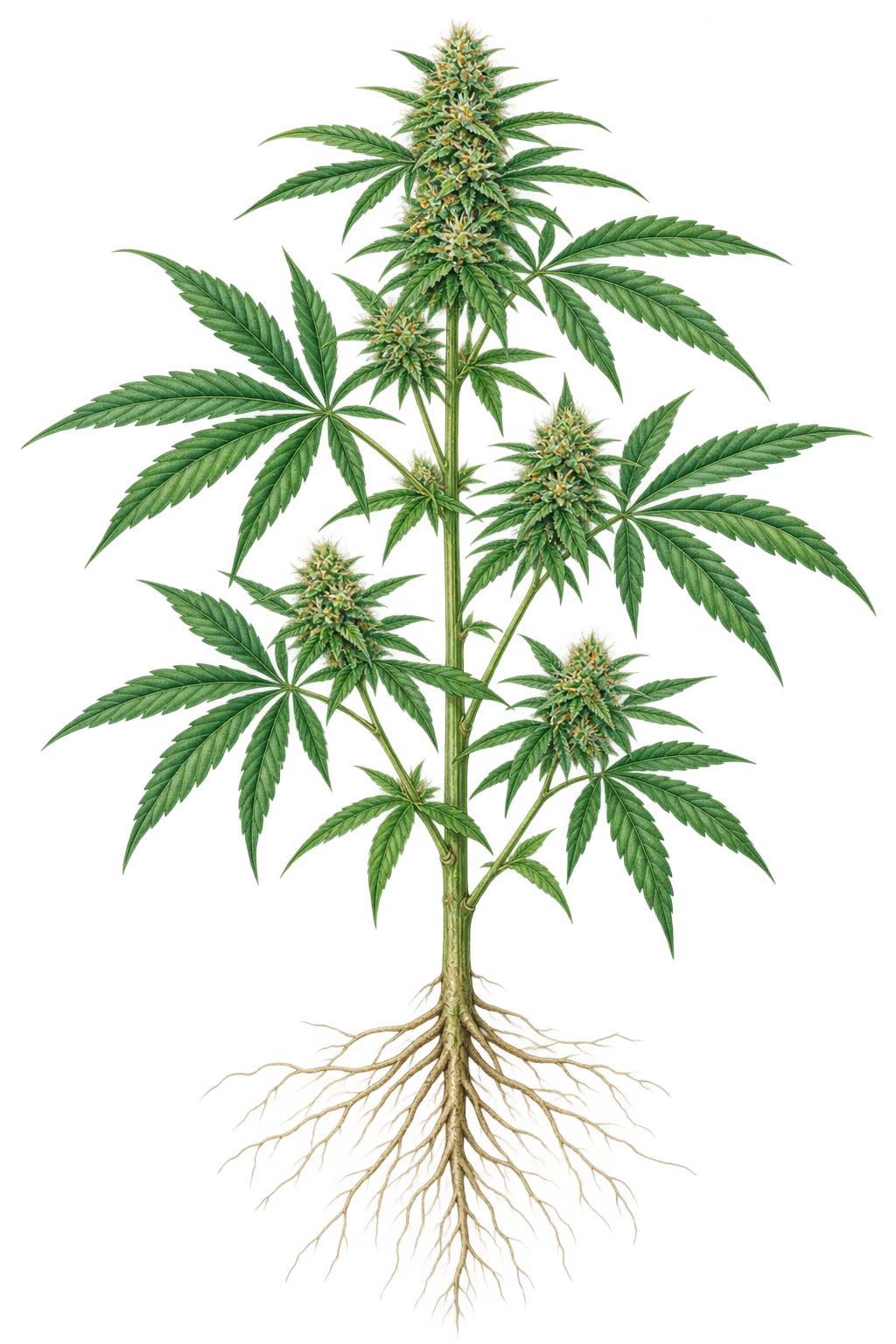
A cannabis plant has several parts, each with a different role.
FLOWER
The reproductive structure of the plant. Female flowers produce much of the resin associated with cannabinoids and aromatic compounds.
LEAF
Captures light for photosynthesis. The distinctive palmate leaf has become the plant's most recognizable symbol.
STEM & STALK
Support the plant and transport water and nutrients. Fibrous stalks have also been used historically for textiles, rope and other materials.
ROOTS
Anchor the plant and absorb water and nutrients from the soil.
SEED
Contains the embryo of a new plant and stores nutrients needed during early growth.
TRICHOMES
Tiny glandular structures found especially around the flowers. Many of the plant's cannabinoids and aromatic compounds are produced and stored here.
Every part of the plant has a function.
04
Male, female
and the life cycle.
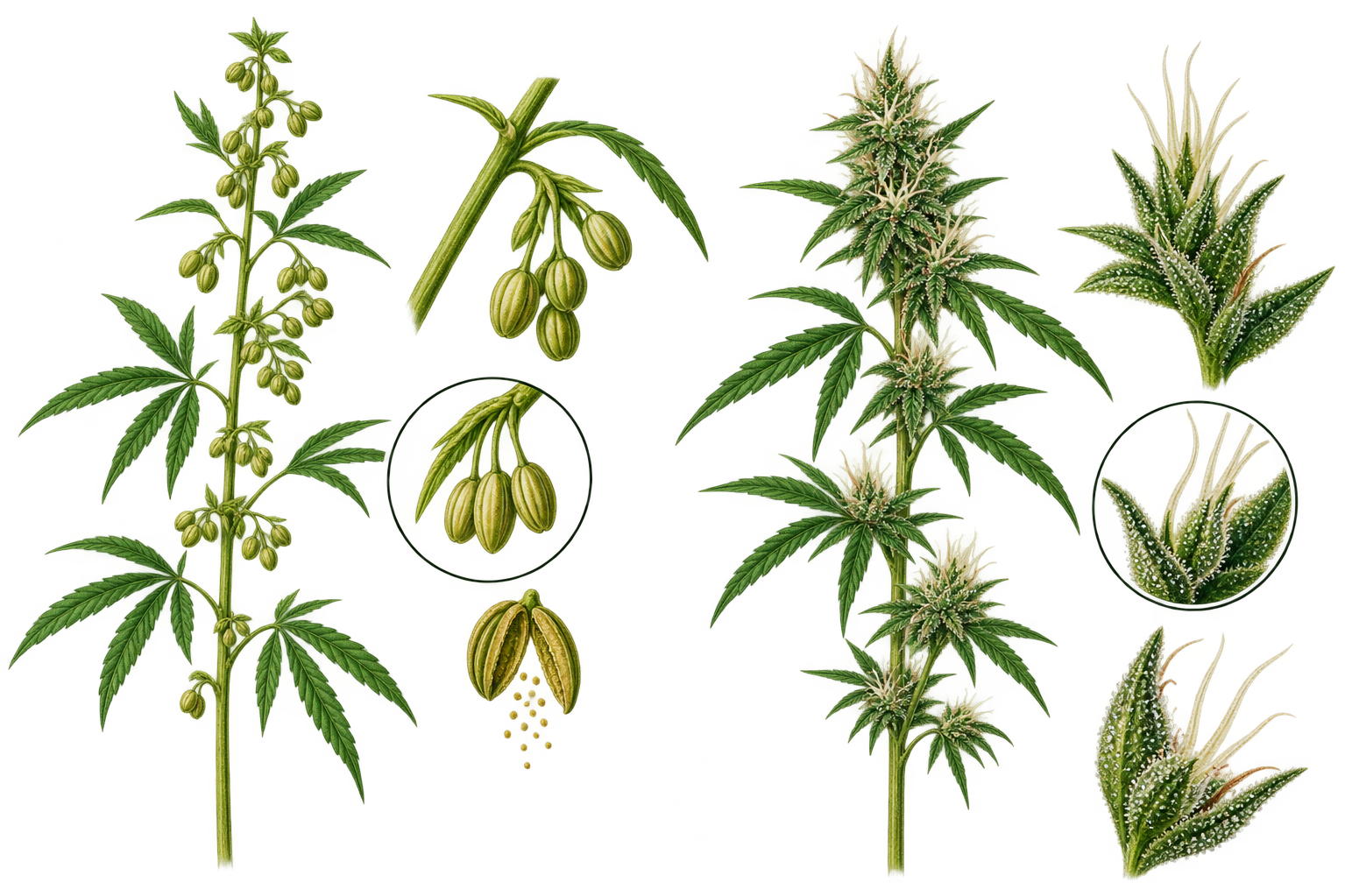
Cannabis plants grow through stages.
Cannabis begins as a seed, develops into a seedling, enters vegetative growth and, under the right conditions, begins flowering.
Cannabis is commonly dioecious, meaning male and female flowers usually occur on separate plants, although plants can also develop both male and female reproductive structures.
MALE PLANTS
Produce pollen.
FEMALE PLANTS
Produce flowers that can receive pollen and develop seeds. The resin-rich flowers commonly associated with cannabis production are female flowers.
POLLINATION
When pollen reaches a receptive female flower, seeds can develop.
THE BASIC CYCLE
Seed → Seedling → Vegetative Growth → Flowering → Pollination → Seed
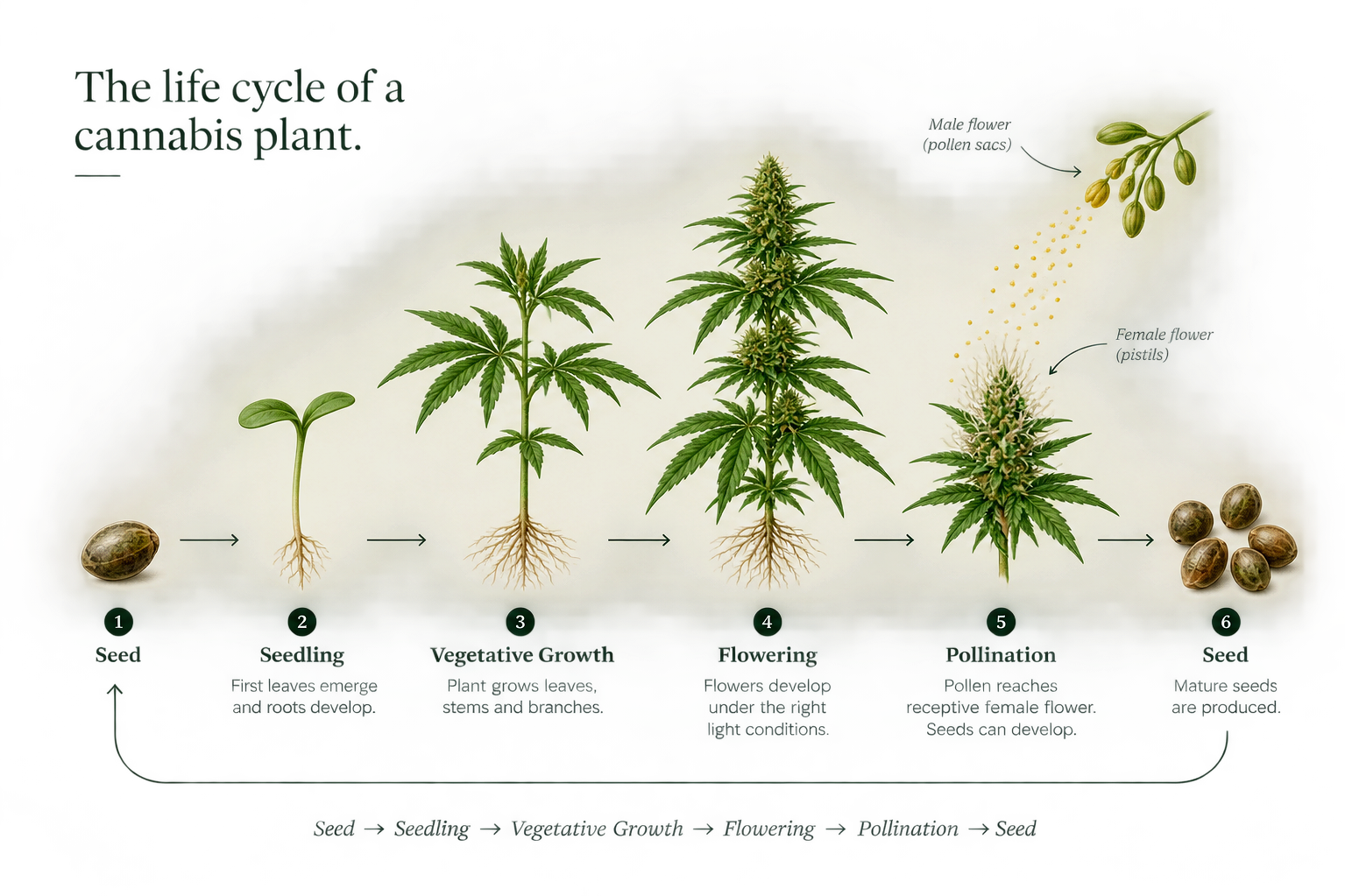
Learn to recognize male and female plants. It is one of the first practical skills in cannabis cultivation.
05
Cannabinoids, terpenes
and trichomes.
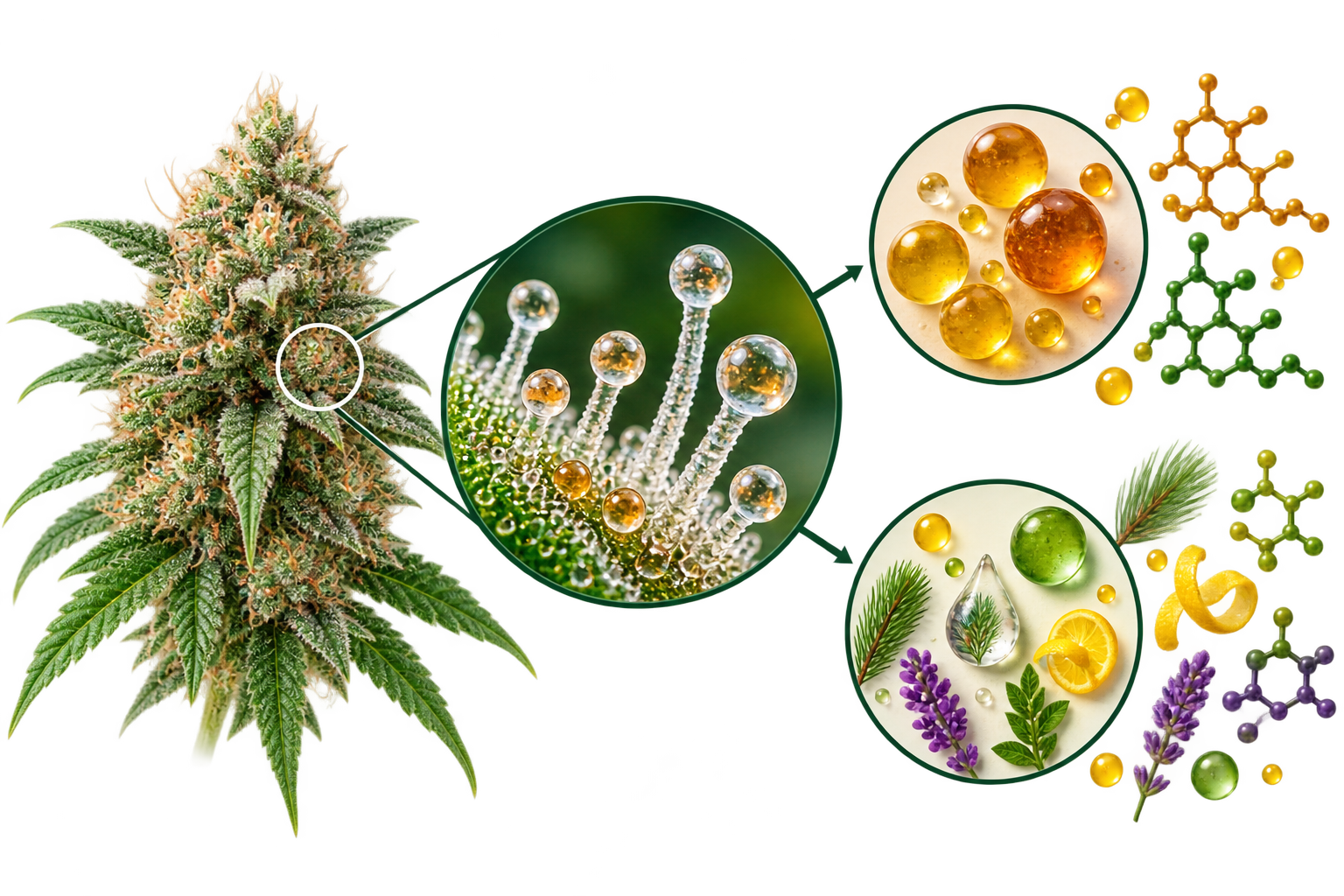
The plant produces hundreds of chemical compounds.
Cannabis is more than THC. Its chemistry includes cannabinoids, terpenes, flavonoids and many other compounds.
For a beginner, three ideas matter most.
CANNABINOIDS
Compounds produced by the cannabis plant that interact with biological systems. THC and CBD are the best known, but they are only two among many cannabinoids.
THC
Delta-9-tetrahydrocannabinol is the cannabinoid most associated with the intoxicating effects of cannabis.
CBD
Cannabidiol does not produce the characteristic intoxication associated with THC and has become important in medical and wellness research and products.
TERPENES
Aromatic compounds found throughout the plant kingdom. They contribute to the distinctive aromas of different cannabis varieties.
TRICHOMES
Tiny glandular structures concentrated especially around cannabis flowers. Many cannabinoids and terpenes are produced and stored in glandular trichomes.
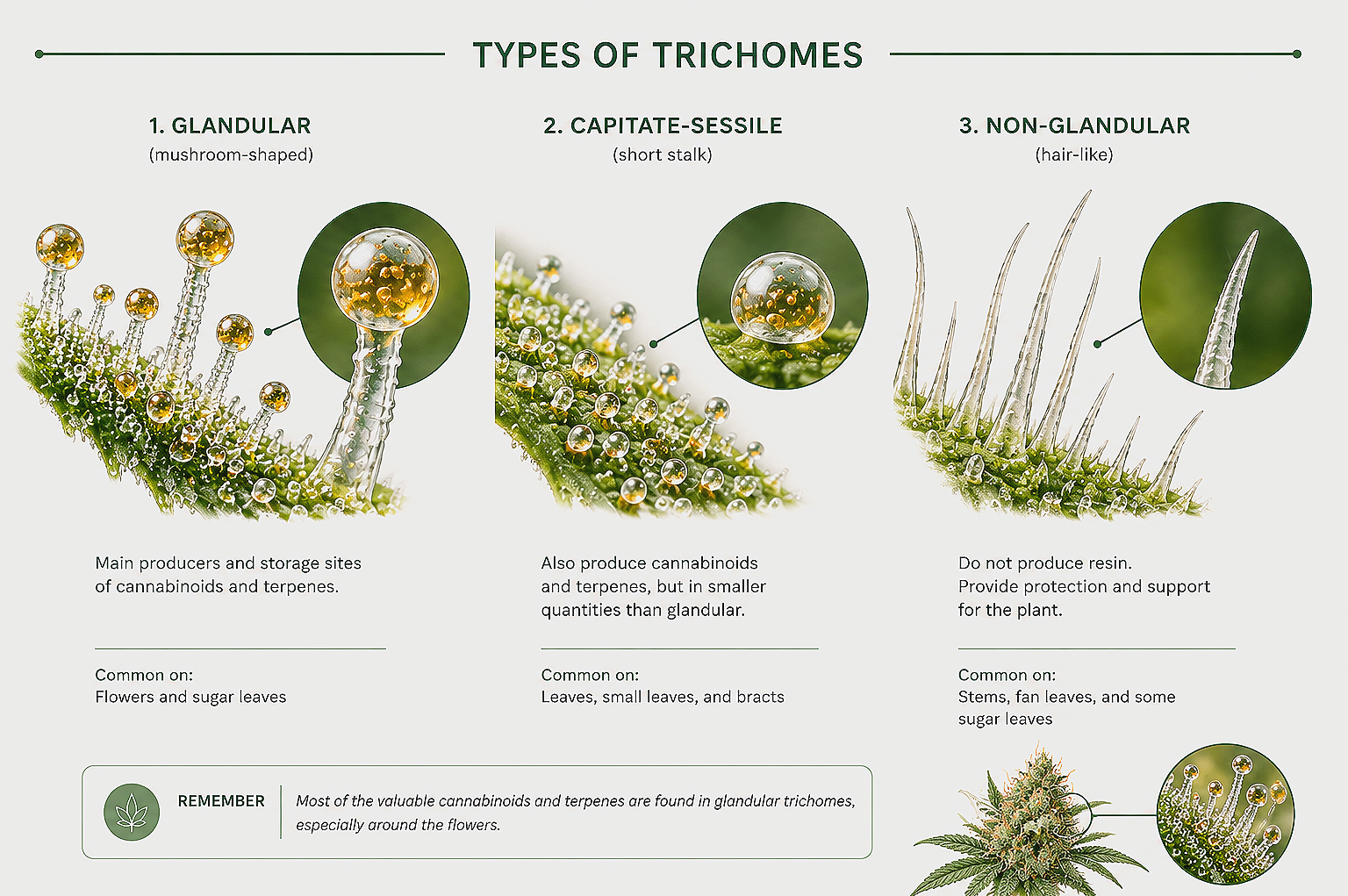
The plant is biology. Its effects depend partly on chemistry.
06
Cannabis and the human body.
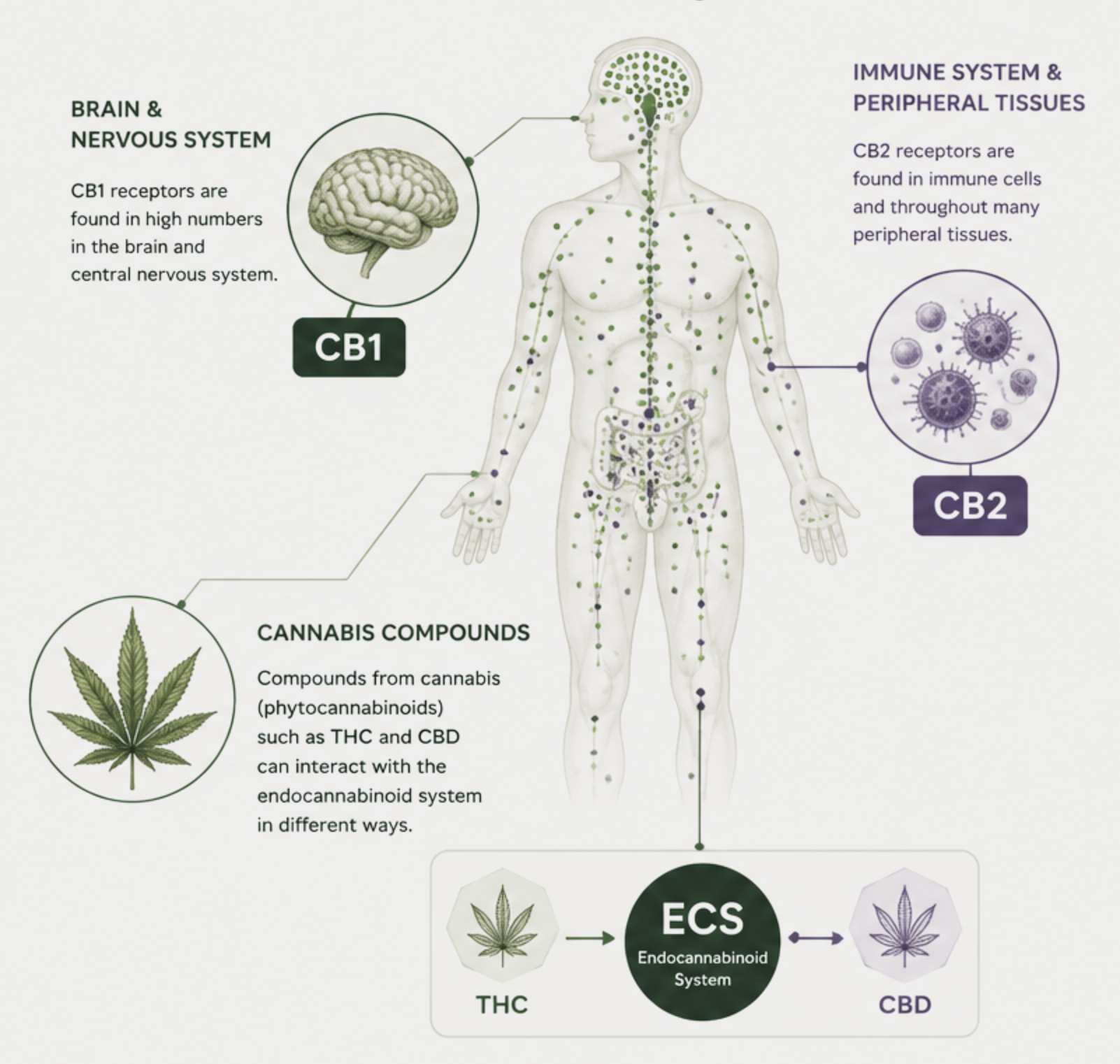
Our bodies have a system that interacts with cannabinoids.
The human body contains the endocannabinoid system, often called the ECS.
The ECS is involved in regulating many normal biological processes, including mood, appetite, sleep, pain, memory and immune function.
The body naturally produces its own signaling molecules called endocannabinoids. Cannabis produces compounds called phytocannabinoids, including THC and CBD, that can interact with this system in different ways.
THREE THINGS TO KNOW
ENDOCANNABINOIDS
Cannabinoid-like compounds produced naturally by the body.
RECEPTORS
CB1 and CB2 are two of the best-known cannabinoid receptors. They are found in different tissues throughout the body.
CANNABIS COMPOUNDS
THC, CBD and other cannabinoids can influence this biological system, but they do not all act in the same way.
Cannabis does not simply “enter the body.” Its compounds interact with biology.
07
Effects are not the same for everyone.
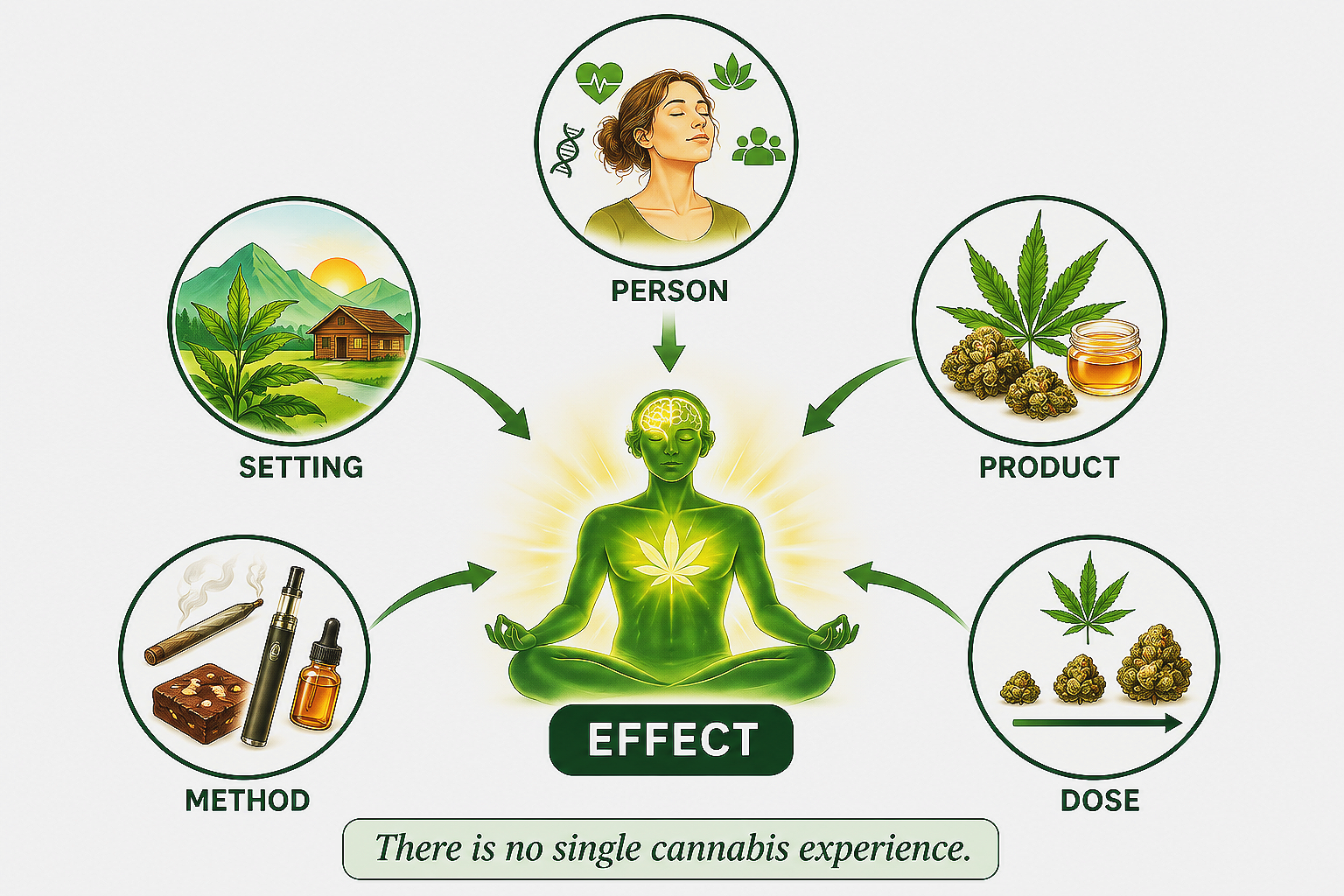
The same cannabis can affect two people differently.
Cannabis does not produce one predictable experience.
Its effects can vary according to the person, the product, the amount used and the circumstances in which it is used.
FIVE THINGS MATTER
THE PERSON
Age, body chemistry, health, previous experience and individual sensitivity can influence effects.
THE PRODUCT
Different products can contain very different amounts and combinations of THC, CBD and other compounds.
THE DOSE
More does not necessarily mean better. Effects can change considerably as the amount increases.
THE METHOD
How cannabis is consumed affects how quickly effects begin and how long they may last.
THE SETTING
Mood, surroundings and expectations can also influence the experience.
There is no single cannabis experience.
08
One plant.
Many uses.
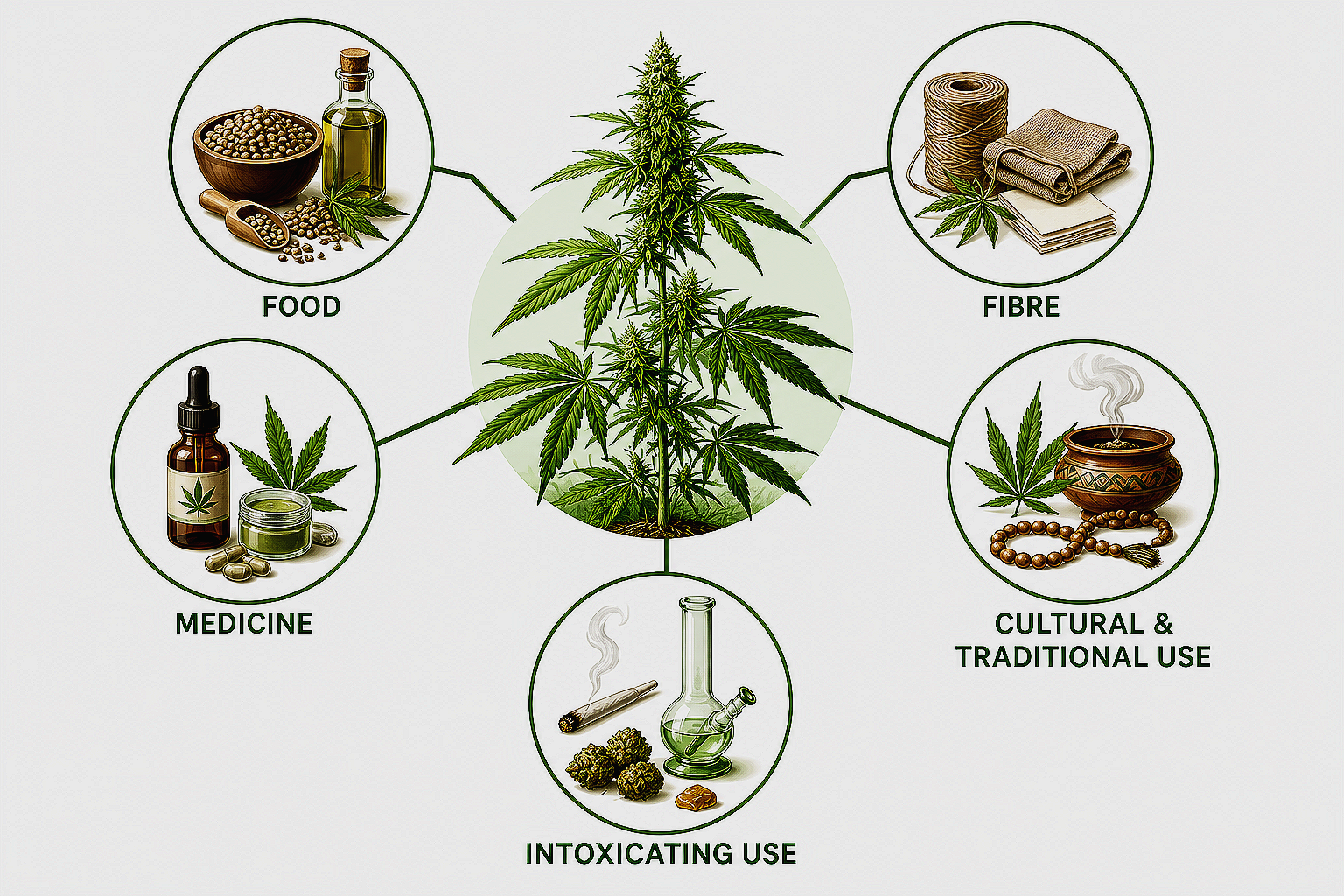
People have used cannabis in very different ways.
Across cultures and throughout history, different parts of the cannabis plant have been used for food, fibre, medicine, ritual and intoxication.
The purpose matters because cannabis is not one product.
FOOD & SEED
Cannabis seeds can be eaten and processed into foods and oils.
FIBRE & MATERIALS
Stalks provide fibre traditionally used for rope, textiles, paper and other materials.
MEDICINE
Cannabis and cannabis-derived compounds are used medically in different forms and under different regulatory systems.
CULTURAL & TRADITIONAL USE
Cannabis has long appeared in traditional practices, ceremonies and local cultures.
INTOXICATING USE
Some cannabis products are used for their psychoactive effects, particularly those containing significant amounts of THC.
The same plant can become very different products depending on which part is used and why.
09
From plant
to product.
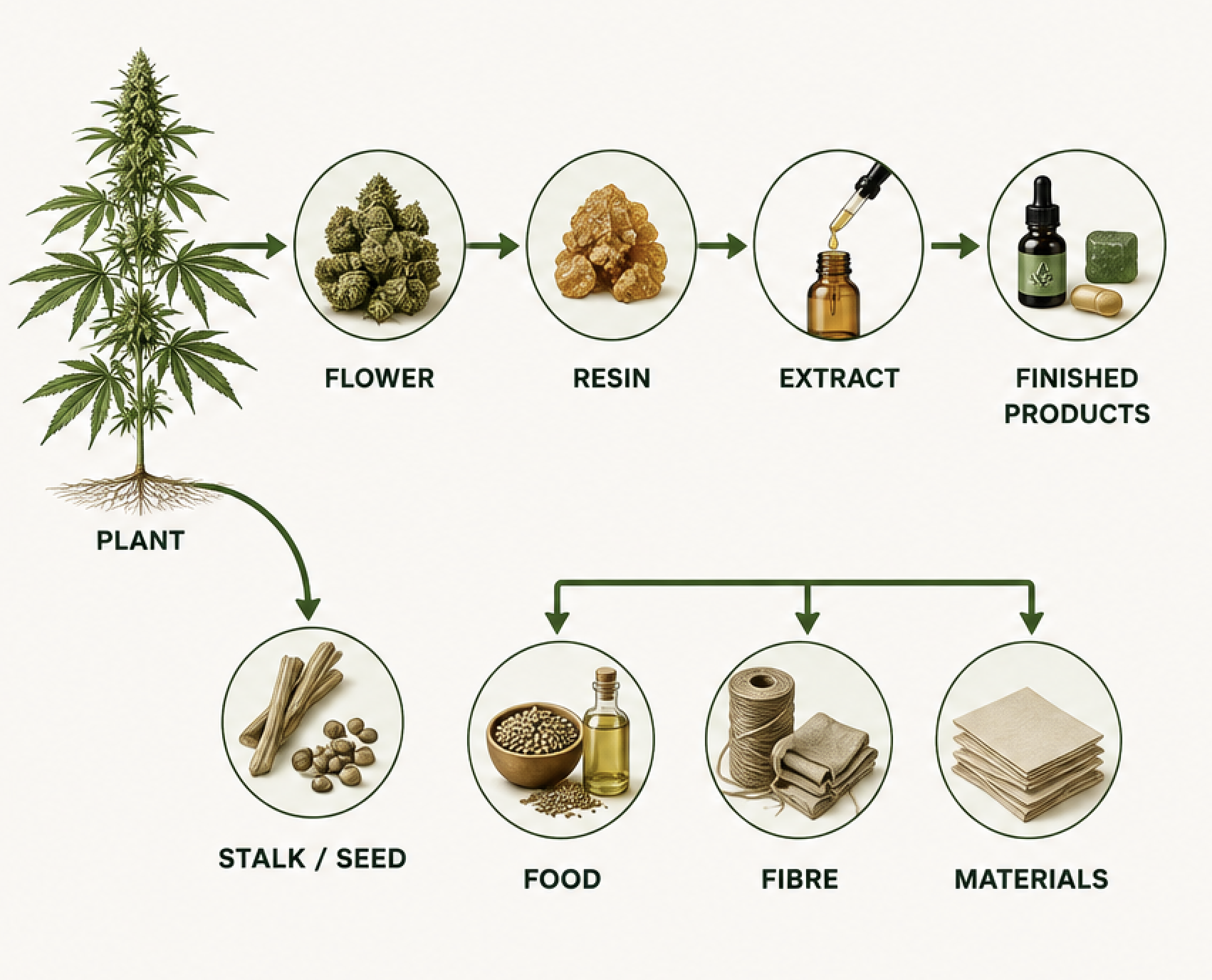
What happens after harvest matters.
Cannabis may begin as a plant, but what reaches a consumer can be very different depending on how it is harvested, dried, processed, stored and prepared.
FLOWER
Dried cannabis flower may be used directly or processed further.
RESIN
Trichome-rich material can be separated or concentrated into resin products.
EXTRACTS
Cannabinoids and other compounds can be extracted into oils and concentrates.
EDIBLES & ORAL PRODUCTS
Cannabis compounds can be incorporated into foods, capsules and other oral preparations.
TOPICALS
Cannabinoids may also be formulated into products applied to the skin.
FIBRE & SEED PRODUCTS
Other parts of the plant can become food, oil, textiles, paper and industrial materials.
The product is shaped by what happens after the plant is harvested.
10
You now know the plant.
The foundation is in place.
Cannabis can appear complicated because it sits at the intersection of biology, medicine, culture, agriculture, industry and law.
But the starting point is much simpler.
Cannabis is a plant.
You now understand its basic structure, how male and female plants differ, how the plant grows and reproduces, and where cannabinoids and terpenes are produced.
You have also seen how cannabis interacts with the human body, why its effects can differ from person to person, and how one plant can become many very different products.
SIX IDEAS TO REMEMBER
THE PLANT
Start with the biology before discussing the politics, medicine or business.
THE CHEMISTRY
Cannabis contains many compounds. THC is only one of them.
THE PERSON
The same cannabis product can affect different people differently.
THE PURPOSE
Food, fibre, medicine, traditional use and intoxication are not the same thing.
THE PRODUCT
What reaches the consumer depends on what happens to the plant after harvest.
THE LAW
How cannabis is defined and regulated depends on where you are and what the plant or product is being used for.
You don't need to know everything about cannabis yet. You now know where to begin.
CLASS 01 COMPLETE
UNDERSTANDING CANNABIS
NEXT → CLASS 02
CANNABIS THROUGH HISTORY
CLASS 01
KNOWLEDGE CHECK
You know the basics. Let’s check.
10 questions · About 3 minutes · Retake anytime
1. What is the best starting point for understanding cannabis?
A. Cannabis law
B. Cannabis as a plant
C. Cannabis products
D. Cannabis business
2. Which statement best describes hemp and marijuana?
A. They are completely unrelated plants
B. Hemp is always male and marijuana is female
C. The distinction often depends on legal definitions, chemistry and intended use
D. Hemp does not contain cannabinoids
3. Which part of the cannabis plant produces much of the resin associated with cannabinoids and aromatic compounds?
A. Roots
B. Stem
C. Female flowers
D. Seeds
4. What is one basic difference between male and female cannabis plants?
A. Male plants produce pollen
B. Female plants do not flower
C. Male plants do not have leaves
D. Female plants cannot produce seeds
5. Where are many cannabinoids and terpenes produced and stored?
A. Roots
B. Glandular trichomes
C. Seeds
D. Stalk fibres
6. What is the endocannabinoid system (ECS)?
A. A system found only in cannabis
B. A biological system in the human body that interacts with cannabinoid signaling
C. Another name for THC
D. A cannabis extraction method
7. Why can the same cannabis affect two people differently?
A. Cannabis always changes chemically between users
B. Effects can depend on the person, product, dose, method and setting
C. Only age determines the effect
D. Cannabis affects everyone the same way
8. Cannabis has historically been used for:
A. Intoxication only
B. Medicine only
C. Fibre only
D. Food, fibre, medicine, traditional purposes and intoxication
9. Why does what happens after harvest matter?
A. It can determine what kind of product ultimately reaches the consumer
B. Cannabis cannot be used after drying
C. Harvesting removes cannabinoids
D. Every harvested plant becomes the same product
10. Which statement best summarizes Class 01?
A. Cannabis should primarily be understood through law
B. THC explains everything important about cannabis
C. Start with the plant, then understand its chemistry, uses, effects, products and regulation
D. Cannabis is one plant with one principal use
RESULT
For 8–10 correct:
Excellent. The foundation is in place. You understand the essential ideas from Class 01.
CLASS 01 COMPLETE
Understanding Cannabis
NEXT → CLASS 02
Cannabis Through History
For 5–7 correct:
Almost there.You have the main ideas. Review the questions you missed and try again.
REVIEW CLASS 01 →
RETAKE KNOWLEDGE CHECK →
For 0–4 correct:
Take another look.There is no penalty and no limit on attempts. Return to Class 01, review the fundamentals and try again when you're ready.
RETURN TO CLASS 01 →
CHECK YOUR ANSWERS
1 B · 2 C · 3 C · 4 A · 5 B · 6 B · 7 B · 8 D · 9 A · 10 C