English | नेपाली
CLASS 08
CANNABIS PRODUCTS, PROCESSING & TESTING
01
From plant to product
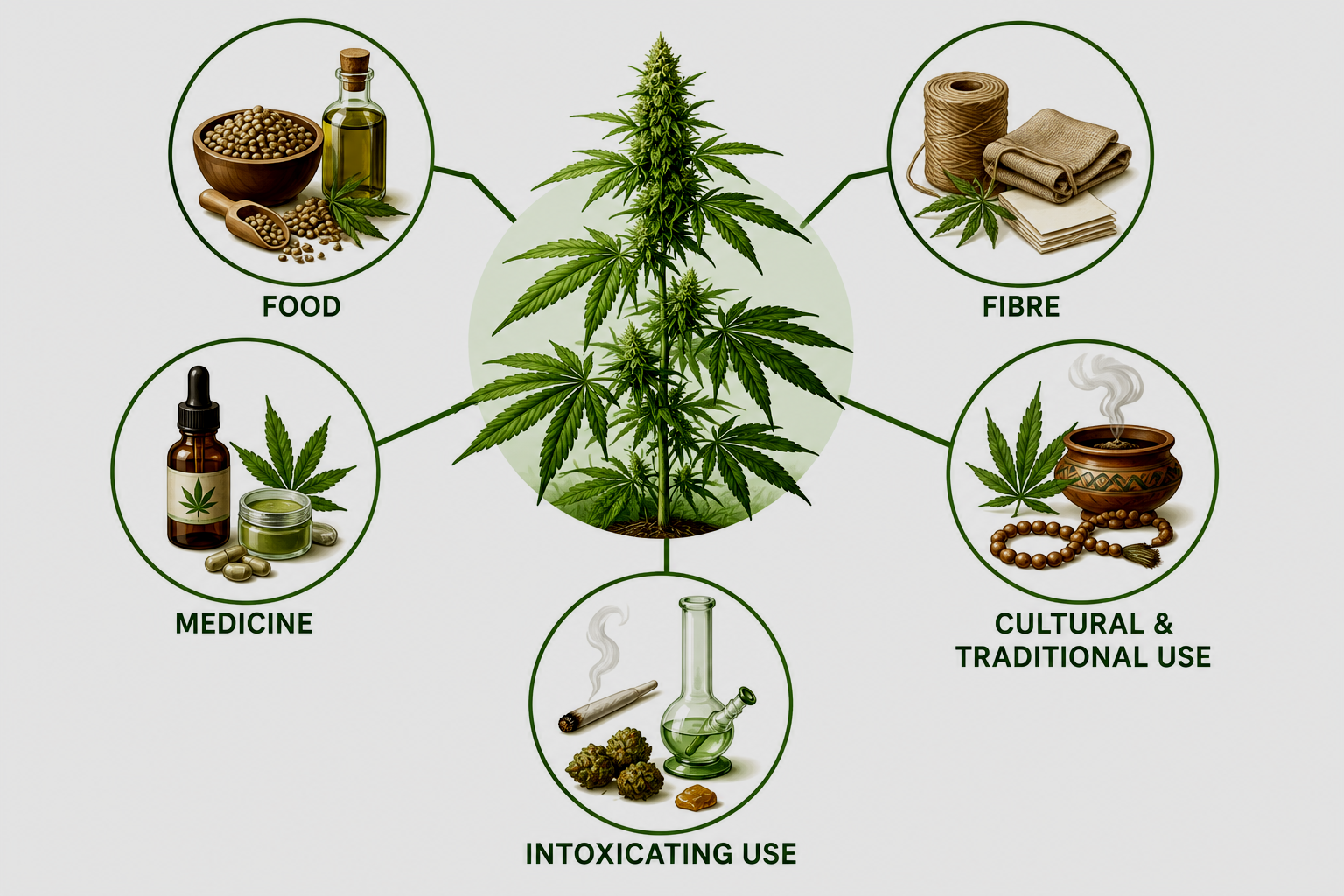
Harvest changes the question.
During cultivation, the grower's attention is focused on keeping a living plant healthy.
After harvest, the question changes:
What will this plant material become?
Cannabis can enter many different product pathways.
FLOWER
Harvested female flowers may be dried, prepared and packaged for their intended market.
This is one of the simplest transformations from plant to finished cannabis product.
EXTRACTS & CONCENTRATES
Compounds can be separated from cannabis plant material to create products containing concentrated cannabinoids and other constituents.
Different processing methods produce very different types of extracts.
OILS & FORMULATIONS
Cannabis extracts or cannabinoids can become ingredients in formulated products such as:
OILS
CAPSULES
TINCTURE-LIKE LIQUIDS
SPRAYS
and other preparations.
EDIBLES & BEVERAGES
Cannabinoids can also be incorporated into foods and drinks.
This introduces additional questions involving dose consistency, food safety, packaging and accidental consumption.
TOPICAL PRODUCTS
Cannabis-derived ingredients may appear in creams, balms, lotions and other products applied to the skin.
Again, the formulation determines what the product actually does and how it behaves.
ONE PLANT → MANY POSSIBLE PRODUCTS
The important lesson is not to memorize a catalogue of cannabis products.
It is to understand that every transformation introduces new decisions about:
PROCESSING
CONSISTENCY
POTENCY
CONTAMINATION
TESTING
PACKAGING
and INTENDED USE.
Processing creates responsibility.
Once cannabis becomes a manufactured product, knowing what is inside it becomes increasingly important.
Cultivation creates the raw material. Processing determines what that material becomes.
And testing helps us understand what we actually produced.
02
Cannabis flower
Flower is the cannabis product closest to the harvested plant.
Cannabis flower may look like a relatively simple product.
The plant is grown, the flowers are harvested, dried and prepared for use.
But even this minimally processed product requires careful handling.
AFTER HARVEST
Fresh cannabis contains substantial moisture.
Before flower can become a stable finished product, moisture must be reduced through controlled drying.
Drying changes the physical condition of the harvested material and helps make appropriate storage possible.
But drying is not simply about making cannabis as dry as possible.
MOISTURE MATTERS
Too much remaining moisture can create conditions that encourage microbial growth and deterioration.
Poorly controlled drying can also affect the quality of the finished material.
This introduces an important post-harvest principle:
Quality can be lost after a healthy plant has already been grown.
PREPARATION
After drying, flower may undergo additional preparation before packaging.
Depending on the product and regulatory system, this can include:
TRIMMING
SORTING
INSPECTION
TESTING
PACKAGING
Throughout these steps, careful handling helps protect the material from contamination and unnecessary damage.
WHAT IS ACTUALLY IN THE FLOWER?
Appearance alone cannot tell us everything about cannabis flower.
Two flowers that look similar may contain very different concentrations of:
THC
CBD
OTHER CANNABINOIDS
TERPENES
They may also differ in moisture, microbial quality and the presence or absence of contaminants.
This is why descriptions such as:
“strong”
“premium”
or even a cultivar name cannot substitute for analytical information.
QUALITY IS MORE THAN POTENCY
A flower with very high THC is not automatically a higher-quality product.
Quality can also involve:
CONSISTENCY
CLEANLINESS
CORRECT MOISTURE
ABSENCE OF HARMFUL CONTAMINANTS
ACCURATE LABELLING
and suitability for its intended use.
Flower is a product—not simply a plant.
Once harvested cannabis is prepared for another person to use, responsibility extends beyond cultivation.
The producer needs to know:
What is it?
What does it contain?
Is it suitable for its intended use?
Good cultivation creates good raw material. Good post-harvest practice helps preserve it.
The less a product is processed, the less we should assume that processing and quality control don't matter.
03
Extracts & concentrates
Processing can concentrate compounds from the cannabis plant.
Cannabis flower contains cannabinoids, terpenes and many other plant compounds.
Instead of using the flower directly, processors can separate selected compounds or fractions from the plant material.
The resulting products are broadly called extracts or concentrates.
WHAT DOES “CONCENTRATE” MEAN?
Think about the original plant.
Cannabinoids such as THC are distributed through its resin-producing structures.
Processing can collect and concentrate resin or extract compounds from that plant material.
The result may contain a much higher concentration of cannabinoids than the original flower.
That is the central concept beginners need to understand:
FLOWER → SEPARATION / EXTRACTION → CONCENTRATED MATERIAL
DIFFERENT METHODS CREATE DIFFERENT PRODUCTS
Cannabis compounds can be separated in different ways.
Some processes use physical or mechanical separation.
Others use substances that extract compounds from plant material.
Modern commercial processing may also use carefully controlled equipment, temperature, pressure and other technologies.
The details belong in advanced processing training.
For Fundamentals, remember:
The processing method affects what ends up in the final product.
SOLVENTLESS PROCESSING
Some concentrates are produced primarily through physical processes that separate resin from plant material.
Examples include forms of hash and rosin.
These are often described as solventless because an extraction solvent is not used in producing the concentrate.
SOLVENT-BASED EXTRACTION
Other processes use extraction solvents to separate desired compounds from cannabis.
Depending on the system, examples can include ethanol, carbon dioxide or hydrocarbons.
When solvents are involved, manufacturing controls and testing become particularly important.
The finished product must meet applicable safety standards—including requirements concerning residual solvents where relevant.
CONCENTRATION CHANGES RISK
An extract containing a high concentration of THC can deliver much more THC in a small amount than typical cannabis flower.
So:
SMALLER PRODUCT ≠ SMALLER DOSE
This connects directly to Classes 06 and 07.
Potency, dose and route still matter after cannabis has been processed.
EXTRACT IS NOT YET THE FINAL PRODUCT
An extract may itself become a finished product.
Or it can become an ingredient used to manufacture something else:
OIL
CAPSULE
EDIBLE
BEVERAGE
TOPICAL
or another formulated cannabis product.
That creates our next step:
PLANT → EXTRACT → FORMULATION → FINISHED PRODUCT
Processing changes both the product and the responsibility.
As cannabis becomes more concentrated or more extensively manufactured, accurate formulation, testing and quality control become increasingly important.
Extraction separates compounds. Concentration changes their proportion. Testing tells us what resulted.
The farther we move from the original plant, the more important it becomes to know exactly what is in the product.
04
Oils, edibles & other formulations
An extract becomes a product through formulation.
Once cannabinoids have been extracted or otherwise prepared, they can be incorporated into many different products.
This step is called formulation.
Formulation determines not only what the finished product looks like, but also how cannabinoids are delivered and how consistently they are distributed.
OILS
Cannabinoids can be incorporated into oils designed for oral or other intended routes of administration.
A formulated oil can allow the amount of cannabinoids to be expressed in measurable terms, such as:
THC per mL
CBD per mL
or a defined amount per serving.
That is much more useful than simply describing a product as:
“strong” or “mild.”
EDIBLES
Cannabinoids can also be incorporated into foods such as gummies, chocolates or baked products.
For a regulated edible, an important manufacturing challenge is:
CONSISTENCY
If a package contains multiple servings, the cannabinoids should be distributed predictably.
One piece should not contain very little THC while another unexpectedly contains much more.
This is sometimes referred to as homogeneity—the even distribution of an ingredient throughout a product.
BEVERAGES
Cannabinoids can also be formulated into drinks.
Because cannabinoids such as THC and CBD do not naturally mix easily with water, beverage formulation can require additional processing technology.
For Fundamentals, the important point is simply that formulation affects how a product behaves.
CAPSULES & MEASURED PRODUCTS
Capsules and other unit-dose products can contain a defined quantity of cannabinoids.
This illustrates one advantage of standardized manufacturing:
KNOWN PRODUCT → DEFINED AMOUNT → CONSISTENT UNIT
provided that the product has been properly manufactured and verified.
TOPICALS
Cannabis-derived ingredients may also be incorporated into:
CREAMS
BALMS
LOTIONS
and other products applied to the skin.
As we learned in Class 06, topical and transdermal products should not automatically be treated as the same thing.
Their formulation and intended route matter.
FORMULATION DOES NOT PROVE EFFECTIVENESS
A professionally manufactured product can be:
consistent
accurately measured
properly tested
and still lack evidence for a particular medical claim.
Product quality and medical effectiveness are related questions—but they are not the same question.
Consistency is part of quality.
Once cannabis becomes a formulated product, producers need to know:
WHAT IS IN IT?
HOW MUCH IS IN IT?
IS IT EVENLY DISTRIBUTED?
IS IT STABLE?
IS IT SAFE FOR ITS INTENDED USE?
Formulation turns an ingredient into a product. Quality control helps make that product consistent.
Making the product is only part of the job. Knowing what you made matters too.
05
Processing changes the product
Processing can change the chemistry, concentration and form of cannabis.
A harvested cannabis plant is raw material.
Every processing step after harvest can change what ultimately reaches the consumer.
For Fundamentals, we don't need to learn how to manufacture cannabis products. We need to understand what processing is doing to the material.
SEPARATION
Some processes physically separate desirable parts of the cannabis plant from other plant material.
For example, resin-rich structures can be separated and collected.
The important idea:
SEPARATION → selects part of the original material
EXTRACTION
Extraction goes further.
It uses a process to remove selected compounds from cannabis plant material and collect them in an extract.
As we learned earlier:
PLANT MATERIAL → EXTRACTION → EXTRACT
The resulting extract can contain cannabinoids at concentrations very different from the original plant.
REFINEMENT
An extract may undergo additional processing to remove or separate particular components.
This can change its:
COMPOSITION
PURITY
CONCENTRATION
and physical characteristics.
The more processing occurs, the more important controlled manufacturing and testing become.
DECARBOXYLATION
Here is one new word worth learning:
DECARBOXYLATION
In the living and freshly harvested plant, important cannabinoids occur largely in acidic forms.
For example:
THCA → THC
CBDA → CBD
Heat and time can cause these compounds to lose a chemical group and change into their corresponding neutral forms.
This process is called decarboxylation.
You don't need to memorize the chemistry.
Remember simply:
Cannabis chemistry can change during processing.
FORMULATION
The processed cannabis ingredient may then be combined with other ingredients to create a finished product.
For example:
EXTRACT + CARRIER OIL → CANNABIS OIL
or
CANNABIS INGREDIENT + FOOD PRODUCT → EDIBLE
Formulation determines the final concentration, consistency, serving format and intended route of administration.
THE PRODUCT HAS CHANGED
Compare the journey:
FLOWER
↓
SEPARATION / EXTRACTION
↓
REFINEMENT
↓
FORMULATION
↓
FINISHED PRODUCT
At each stage, something can change.
And at each stage, something can also go wrong.
Processing creates new quality-control responsibilities.
A beautifully grown cannabis plant does not guarantee a safe, consistent finished product.
Every transformation creates another point where quality must be protected.
That is why cannabis manufacturing and cannabis testing belong together.
06
What can go wrong?
A cannabis product can look perfectly normal and still contain something you cannot see.
Quality control is not only about THC or CBD.
Cannabis is an agricultural product, and processed cannabis may pass through multiple stages before reaching a consumer.
At different points, unwanted substances or organisms can enter—or remain in—the product.
MICROBIAL CONTAMINATION
Cannabis plant material can support the growth of microorganisms under certain conditions.
Testing may look for potentially harmful:
BACTERIA
YEAST
MOLD
and, depending on the regulatory system, particular microbial pathogens.
This is one reason drying and storage conditions matter.
PESTICIDE RESIDUES
Pesticides may be used during agricultural production.
If inappropriate chemicals are used—or residues remain above permitted limits—they can create a safety concern.
This is particularly important because some cannabis products may eventually be inhaled, concentrated or consumed as medicines.
HEAVY METALS
Cannabis can take up substances from its growing environment.
Potential contaminants can include heavy metals such as:
LEAD
ARSENIC
CADMIUM
MERCURY
Contamination can originate from soil, water, nutrients or other inputs.
The important lesson is that contamination may begin before processing ever starts.
RESIDUAL SOLVENTS
Some extraction processes use solvents.
Proper processing should remove them to acceptable levels, but testing may be needed to determine whether unwanted residual solvents remain in the finished extract.
This connects directly to what we learned in Section 03.
FOREIGN MATERIAL
Physical contamination can also occur.
Depending on how cannabis is grown, harvested, processed and packaged, unwanted material might include:
DUST
HAIR
INSECT MATERIAL
PACKAGING DEBRIS
or other foreign matter.
Good production practices are designed to prevent these problems rather than simply discover them afterward.
CONTAMINATION CAN MOVE THROUGH THE SUPPLY CHAIN
Consider contaminated plant material entering extraction.
Processing does not automatically make that contamination disappear.
In some circumstances, a contaminant may even become concentrated along with the desired compounds.
That gives us an important quality principle:
Testing the final product cannot replace good practices throughout production.
PREVENT → CONTROL → TEST
A good quality system works at several levels:
PREVENT contamination where possible.
CONTROL the cultivation and processing environment.
TEST to verify that required standards have been met.
You cannot judge safety by appearance alone.
A product can smell good.
It can look clean.
It can have attractive packaging.
It can contain exactly the desired amount of THC.
And it can still fail an important safety test.
Potency tells us how much of a cannabinoid is present. Safety testing asks what else might be there.
Quality means knowing both.
07
What does cannabis testing measure?
“Lab tested” is only useful if we know what was tested.
Cannabis testing can answer different questions about a product.
One test might measure cannabinoids.
Another might look for contaminants.
A product therefore should not simply be described as “tested” without understanding what the laboratory actually examined.
POTENCY
Potency testing measures the amount or concentration of particular cannabinoids in a sample.
Commonly reported cannabinoids include:
THC
THCA
CBD
CBDA
and, depending on the laboratory, additional cannabinoids.
Results may be reported as a percentage, concentration or amount per unit, depending on the type of product.
CANNABINOID PROFILE
Testing can tell us more than whether THC is present.
A cannabinoid profile shows the amounts of several cannabinoids detected in the sample.
This gives us a more useful description of the product's chemistry than terms such as:
“strong”
“mild”
or a cultivar name alone.
CONTAMINANTS
Safety testing may look for substances or organisms that should not be present—or should remain below established limits.
Depending on the product and regulatory system, testing can include:
MICROBES
PESTICIDE RESIDUES
HEAVY METALS
RESIDUAL SOLVENTS
MYCOTOXINS
and other contaminants.
Not every test panel includes everything.
MOISTURE & WATER ACTIVITY
For cannabis flower, laboratories may also evaluate moisture-related characteristics.
One particularly useful measurement is water activity.
Moisture content tells us how much water is present.
Water activity helps indicate how much of that water is available to support processes such as microbial growth.
They are related measurements—but they are not the same thing.
TERPENES
Some laboratories also provide a terpene profile.
This can identify and quantify aromatic compounds such as myrcene, limonene or pinene.
Terpene testing can help characterize a product, but detecting a particular terpene does not by itself prove a medical effect.
TESTING IS A SAMPLE
There is another important concept:
The laboratory usually tests a sample taken from a larger batch.
That means sampling procedures matter.
If the sample does not reasonably represent the batch, even an accurate laboratory measurement may give a misleading picture of the overall product.
PASS OR FAIL
For regulated products, laboratory results can be compared against standards established by the relevant regulatory system.
A contaminant may have an allowable limit.
A result above that limit may cause the batch to fail.
So testing serves two related purposes:
MEASURE — What is actually present?
VERIFY — Does it meet the required standard?
Testing turns assumptions into measurements.
But remember:
“Lab tested” is not a complete answer. Ask: tested for what, using what sample, and against what standard?
Good testing doesn't make a product safe by itself. It helps verify whether the quality system worked.
08
Reading a Certificate of Analysis
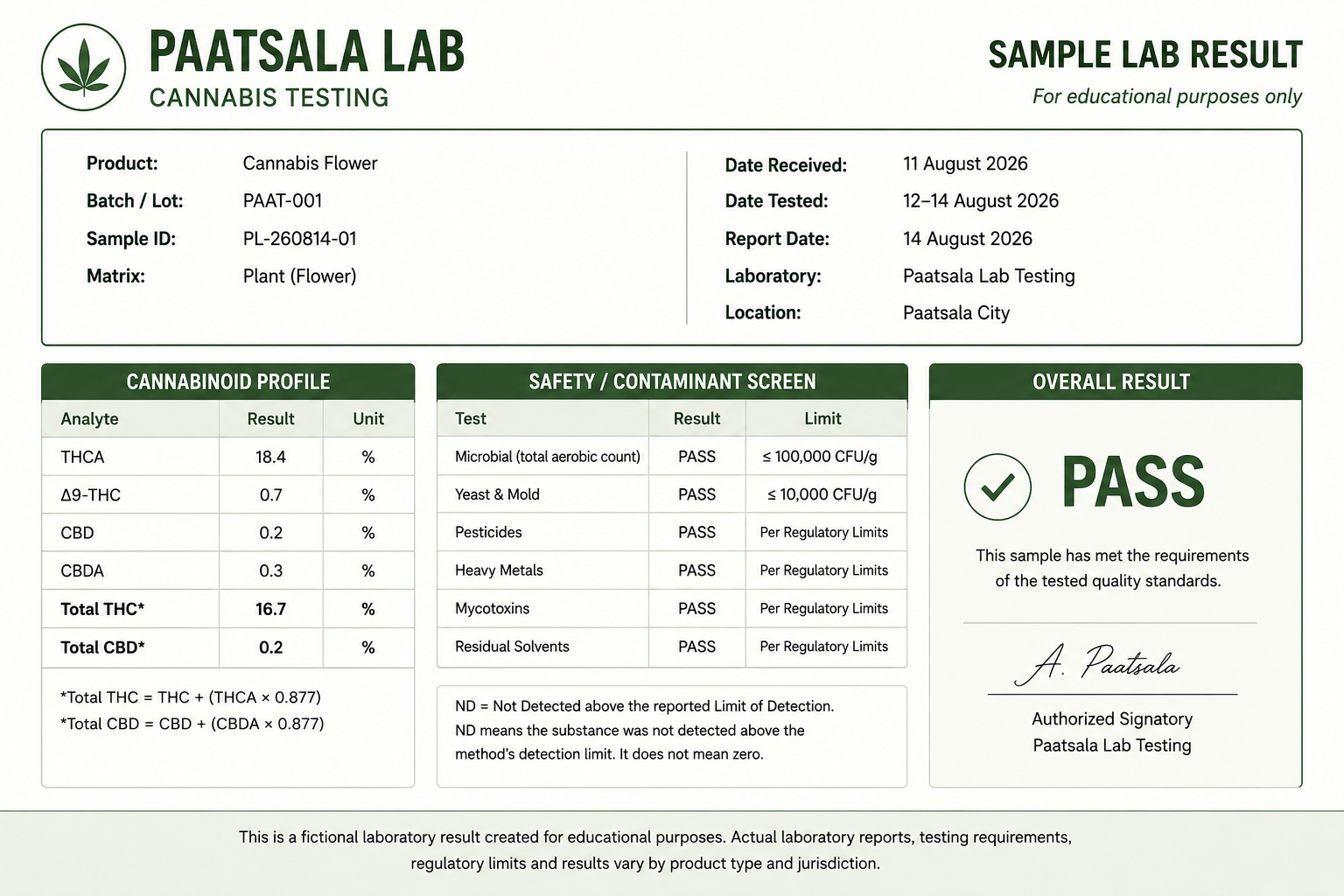
A laboratory report tells the story behind the label.
A Certificate of Analysis, commonly called a COA, is a laboratory report showing the results of tests performed on a sample.
COAs can look complicated at first.
But a beginner does not need to understand every laboratory term.
Start with five questions.
1. WHAT PRODUCT WAS TESTED?
Look for information such as:
PRODUCT NAME
BATCH OR LOT NUMBER
SAMPLE IDENTIFICATION
The batch number is particularly important.
A COA for one batch should not automatically be assumed to represent another batch of the same product.
2. WHO TESTED IT — AND WHEN?
Look for:
LABORATORY NAME
DATE RECEIVED
DATE TESTED
REPORT DATE
This helps establish where the results came from and when the testing occurred.
3. WHAT CANNABINOIDS WERE FOUND?
The cannabinoid section may report compounds such as:
THC · THCA · CBD · CBDA
Results might appear as percentages for flower or as concentrations or amounts for formulated products.
For example, a fictional flower sample might show:
THCA — 18.4%
Δ9-THC — 0.7%
CBDA — 0.3%
Those numbers describe different cannabinoids present in the tested sample.
4. WHAT SAFETY TESTS WERE PERFORMED?
Now look beyond potency.
A COA might contain sections for:
MICROBIAL CONTAMINANTS
PESTICIDES
HEAVY METALS
RESIDUAL SOLVENTS
MYCOTOXINS
The exact testing requirements depend on the product and regulatory system.
A COA containing cannabinoid results alone does not necessarily mean the product underwent a complete safety-testing panel.
5. DID IT MEET THE STANDARD?
Results may be compared with an established limit.
You might see terms such as:
PASS
FAIL
ND — NOT DETECTED
or numerical results alongside an allowable limit.
But be careful:
ND does not necessarily mean absolute zero.
It generally means the substance was not detected above the analytical method's relevant detection threshold.
DON'T JUST LOOK AT THE THC NUMBER
When reading a COA, ask:
BATCH → LAB & DATE → CANNABINOIDS → SAFETY TESTS → RESULT
A COA is useful because it connects a particular sample and batch to actual measurements.
Read the report—not just the marketing claim.
09
Packaging & labels
The label is where the product explains itself to the consumer.
By the time cannabis reaches packaging, many things have already happened:
cultivation → harvest → processing → testing
The label connects that history to the person receiving the product.
A good label should help answer a few basic questions.
WHAT IS THE PRODUCT?
The package should clearly identify what the consumer is looking at.
For example:
CANNABIS FLOWER
OIL
EDIBLE
TOPICAL
or another product type.
The product name should not replace a clear description of what the product actually is.
HOW MUCH DOES IT CONTAIN?
For cannabis products, potency information can be especially important.
Depending on the product and regulatory system, labels may include:
THC
CBD
TOTAL CANNABINOID CONTENT
AMOUNT PER SERVING
AMOUNT PER PACKAGE
For an edible, knowing the amount per piece can be much more useful than knowing only the total amount in the package.
WHAT ELSE IS IN IT?
Manufactured cannabis products may contain many ingredients besides cannabinoids.
A label can identify:
INGREDIENTS
ALLERGENS
CARRIER OILS
FLAVORS OR OTHER ADDITIVES
That becomes particularly important with foods, beverages and topical products.
WHICH BATCH DID IT COME FROM?
Remember the COA from Section 08.
The batch or lot number helps connect the package to production and laboratory records.
This is a basic part of traceability.
If a problem is discovered later, the batch information can help identify which products may be affected.
HOW SHOULD IT BE USED OR STORED?
Depending on the product, a label may include information about:
SERVING SIZE
ROUTE OF USE
STORAGE
EXPIRATION OR BEST-BY DATE
and other instructions appropriate to the product.
WARNINGS MATTER
Regulated cannabis labels may also carry warnings relating to issues such as:
THC INTOXICATION
CHILDREN
PREGNANCY
DRIVING OR OPERATING MACHINERY
Requirements differ between jurisdictions, but the principle is the same:
The consumer should not have to guess about an important risk.
PACKAGING ALSO HAS A JOB
Packaging is not only decoration.
It can help:
PROTECT THE PRODUCT
PREVENT CONTAMINATION
CONTROL LIGHT OR MOISTURE
REDUCE ACCIDENTAL ACCESS
and preserve information needed for traceability.
For products that could easily be mistaken for ordinary food, child-resistant and clearly differentiated packaging can be especially important.
MARKETING SHOULD NOT OVERRULE INFORMATION
A package may be beautifully designed.
But branding should not make essential information difficult to find.
And, as we learned in Class 06:
A label should not turn an unsupported medical claim into a fact.
A good label answers the consumer's basic questions.
WHAT IS IT?
WHAT IS IN IT?
HOW MUCH?
WHICH BATCH?
HOW SHOULD IT BE HANDLED?
Packaging protects the product. Labelling communicates what the consumer needs to know.
The final step is making sure quality can be followed all the way from the plant to the person.
10
Quality follows the product
Quality is not created by one test at the end.
We have followed cannabis from the harvested plant through processing, formulation, testing and packaging.
At every stage, the product can be protected.
And at every stage, quality can be lost.
CULTIVATION
Quality begins with the raw material.
Plant health, growing conditions, agricultural inputs and contamination during cultivation can all influence what enters the supply chain.
HARVEST & POST-HARVEST
Harvested cannabis must be handled appropriately.
Drying, storage and handling can affect moisture, microbial quality and the condition of the plant material.
A good crop can still become a poor product after harvest.
PROCESSING
Processing transforms the raw material.
Extraction, refinement and formulation can change:
POTENCY
COMPOSITION
CONSISTENCY
and the physical form of the product.
Processing also introduces new opportunities for contamination or manufacturing error.
TESTING
Testing provides measurements.
It can help determine:
WHAT CANNABINOIDS ARE PRESENT
HOW MUCH IS PRESENT
WHETHER PARTICULAR CONTAMINANTS WERE DETECTED
WHETHER THE TESTED SAMPLE MEETS APPLICABLE STANDARDS
But testing alone does not manufacture quality into a poorly produced product.
PACKAGING & LABELLING
Packaging protects the finished product.
Labelling communicates essential information to the consumer and connects the product to its batch, potency and production records.
Together they contribute to another important concept:
TRACEABILITY
Traceability means being able to follow a product through the supply chain.
Depending on the regulatory system, records may connect:
PLANT → HARVEST → BATCH → PROCESSING → TEST → PACKAGE
If a problem is discovered, traceability can help determine where the product came from and which other products may be affected.
THE CONSUMER
Finally, the product reaches a person.
By then, that person should not have to guess:
WHAT IS THIS?
WHAT DOES IT CONTAIN?
HOW POTENT IS IT?
HAS IT BEEN APPROPRIATELY TESTED?
HOW SHOULD IT BE STORED OR HANDLED?
QUALITY IS A SYSTEM
This is the central lesson of Class 08:
GROW → HARVEST → PROCESS → TEST → PACKAGE → CONSUMER
Quality does not belong to any one step.
Each stage depends on the one before it.
You cannot test quality into a product at the end. Quality must be protected throughout the process.
From plant to person, responsibility follows the product.
The cannabis industry ultimately depends on knowing what we produce—and being able to demonstrate it.
YOU NOW UNDERSTAND PRODUCTS, PROCESSING & TESTING
A cannabis product carries its history with it.
Cannabis can move from a harvested plant into flower, extracts, oils, edibles, topicals and many other products.
Every transformation introduces new questions about quality, consistency, safety and responsibility.
SIX IDEAS TO REMEMBER
FLOWER IS ALREADY A PRODUCT
Even minimally processed cannabis requires appropriate harvesting, drying, storage, handling and quality control.
PROCESSING CHANGES CANNABIS
Separation, extraction, refinement, decarboxylation and formulation can change the chemistry, concentration and physical form of cannabis.
CONSISTENCY MATTERS
A manufactured cannabis product should contain predictable amounts of its ingredients from unit to unit and batch to batch.
CONTAMINATION MAY BE INVISIBLE
Microbes, pesticides, heavy metals, residual solvents and other contaminants cannot necessarily be detected by looking at a product.
TESTING PROVIDES MEASUREMENTS
Laboratory testing can measure cannabinoids and evaluate contaminants—but “lab tested” only means something when we know what was tested.
TRACEABILITY CONNECTS THE SYSTEM
Batch numbers, testing records, packaging and production records can help follow a product through the supply chain.
THE BIG IDEA
GROW → HARVEST → PROCESS → TEST → PACKAGE → CONSUMER
And across the entire journey:
QUALITY + TRACEABILITY
You cannot test quality into a product at the end. Quality must be protected throughout the process.
Now let's see what you remember.
CLASS 08
KNOWLEDGE CHECK
You understand the fundamentals of cannabis products, processing and testing. Let's check.
10 questions · About 3 minutes · Retake anytime
1. Why does cannabis flower require post-harvest quality control?
A. Flower contains no moisture
B. Drying, storage and handling can affect its quality and safety
C. Only extracts require quality control
D. Testing replaces proper storage
2. What is an extract or concentrate?
A. A cannabis seed
B. A type of fertilizer
C. Material in which compounds or resin have been separated or extracted from the plant, often producing greater cannabinoid concentrations
D. Any dried cannabis leaf
3. What does formulation do?
A. Determines the genetics of the plant
B. Turns prepared cannabis ingredients into a defined finished product
C. Eliminates every contaminant
D. Proves that a product is medically effective
4. What is decarboxylation?
A. Removing all THC from cannabis
B. Laboratory testing for pesticides
C. A chemical transformation in which cannabinoid acids such as THCA can convert to forms such as THC
D. Packaging cannabis in an airtight container
5. Which could be a cannabis contaminant?
A. Microbial contamination
B. Pesticide residues
C. Heavy metals
D. Residual solvents
E. All of the above
6. What does potency testing primarily tell us?
A. Whether the packaging is attractive
B. The amount or concentration of particular cannabinoids in the tested sample
C. Whether cannabis will treat a disease
D. Whether every product in the market is safe
7. What does “lab tested” tell you by itself?
A. The product passed every possible safety test
B. The product is medically effective
C. Very little unless you know what was tested and what the results were
D. The product contains no contaminants
8. What is a Certificate of Analysis (COA)?
A. A cultivation license
B. A laboratory report showing results from tests performed on a sample
C. A medical prescription
D. A cannabis advertisement
9. Why is a batch or lot number important?
A. It tells the consumer whether the product tastes good
B. It identifies the cannabis strain permanently
C. It helps connect a product with production, testing and traceability records
D. It guarantees the product has high THC
10. Which statement best describes cannabis quality?
A. High THC means high quality
B. Testing at the end guarantees quality
C. Attractive packaging demonstrates quality
D. Quality must be protected throughout cultivation, processing, testing, packaging and distribution
RESULTS
8–10 — EXCELLENT
You understand how cannabis moves from harvested material to a tested, packaged product.
CLASS 08 COMPLETE
CANNABIS PRODUCTS, PROCESSING & TESTING
NEXT → CLASS 09
5–7 — ALMOST THERE
You understand the main ideas. Review the sections you missed and try again.
0–4 — TAKE ANOTHER LOOK
Return to Class 08 and review the product journey. There is no penalty and no limit on attempts.
CHECK YOUR ANSWERS
1 B · 2 C · 3 B · 4 C · 5 E · 6 B · 7 C · 8 B · 9 C · 10 D