English | नेपाली
CLASS 09
CANNABIS INDUSTRY & ENTREPRENEURSHIP
01
Cannabis is an economy, not one business
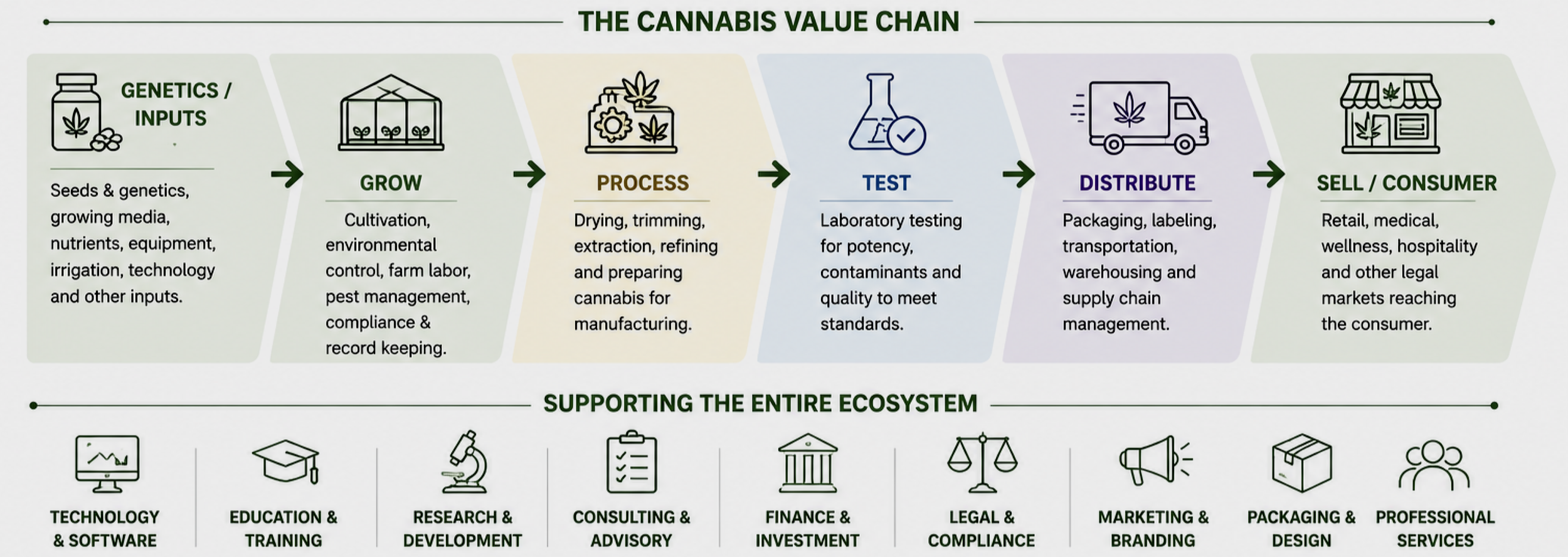
When people hear “cannabis industry,” they often imagine a grower or a cannabis shop.
Those are only two parts of a much larger economic system.
Before a cannabis product reaches a consumer, many different people and businesses may have contributed to it.
BEFORE THE PLANT IS GROWN
A cultivator may need:
SEEDS & GENETICS
GREENHOUSES
IRRIGATION
GROWING MEDIA
EQUIPMENT
AGRICULTURAL INPUTS
TECHNOLOGY
Already, businesses exist around the plant without necessarily selling cannabis itself.
DURING CULTIVATION
Commercial cultivation creates demand for:
FARM LABOR
AGRONOMIC KNOWLEDGE
PEST MANAGEMENT
ENVIRONMENTAL CONTROL
RECORD KEEPING
SECURITY
COMPLIANCE
The grower is part of a larger network.
AFTER HARVEST
The economic chain expands further:
DRYING & STORAGE
PROCESSING
EXTRACTION
MANUFACTURING
LABORATORY TESTING
PACKAGING
TRANSPORTATION & DISTRIBUTION
WHEN THE PRODUCT REACHES THE MARKET
Businesses may then participate through:
RETAIL
MEDICAL SERVICES
WELLNESS
HOSPITALITY
EDUCATION
RESEARCH
SOFTWARE
CONSULTING
MARKETING
and many other services, depending on what the law permits.
THE INDUSTRY IS AN ECOSYSTEM
This gives us our first entrepreneurship lesson:
You do not necessarily need to grow cannabis to build a business in the cannabis economy.
Someone might grow the plant.
Someone else might test it.
Another company might manufacture packaging.
Someone may build software for tracking inventory.
Another person may train workers.
Another may provide accounting or legal services.
WHERE DOES THE MONEY MOVE?
Think of the industry as a chain:
INPUTS → CULTIVATION → PROCESSING → TESTING → DISTRIBUTION → MARKET
Around that chain sits another economy:
SERVICES · TECHNOLOGY · EDUCATION · RESEARCH · PROFESSIONAL SUPPORT
Every step involves a customer purchasing something from somebody else.
That is where entrepreneurship begins.
THE FIRST QUESTION IS NOT:
“How do I start a cannabis company?”
A better question is:
“Where in the cannabis economy can I create value?”
That question opens far more possibilities.
An emerging industry creates opportunities around the plant—not only in the plant.
Learn the ecosystem before choosing your place in it.
02
The cannabis value chain
Every step adds value—and every step adds cost.
A value chain describes the journey through which a product moves from its starting materials to the final customer.
For cannabis, that journey may involve many independent businesses.
Understanding where value, cost and responsibility enter the chain is fundamental to understanding the industry.
GENETICS & INPUTS
Before cultivation begins, growers need inputs.
These may include:
SEEDS OR PLANT GENETICS
GROWING MEDIA
IRRIGATION
EQUIPMENT
AGRICULTURAL INPUTS
GREENHOUSE OR ENVIRONMENTAL SYSTEMS
These businesses sell to the cultivator.
The cultivator is their customer.
CULTIVATION
The grower transforms those inputs into cannabis biomass, flower, seed, fibre or other agricultural material.
But cultivation adds costs:
LAND · LABOR · WATER · ENERGY · EQUIPMENT · COMPLIANCE
A crop has economic value only if somebody needs what is being produced at a price that can support those costs.
PROCESSING & MANUFACTURING
Raw cannabis may then be dried, processed, extracted or transformed into finished products.
Processing can increase the value of the material.
But it also adds:
EQUIPMENT
LABOR
FACILITIES
PACKAGING
QUALITY CONTROL
and potentially additional licensing requirements.
TESTING
In regulated markets, testing becomes another specialized part of the chain.
Laboratories provide a service to cultivators, processors or manufacturers.
Testing therefore creates both:
A COST TO THE PRODUCER
and
A BUSINESS OPPORTUNITY FOR THE LABORATORY.
This is a useful way to think about an industry.
DISTRIBUTION
Products need to move between businesses and eventually toward their market.
Depending on the regulatory system, this can involve:
TRANSPORTATION
WAREHOUSING
INVENTORY MANAGEMENT
WHOLESALE
and specialized distribution businesses.
RETAIL & THE CUSTOMER
Eventually, a product reaches its final market.
That could be through:
RETAIL
MEDICAL ACCESS
WELLNESS
HOSPITALITY
INDUSTRIAL USE
or another legally permitted channel.
The final customer pays for the product—but that price must support much of what happened before it reached them.
FOLLOW THE MONEY BACKWARD
Suppose a consumer pays:
$20
for a finished cannabis product.
That does not mean the farmer earned $20.
That price may need to support:
RETAIL
← DISTRIBUTION
← PACKAGING
← TESTING
← PROCESSING
← CULTIVATION
← INPUTS
plus taxes, compliance and other operating costs.
This is one of the most important lessons for someone entering any agricultural industry:
Retail price is not farm income.
WHERE IS VALUE ADDED?
At every stage, ask:
What does this business receive?
What does it do to it?
Who buys the result?
What does that customer pay for?
For example:
SEED COMPANY
Genetics → sells to grower
GROWER
Inputs → crop → sells to processor
PROCESSOR
Crop → ingredient → sells to manufacturer
MANUFACTURER
Ingredient → finished product → sells into distribution/market
RETAILER
Finished product → access + service → sells to consumer
The exact chain varies enormously, but the principle remains.
Every business has a customer.
That gives us the entrepreneurial question:
Who is your customer—and what value are you adding for them?
A product can increase in value as it moves through the chain. But costs increase too. A viable business has to understand both.
Follow the product. Follow the costs. Follow the customer.
03
Plant-touching & ancillary businesses
You can participate in the cannabis economy without touching the plant.
One of the biggest misconceptions about cannabis entrepreneurship is that entering the industry means you must:
GROW CANNABIS
PROCESS CANNABIS
or
SELL CANNABIS
Those businesses are important, but they are only one part of the opportunity.
PLANT-TOUCHING BUSINESSES
A plant-touching business directly handles cannabis somewhere in the supply chain.
Depending on the regulatory system, this can include:
CULTIVATION
PROCESSING & EXTRACTION
PRODUCT MANUFACTURING
DISTRIBUTION
RETAIL
Because these businesses handle regulated cannabis, they may require specific licenses, security systems, record keeping, testing, inspections and other forms of regulatory compliance.
ANCILLARY BUSINESSES
An ancillary business provides products or services to the cannabis industry without necessarily possessing cannabis itself.
Think back to our grower.
What does that grower need?
Perhaps:
GREENHOUSE EQUIPMENT
IRRIGATION
PACKAGING
SOFTWARE
ACCOUNTING
LEGAL SERVICES
TRAINING
MARKETING
LAB EQUIPMENT
TRANSPORT OR LOGISTICS
The cannabis company becomes the customer of these businesses.
THE OPPORTUNITY AROUND THE PLANT
Imagine a new regulated cannabis industry begins with:
100 licensed growers.
Those growers suddenly need equipment, supplies, workers, professional services and technical knowledge.
An entrepreneur could ask:
What do all 100 growers need?
That question may reveal an opportunity more attractive than becoming the 101st grower.
EXISTING SKILLS CAN ENTER A NEW INDUSTRY
This is particularly important for someone beginning with limited capital.
A person may already know how to:
BUILD GREENHOUSES
DESIGN PACKAGING
MANAGE ACCOUNTS
CREATE WEBSITES
REPAIR EQUIPMENT
TRAIN WORKERS
TRANSPORT AGRICULTURAL PRODUCTS
PROVIDE HOSPITALITY
The opportunity may not require learning an entirely new profession.
It may involve applying an existing skill to an emerging market.
NOT EVERY ANCILLARY BUSINESS IS UNREGULATED
This distinction needs one caution.
Being ancillary does not automatically mean no rules apply.
A laboratory, transportation company, advertising agency, financial service provider or equipment supplier may still face regulations relevant to its activities.
The exact requirements depend on the jurisdiction.
So the question is not simply:
“Do I touch cannabis?”
It is also:
“What rules apply to the service I provide?”
TWO PATHS INTO THE ECONOMY
PLANT-TOUCHING
Grow → Process → Manufacture → Distribute → Sell
Often more directly exposed to cannabis-specific licensing and compliance.
ANCILLARY
Supply → Equip → Advise → Educate → Support
Creates value around the regulated industry.
Neither path is automatically better.
They involve different skills, capital requirements, risks and opportunities.
Sometimes the best opportunity in an emerging industry is selling something the industry itself needs.
FIND THE BOTTLENECK
When a new market develops, don't look only for the obvious business.
Ask:
What is difficult?
What is missing?
What are businesses repeatedly paying for?
What can I already do well?
That is often where entrepreneurship begins.
You don't have to touch the plant to create value around it.
The opportunity may already be hiding inside a skill you have.
04
Start with a problem, not a product
A good business begins with something somebody needs.
Entrepreneurs often begin with an idea:
“I want to grow cannabis.”
“I want to make a cannabis product.”
“I want to open a shop.”
But an idea is not yet a business.
Before deciding what to sell, ask:
What problem am I solving—and for whom?
START WITH THE CUSTOMER
Every business needs someone willing to pay for what it provides.
Your customer might be:
A FARMER
A PROCESSOR
A RETAILER
A PATIENT OR CONSUMER
A HOSPITALITY BUSINESS
A GOVERNMENT OR RESEARCH INSTITUTION
or another business in the cannabis value chain.
Different customers have different problems.
LOOK FOR A REAL NEED
Imagine growers are struggling to obtain reliable planting material.
That may create an opportunity in genetics or propagation, where legally permitted.
Perhaps processors cannot find suitable locally produced biomass.
That may create an opportunity for farmers.
Perhaps businesses struggle with testing, packaging, compliance or trained workers.
Each problem points toward a different enterprise.
DON'T CONFUSE INTEREST WITH DEMAND
People saying:
“That sounds interesting.”
is not the same as people saying:
“I will pay for that.”
Real demand means there are customers who need or want the product or service and are willing and able to purchase it.
This distinction can save an entrepreneur a great deal of money.
TALK BEFORE YOU BUILD
Before investing heavily, potential entrepreneurs can learn by speaking with the people they expect to serve.
Ask:
What do you currently buy?
What problem do you have?
What is difficult to obtain?
What does it cost you now?
What would make you switch suppliers?
The answers may change the original business idea.
That's useful.
TEST SMALL
A new entrepreneur does not always need to begin with a factory, large farm or expensive storefront.
Where legally appropriate, an idea may first be tested through:
A SAMPLE
A SMALL PILOT
A LIMITED SERVICE
A PROTOTYPE
A SMALL GROUP OF CUSTOMERS
The objective is to learn before committing large amounts of money.
FOLLOW THE SIGNAL
Imagine you want to grow cannabis.
You speak with ten potential buyers.
Eight tell you:
“We already have enough flower. What we cannot find is consistent material for processing.”
That information matters.
A good entrepreneur does not ignore the market simply because the original idea sounded exciting.
IDEA → PROBLEM → CUSTOMER → SOLUTION → TEST
This is the basic entrepreneurial sequence.
Not:
IDEA → SPEND MONEY → HOPE
THE BUSINESS QUESTION
Before investing, try to complete this sentence:
We help ______ solve ______ by providing ______.
For example:
We help licensed growers reduce crop losses by providing reliable greenhouse monitoring services.
Now we have something that can actually be investigated.
Entrepreneurship is not simply creating products. It is creating value for someone willing to pay for it.
Find the problem before building the solution.
05
Know your market
A good idea still needs enough customers.
You may have identified a genuine problem.
You may even have a good solution.
The next question is:
Is there a market for it?
A market exists when there are enough potential customers who want or need what you offer and are willing and able to pay for it.
WHO IS THE CUSTOMER?
Be specific.
“Cannabis businesses” is not a customer group.
Perhaps your actual customers are:
SMALL CULTIVATORS
LICENSED PROCESSORS
MEDICAL PATIENTS
RETAILERS
HOSPITALITY OPERATORS
RESEARCH INSTITUTIONS
Each group has different needs and purchasing behavior.
HOW MANY CUSTOMERS ARE THERE?
Suppose you want to provide greenhouse services.
Your market is not:
“Everyone interested in cannabis.”
It might be:
licensed cultivators operating greenhouses within the area you can realistically serve.
Now you can begin estimating whether enough potential customers exist.
WHAT ARE THEY BUYING NOW?
Customers rarely begin with nothing.
They may already be:
BUYING FROM ANOTHER SUPPLIER
IMPORTING THE PRODUCT
DOING THE WORK THEMSELVES
USING A SUBSTITUTE
or simply living with the problem.
Understanding the current solution helps reveal what your business must improve.
KNOW YOUR COMPETITION
Competition is useful information.
Ask:
Who already serves this customer?
What do they charge?
What do they do well?
Where are customers dissatisfied?
Why would someone choose us instead?
Your advantage might be:
PRICE
QUALITY
CONSISTENCY
LOCATION
SPEED
SPECIALIZED KNOWLEDGE
CUSTOMER SERVICE
or something else customers actually value.
PRICE MATTERS
A product may be excellent and still fail commercially if customers will not pay enough to cover the cost of producing it.
Ask both:
What will customers pay?
and
What will it cost us to deliver?
The space between those numbers becomes extremely important.
We will look at that in the next section.
DON'T BUILD A MARKET FROM ASSUMPTIONS
An entrepreneur might say:
“There will be thousands of cannabis farmers, so everyone will need my product.”
Maybe.
But that's a prediction—not evidence.
Better evidence comes from:
CUSTOMER CONVERSATIONS
ACTUAL ORDERS
PILOT SALES
MARKET DATA
COMPETITOR PRICES
LICENSE OR INDUSTRY DATA
The closer you get to actual purchasing behavior, the stronger your information becomes.
START SMALL, LEARN FAST
You don't need perfect information before starting.
But you should try to replace assumptions with evidence before making large investments.
Think of market research as a process:
ASSUMPTION → ASK → TEST → OBSERVE → ADJUST
FOUR QUESTIONS
Before entering a cannabis market, be able to answer:
WHO IS MY CUSTOMER?
WHAT DO THEY NEED?
WHAT ARE THEY PAYING NOW?
WHY WOULD THEY BUY FROM ME?
If those questions are difficult to answer, more market research is probably needed.
A large industry does not automatically mean there is a market for your particular business.
Know the customer before you scale the business.
Opportunity becomes more convincing when assumptions begin turning into evidence.
06
Understand your numbers
Sales are not the same as profit.
A business can sell a lot of cannabis products and still lose money.
That is why entrepreneurs need to understand a few basic numbers before investing or expanding.
You do not need to be an accountant.
But you do need to know where the money comes from and where it goes.
REVENUE
Revenue is the money the business receives from sales.
Imagine a cultivator sells:
100 kg × $10 per kg = $1,000 revenue
That sounds good.
But we still don't know whether the business made money.
COSTS
The business had to spend money to produce those 100 kg.
Costs might include:
SEEDS OR GENETICS
LABOR
LAND OR RENT
WATER & ENERGY
EQUIPMENT
NUTRIENTS & INPUTS
TESTING
PACKAGING
TRANSPORTATION
LICENSING & COMPLIANCE
Suppose those costs total:
$800
Now the picture looks different.
REVENUE − COSTS = PROFIT
In our simplified example:
$1,000 revenue
− $800 costs
= $200 profit
This is deliberately simplified. Real businesses distinguish between different types of costs and different measures of profit.
For Fundamentals, the lesson is:
Don't judge a business by sales alone.
MARGIN
Margin helps us understand how much of the selling price remains after particular costs.
Suppose something costs $8 to produce and is sold for $10.
The $2 difference matters.
If costs rise to $9.50 while the selling price remains $10, the business may still be selling—but its economics have changed dramatically.
FIXED & VARIABLE COSTS
Another useful distinction:
FIXED COSTS
Expenses that may continue even when production changes.
Examples might include:
RENT · INSURANCE · SOME SALARIES · LICENSE FEES
VARIABLE COSTS
Expenses that generally change with the amount produced or sold.
Examples might include:
PACKAGING · RAW MATERIALS · SOME LABOR · SHIPPING
Understanding both helps an entrepreneur estimate how much must be sold before the business can sustain itself.
CASH FLOW
Profit and cash are not exactly the same thing.
Imagine you deliver a large order today.
Your customer agrees to pay you 60 days later.
Meanwhile:
workers need paying
rent is due
supplies must be purchased
The sale may eventually be profitable, but the business still needs enough cash to survive those 60 days.
That is cash flow.
CANNABIS CAN ADD EXTRA COSTS
A regulated cannabis business may face costs that an ordinary agricultural business does not.
Depending on the jurisdiction, these can include:
LICENSING
SECURITY
TESTING
TRACKING SYSTEMS
SPECIAL PACKAGING
RECORD KEEPING
REGULATORY STAFF OR PROFESSIONAL SERVICES
These costs need to be included in the business model from the beginning.
START WITH SIMPLE QUESTIONS
Before investing, ask:
WHAT WILL I SELL IT FOR?
HOW MANY CAN I REALISTICALLY SELL?
WHAT DOES EACH UNIT COST ME?
WHAT ARE MY MONTHLY FIXED COSTS?
WHEN WILL CUSTOMERS PAY ME?
HOW MUCH CASH DO I NEED UNTIL THEN?
You don't need a 50-page financial model to begin asking good questions.
THE BASIC BUSINESS EQUATION
REVENUE − COSTS = PROFIT
But underneath it:
CASH KEEPS THE BUSINESS OPERATING.
A profitable idea can still fail if it runs out of cash before the money arrives.
Know your numbers before your numbers become the problem.
Revenue tells you what you sold. Profit tells you what remained. Cash flow helps determine whether you can keep going.
07
Compliance is part of the business model
In a regulated industry, following the rules costs money.
Entrepreneurs sometimes build a business plan around:
PRODUCT + CUSTOMER + PRICE
and think about regulation afterward.
In cannabis, that can be a serious mistake.
If an activity is regulated, compliance affects how the business operates, what it costs to operate and sometimes whether the business can operate at all.
LICENSING
Plant-touching cannabis businesses may require specific authorization before they can begin operating.
Depending on the regulatory system, requirements may apply to:
CULTIVATION
PROCESSING
MANUFACTURING
TRANSPORTATION
DISTRIBUTION
RETAIL
Obtaining permission may require time, documentation, facilities and money.
FACILITIES & SECURITY
Regulations may determine how a cannabis facility must be designed or operated.
Requirements can include:
SECURE CULTIVATION AREAS
CONTROLLED ACCESS
STORAGE
SURVEILLANCE
SANITATION
These requirements become part of the startup cost.
TESTING
If products must be laboratory tested before entering the market, testing is not an optional expense.
The entrepreneur needs to know:
WHAT MUST BE TESTED?
HOW OFTEN?
WHAT DOES IT COST?
WHAT HAPPENS IF A BATCH FAILS?
A failed batch can mean more than the cost of another laboratory test. It can mean losing some or all of the value already invested in producing that batch.
RECORD KEEPING & TRACEABILITY
Regulated cannabis systems may require businesses to document the movement of cannabis through the supply chain.
Records can connect:
CULTIVATION → HARVEST → BATCH → PROCESSING → TESTING → SALE
Maintaining those records requires people, systems and time.
PACKAGING & LABELLING
As we learned in Class 08, regulated products may have requirements involving:
PACKAGING
POTENCY INFORMATION
BATCH IDENTIFICATION
WARNINGS
SERVING INFORMATION
CHILD-RESISTANT FEATURES
Those requirements affect product design and manufacturing costs.
TAXES & FEES
Licensing fees, business taxes and cannabis-specific taxes or charges can also influence whether an enterprise is financially viable.
A business model should therefore calculate the economics after compliance, not before it.
COMPLIANCE CAN CHANGE THE BUSINESS IDEA
Imagine two entrepreneurs each have $10,000.
One plans to enter licensed cannabis cultivation.
The other provides greenhouse monitoring equipment to licensed growers.
Their regulatory requirements, startup costs and risks may be completely different.
That doesn't make one business better.
It means:
The regulatory pathway is part of choosing the business model.
COMPLIANCE CAN ALSO CREATE BUSINESS
Here is the other side.
Every regulatory requirement can create demand for someone who helps businesses meet it.
An emerging cannabis industry may need:
COMPLIANCE SPECIALISTS
LABORATORIES
SECURITY PROVIDERS
ACCOUNTANTS
SOFTWARE
PACKAGING COMPANIES
TRAINING
LEGAL & PROFESSIONAL SERVICES
Regulation therefore creates costs—but it can also create markets.
ADD COMPLIANCE TO THE EQUATION
Earlier we had:
REVENUE − COSTS = PROFIT
Now remember that:
COMPLIANCE IS PART OF COST
And when evaluating an opportunity:
IDEA → MARKET → REGULATION → COST → VIABILITY
Don't build the business first and discover the rules later.
In cannabis, compliance isn't paperwork around the business. It is part of the business.
Know the rules before committing the money.
08
Farmers & local enterprise
Legal cannabis does not automatically mean prosperous farmers.
In agricultural regions, cannabis is often discussed as an opportunity for farmers.
That opportunity can be real.
But simply allowing cultivation does not guarantee that small farmers will benefit.
The important question is:
Where will farmers sit in the value chain?
GROWING IS ONLY THE FIRST STEP
A farmer may produce cannabis successfully and still have a poor business if there is:
NO RELIABLE BUYER
NO AGREED QUALITY STANDARD
NO PROCESSING CAPACITY
NO ACCESS TO TESTING
HIGH TRANSPORT COSTS
or a market price below the cost of production.
This is why cultivation should begin with the market—not simply with the availability of land.
WHAT DOES THE BUYER NEED?
Different markets require different raw materials.
A buyer producing a medical product may need something very different from a business purchasing material for industrial processing.
Farmers therefore need to understand:
WHAT TO GROW
WHAT QUALITY IS REQUIRED
HOW MUCH IS NEEDED
WHEN IT IS NEEDED
WHAT THE BUYER WILL PAY
VALUE CAN BE ADDED LOCALLY
If agricultural material leaves a community immediately after harvest, much of the later economic activity may happen somewhere else.
Local enterprise can potentially develop around:
SEED & PLANTING MATERIAL
NURSERIES
DRYING & STORAGE
PROCESSING
PACKAGING
TRANSPORTATION
QUALITY CONTROL
EQUIPMENT & FARM SERVICES
TRAINING
This means the economic question is larger than:
“How much can the farmer earn per kilogram?”
We should also ask:
How much of the value chain can remain within the local economy?
COOPERATIVES & SHARED SERVICES
Small producers may not individually be able to afford every piece of infrastructure they need.
Depending on the regulatory system and business model, farmers might cooperate around services such as:
PROCESSING
STORAGE
EQUIPMENT
TESTING ACCESS
TRANSPORT
MARKETING
Shared infrastructure can sometimes reduce costs and help smaller producers reach markets they could not serve alone.
CONTRACTS CAN REDUCE UNCERTAINTY
One approach in agricultural markets is to establish the buyer before production begins.
A producer may know:
WHAT THE BUYER WANTS
HOW MUCH THEY WANT
THE REQUIRED QUALITY
THE DELIVERY PERIOD
THE AGREED PRICE OR PRICING METHOD
before committing to production.
That does not remove agricultural or market risk, but it can reduce the danger of:
GROW FIRST → SEARCH FOR BUYER LATER
FARMERS NEED INFORMATION TOO
Small producers can be disadvantaged when other participants understand the market better than they do.
Access to information about:
PRICES
QUALITY STANDARDS
LICENSING
INPUT COSTS
BUYERS
TESTING
and CONTRACT TERMS
can therefore be as important as cultivation knowledge.
THE GANDAKI OPPORTUNITY
For an emerging framework such as Gandaki's, the long-term economic opportunity is not simply the number of hectares planted.
A stronger measure would be whether a regulated system can create viable local enterprises across the chain:
FARM → POST-HARVEST → PROCESSING → TESTING → PRODUCT → MARKET
That is how agricultural production can begin connecting with broader rural economic development.
The goal is not simply to grow more cannabis.
It is to build a system in which producers can grow for a known market, to a known standard, at an economically viable cost.
A crop becomes an opportunity when there is a market, a value chain and a way for producers to participate fairly in it.
The strongest cannabis economy may not be the one that grows the most. It may be the one that creates the most sustainable value around what it grows.
09
Build something that can survive
Entering an emerging industry is easier than building a lasting business.
New industries create excitement.
New regulations, new products and new markets can make opportunities appear everywhere.
But an opportunity today does not guarantee a successful business tomorrow.
A sustainable enterprise needs more than being early.
QUALITY
Customers need a reason to continue buying from you.
In cannabis, quality may involve:
RELIABLE RAW MATERIAL
PRODUCT SAFETY
ACCURATE POTENCY
GOOD MANUFACTURING
APPROPRIATE TESTING
PROFESSIONAL SERVICE
Quality depends on what the business provides.
But whatever you sell, customers need to trust that they will receive what was promised.
CONSISTENCY
Producing something excellent once is not enough.
A commercial customer may need the same:
QUALITY
QUANTITY
SPECIFICATION
and DELIVERY SCHEDULE
repeatedly.
For a farmer, that might mean supplying material that meets an agreed standard every harvest.
For a laboratory, it means reliable testing.
For a service company, it means delivering dependable work.
TRUST
Cannabis businesses operate in an industry where consumers, regulators and business partners may demand high levels of accountability.
Trust can be built through:
TRANSPARENCY
ACCURATE INFORMATION
RELIABLE DELIVERY
GOOD RECORDS
HONEST CLAIMS
RESPONSIBLE BUSINESS PRACTICES
Trust takes time to build and can be lost quickly.
PARTNERSHIPS
Very few businesses can perform the entire value chain themselves.
A cultivator may need:
GENETICS SUPPLIERS
PROCESSORS
LABORATORIES
TRANSPORT
BUYERS
PROFESSIONAL SERVICES
A processor depends on reliable raw material.
A retailer depends on reliable suppliers.
An industry therefore develops through networks of businesses, not simply individual companies operating alone.
DON'T BUILD EVERYTHING YOURSELF
An entrepreneur sometimes sees every part of the value chain as another opportunity:
“We'll grow it, process it, package it, distribute it and sell it.”
That may be possible.
But every additional activity requires capital, skills, management and potentially additional regulatory compliance.
Sometimes a stronger business specializes in one thing and does it exceptionally well.
MARKETS CHANGE
Cannabis markets can change quickly.
New competitors enter.
Prices change.
Consumer preferences evolve.
Technology improves.
Regulations change.
Products that were scarce can become abundant.
A business built only around today's shortage may struggle when that shortage disappears.
ADAPT
Sustainable businesses pay attention to what the market is telling them.
The process continues:
BUILD → MEASURE → LEARN → ADAPT
If customers want something different, listen.
If costs become unsustainable, change the model.
If regulation changes, respond.
If the original idea doesn't work, learning from it is more useful than defending it.
DON'T COMPETE ONLY ON PRICE
Someone can almost always try to sell cheaper.
A stronger competitive advantage may come from:
BETTER QUALITY
GREATER CONSISTENCY
SPECIALIZED KNOWLEDGE
RELIABILITY
LOCATION
CUSTOMER RELATIONSHIPS
TRUST
The question is:
Why should the customer come back?
That is much more important than making the first sale.
FROM OPPORTUNITY TO ENTERPRISE
An opportunity says:
“Someone might buy this.”
A sustainable enterprise can say:
“We know our customer, we deliver consistently, our numbers work, and customers return.”
The goal is not simply to enter the cannabis industry. It is to build something worth keeping.
QUALITY + CONSISTENCY + TRUST + ADAPTABILITY
Getting the first customer proves someone will buy. Building a business means giving them a reason to return.
10
From idea to enterprise
Before investing in a cannabis business, test the idea.
By now, we have seen that an opportunity requires more than enthusiasm for cannabis.
A business needs a real problem, a customer, a workable solution, a market, a legal pathway and numbers that make sense.
So before asking:
“How do I start?”
ask:
“Does this idea deserve to become a business?”
Here is a simple way to find out.
THE PAATSALA OPPORTUNITY TEST
1. PROBLEM
What problem exists?
What is difficult, expensive, unavailable, unreliable or inefficient today?
A business should have a reason to exist.
2. CUSTOMER
Who has this problem?
Be specific.
Not simply:
“Cannabis businesses.”
But perhaps:
small cultivators needing affordable testing access
or
processors looking for consistent locally produced raw material.
3. SOLUTION
What will you provide?
Can you explain clearly how your product or service solves the customer's problem?
If the solution takes ten minutes to explain, it may need more work.
4. MARKET
Are enough customers willing to pay?
Look for evidence.
Talk to potential customers.
Study existing suppliers.
Understand prices.
Whenever possible, test whether interest can become an actual purchase.
5. REGULATION
Is the activity legally possible?
Ask:
What license is required?
What standards apply?
What can and cannot be sold?
What compliance costs must be included?
Never build the business model around something the regulatory system does not permit.
6. NUMBERS
Can the business make money?
Estimate:
SELLING PRICE
COST PER UNIT
FIXED COSTS
COMPLIANCE COSTS
EXPECTED SALES
CASH NEEDED TO OPERATE
Remember:
REVENUE − COSTS = PROFIT
And profit on paper does not remove the need for cash flow.
7. CAPABILITY
Can you actually deliver?
Consider:
SKILLS
KNOWLEDGE
EQUIPMENT
CAPITAL
PEOPLE
PARTNERS
TIME
You do not need to possess everything yourself.
Sometimes the missing capability can come through a partner.
8. TEST
Finally:
Can you test it small?
Before building the large farm, factory or company, look for the smallest reasonable way to test the underlying business assumption.
Can you obtain:
ONE CUSTOMER?
ONE ORDER?
ONE CONTRACT?
ONE PILOT?
ONE WORKING PROTOTYPE?
Each provides information.
Then:
TEST → LEARN → ADJUST → TEST AGAIN
Failure at this stage is not necessarily failure of the entrepreneur.
It may simply be inexpensive evidence that the original idea needs to change.
PUT IT ALL TOGETHER
PROBLEM
↓
CUSTOMER
↓
SOLUTION
↓
MARKET
↓
REGULATION
↓
NUMBERS
↓
CAPABILITY
↓
TEST
If one part is weak, investigate it before investing heavily.
THE FIRST BUSINESS PLAN CAN FIT ON ONE PAGE
At this stage, a learner should be able to write:
The problem: ______
Our customer: ______
Our solution: ______
Why they will buy: ______
How we make money: ______
What regulations apply: ______
What we need to deliver: ______
Our first small test: ______
That is already the beginning of a business plan.
Don't begin by asking how much money you can make. Begin by proving that you can create something somebody needs, deliver it legally, and sell it for more than it costs.
IDEA → EVIDENCE → ENTERPRISE
An emerging cannabis economy creates possibilities. Entrepreneurship is the work of turning the right possibility into something that actually works.
YOU NOW UNDERSTAND CANNABIS INDUSTRY & ENTREPRENEURSHIP
A cannabis economy creates opportunities far beyond growing and selling cannabis.
Every stage of the value chain needs businesses, workers, knowledge, infrastructure and services.
The entrepreneur's job is to find where a real need exists and whether it can become a viable enterprise.
SIX IDEAS TO REMEMBER
THE INDUSTRY IS AN ECOSYSTEM
Cannabis creates economic activity across genetics, inputs, cultivation, processing, testing, manufacturing, distribution, retail and supporting services.
YOU DON'T HAVE TO TOUCH THE PLANT
Ancillary businesses can participate through technology, equipment, education, professional services, packaging, logistics and many other areas.
START WITH A PROBLEM
A product idea becomes more meaningful when it solves something a real customer needs.
KNOW YOUR MARKET
Identify the customer, understand the competition, learn what customers currently pay and determine why they would buy from you.
KNOW YOUR NUMBERS & THE RULES
Revenue is not profit. Compliance creates real costs and must be built into the business model from the beginning.
BUILD FOR THE LONG TERM
Quality, consistency, trust, partnerships and adaptability help turn an opportunity into a sustainable enterprise.
THE BIG IDEA
PROBLEM → CUSTOMER → SOLUTION → MARKET → REGULATION → NUMBERS → CAPABILITY → TEST
Then:
TEST → LEARN → ADJUST → TEST AGAIN
Don't simply ask where the cannabis industry is growing. Ask where you can create value within it.
Now let's see what you remember.
CLASS 09
KNOWLEDGE CHECK
You understand the fundamentals of cannabis industry and entrepreneurship. Let's check.
10 questions · About 3 minutes · Retake anytime
1. Which statement best describes the cannabis industry?
A. It consists mainly of growers
B. It consists mainly of retail shops
C. It is a value chain supported by many different businesses and services
D. Every cannabis company must handle cannabis
2. What is an ancillary cannabis business?
A. An illegal cannabis business
B. A business that supports the cannabis industry without necessarily handling cannabis itself
C. A cannabis farm
D. A government regulator
3. What should an entrepreneur identify before developing a solution?
A. A logo
B. A company name
C. A real customer problem or need
D. A large building
4. What is stronger evidence of demand?
A. Friends saying the idea sounds interesting
B. Social-media likes
C. Customers actually purchasing, ordering or committing to the product or service
D. The entrepreneur believing the market will grow
5. Why is retail price different from farmer income?
A. Farmers never receive payment
B. Value-chain costs and margins may exist between production and the final consumer
C. Retailers always set agricultural prices
D. Cannabis has no production costs
6. A business has $10,000 in revenue and $8,000 in costs. In this simplified example, what remains as profit?
A. $18,000
B. $10,000
C. $8,000
D. $2,000
7. Why does cash flow matter?
A. Profit and available cash are always identical
B. A business may have expenses to pay before customers pay what they owe
C. Cash flow matters only to large companies
D. Sales eliminate the need for working capital
8. Why should cannabis entrepreneurs investigate regulation early?
A. Regulation matters only after the first sale
B. Regulation applies only to farmers
C. Licensing, testing, facilities and other requirements can affect both the business model and its costs
D. Regulation determines the company name
9. Which approach can reduce risk for an agricultural producer?
A. Grow as much as possible and then search for buyers
B. Understand the buyer, required quality, market and economics before committing heavily to production
C. Assume legalization guarantees high prices
D. Ignore processing and testing requirements
10. What is the purpose of the Paatsala Opportunity Test?
A. To predict which cannabis company will become largest
B. To guarantee that a business will succeed
C. To determine which cannabis product has the highest THC
D. To systematically examine whether an idea has the foundations of a viable enterprise
RESULTS
8-10 : EXCELLENT
You understand the fundamentals of the cannabis value chain and how to begin evaluating an entrepreneurial opportunity.
CLASS 09 COMPLETE
CANNABIS INDUSTRY & ENTREPRENEURSHIP
NEXT → CLASS 10
5-7 : ALMOST THERE
You understand the main ideas. Review the sections you missed and try again.
0-4 : TAKE ANOTHER LOOK
Return to Class 09 and review the entrepreneurship fundamentals. There is no penalty and no limit on attempts.
CHECK YOUR ANSWERS
1 C · 2 B · 3 C · 4 C · 5 B · 6 D · 7 B · 8 C · 9 B · 10 D