English | नेपाली
CLASS 05
CANNABIS CULTIVATION FUNDAMENTALS
01
Start with the plant
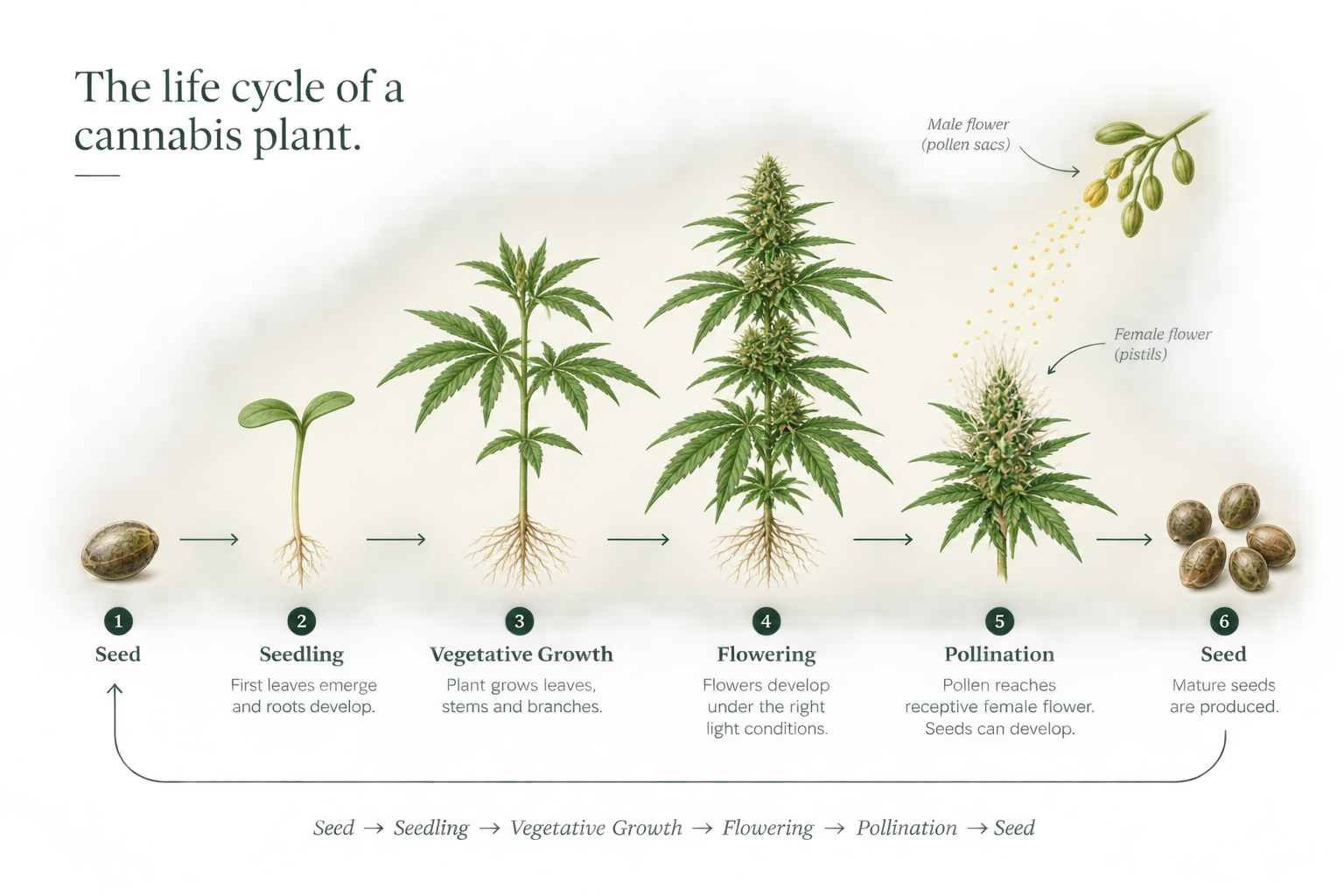
Good cultivation begins with observation.
Cannabis is a plant.
Before thinking about equipment, nutrients, greenhouses or technology, a grower needs to understand what the plant itself needs.
Like other plants, cannabis depends on a few basic things:
LIGHT
provides energy for photosynthesis.
WATER
moves through the plant and supports its biological processes.
AIR
provides carbon dioxide to the leaves and oxygen around the roots.
ROOT SPACE
gives the plant somewhere to anchor itself and obtain water and nutrients.
NUTRIENTS
provide the elements required to build new growth.
A SUITABLE ENVIRONMENT
temperature, humidity and airflow influence how well the plant functions.
THE PLANT RESPONDS
A cannabis plant continually responds to its environment.
Too little light changes its growth.
Too much or too little water affects its roots.
Temperature and humidity influence how the plant uses water.
Nutrition affects leaves and development.
Pests and disease can interfere with all of these processes.
That gives us the first principle of cultivation:
Don't begin by asking, “What should I give the plant?”
Begin by asking, “What is the plant telling me?”
Cultivation is the management of a living environment.
The objective is not to force a plant to grow.
It is to create conditions in which the plant can grow well.
Learn the plant first. The techniques come later.
02
Seed or clone?
A cannabis plant can begin in more than one way.
For cultivation, two common starting points are seeds and clones.
Both can produce healthy cannabis plants, but they are not the same.
SEED
A seed is produced through sexual reproduction.
When it germinates, it produces a new plant with its own combination of genetic traits.
Seed-grown plants generally develop a strong primary root system and can show differences from one plant to another—even when the seeds share the same parents.
Seeds may also be sold or produced as:
REGULAR SEEDS
Can produce male or female plants.
FEMINIZED SEEDS
Produced to greatly increase the likelihood of female plants.
AUTOFLOWERING SEEDS
Produce plants whose transition toward flowering is primarily influenced by age rather than the changing day/night cycle.
We don't need to go deeper into seed breeding or genetics yet.
CLONE
A clone is a cutting taken from a living cannabis plant and encouraged to develop its own roots.
Unlike a seedling, it is not a new genetic combination.
It is genetically derived from the mother plant it came from.
This gives growers an important advantage:
PREDICTABILITY
If a mother plant has desirable characteristics, clones allow growers to reproduce those genetics repeatedly.
But clones can also carry problems from their source—including pests, diseases or poor plant health.
SEED vs. CLONE
SEED
New genetic individual
Starts from germination
Greater genetic variation
Can be stored for later planting
CLONE
Cutting from an existing plant
Same genetics as the mother plant
More predictable characteristics
Requires access to healthy living plant material
Neither is automatically better.
The right starting material depends on the purpose of the crop, available genetics, cultivation system and regulatory requirements.
Seeds create a new plant.
Clones reproduce an existing plant.
Every cultivation cycle begins with genetics.
03
Germination & seedlings
The first days establish the plant.
Germination begins when a viable cannabis seed receives the conditions it needs to start growing.
The seed absorbs water, its protective shell opens, and the first root begins to emerge.
That first root is called the radicle.
Soon afterward, the young shoot emerges and begins growing toward the light.
A SEED NEEDS THREE BASIC THINGS
MOISTURE
The seed needs enough moisture to begin germination.
OXYGEN
Seeds and developing roots need oxygen. A growing medium that stays completely saturated can limit the air available around them.
SUITABLE TEMPERATURE
Germination depends on an environment warm enough to support biological activity without excessive heat.
FROM SEED TO SEEDLING
Once the young plant emerges, its first small leaves—the cotyledons—open.
These are followed by the first true leaves.
The plant has now entered the seedling stage.
At this point, the root system is still small and the plant is particularly sensitive to its environment.
MORE IS NOT ALWAYS BETTER
A common beginner mistake is trying to help the seedling by giving it too much.
Too much water can reduce oxygen around young roots.
Excessive nutrients can stress a plant that does not yet need heavy feeding.
Excessive environmental stress can slow early development.
The objective is simple:
MOIST — NOT WATERLOGGED
GENTLE LIGHT
SUITABLE TEMPERATURE
GOOD AIR AROUND THE ROOTS
WATCH THE PLANT
Healthy seedlings gradually establish new roots and begin producing true leaves.
Instead of trying to make them grow quickly, give them time to establish themselves.
The seed contains the beginning.
The environment determines whether that beginning can develop.
Strong plants begin with healthy roots.
04
Roots & the growing medium

Healthy growth begins below the surface.
We usually notice the leaves first.
But much of what determines the health of a cannabis plant is happening where we cannot see it—in the root zone.
Roots anchor the plant and absorb the water and mineral nutrients needed for growth.
But roots need something else that beginners sometimes overlook:
OXYGEN
Roots carry out respiration and need access to oxygen.
A growing medium that remains saturated for too long can reduce the amount of oxygen available around the roots.
That is why good root-zone management is not simply about watering the plant.
It is about maintaining a balance between:
WATER · AIR · NUTRIENTS · ROOT SPACE
WHAT CAN CANNABIS GROW IN?
Cannabis can be cultivated using different growing systems.
SOIL
A biologically active growing environment containing mineral and organic material.
SOILLESS MEDIA
Materials such as coco coir, peat-based mixes or other substrates can provide physical support while water and nutrients are managed by the grower.
HYDROPONICS
Plants can also be grown without soil, with roots receiving water and mineral nutrients through a managed system.
Each approach requires different management.
But the plant's fundamental needs remain remarkably similar.
ROOTS AND WATER
Too little water and the plant cannot function properly.
Too much water for the particular root environment can also cause problems.
The important question is therefore not:
“How often should cannabis be watered?”
It is:
“Does the root zone need water?”
The answer changes with plant size, growing medium, container, temperature, humidity and other environmental conditions.
WHAT HAPPENS BELOW SHOWS ABOVE
Problems in the root zone often eventually appear in the visible plant.
Slow growth, wilting or changes in leaf appearance may sometimes begin with conditions around the roots.
That is why experienced cultivation begins with observation of the whole plant—including the environment below it.
Healthy roots support healthy plants.
Look below the leaves when trying to understand what the plant needs.
05
Vegetative growth
Now the plant builds its structure.
After the seedling becomes established, cannabis enters a period of rapid vegetative growth.
During this stage, the plant concentrates on developing:
ROOTS
A larger root system supports increasing water and nutrient needs.
STEMS & BRANCHES
The plant builds the structure that will later support flowers.
LEAVES
More leaf area allows the plant to capture more light for photosynthesis.
LIGHT DRIVES GROWTH
Cannabis uses light energy to convert carbon dioxide and water into the compounds it needs for growth.
During vegetative development, adequate light supports the production of new leaves, stems and branches.
This is also where an important characteristic of cannabis becomes useful to understand:
PHOTOPERIOD
Many cannabis varieties respond to the length of the light and dark periods they experience.
Longer days generally support vegetative growth in photoperiod-sensitive cannabis.
As uninterrupted nights become longer, the plant can receive the biological signal to begin flowering.
This is why light is more than simply energy for cannabis.
Light can also provide information to the plant.
Autoflowering cannabis behaves differently, with flowering influenced primarily by plant age rather than requiring the same change in day length.
THE PLANT REVEALS ITS STRUCTURE
As vegetative growth continues, several features become easy to recognize:
NODES — where leaves and branches meet the main stem
INTERNODES — the spaces between nodes
GROWING TIPS — areas where new growth develops
BRANCHES — the structure that expands the plant's canopy
These features help a grower understand how the plant is developing.
MALE OR FEMALE?
As cannabis matures, reproductive structures can begin to reveal whether a plant is male or female.
This matters because male and female plants have different roles in reproduction, and pollination changes what happens to female flowers.
We already learned how to identify the basic male and female structures in Class 01, so we don't need to repeat the full lesson here.
Vegetative growth builds the plant that will flower later.
The objective at this stage is not simply to make the plant bigger.
It is to maintain an environment in which it can develop healthy roots, leaves, stems and branches.
Roots establish the plant.
Vegetative growth builds its structure.
Next, the plant changes its priorities.
06
Flowering
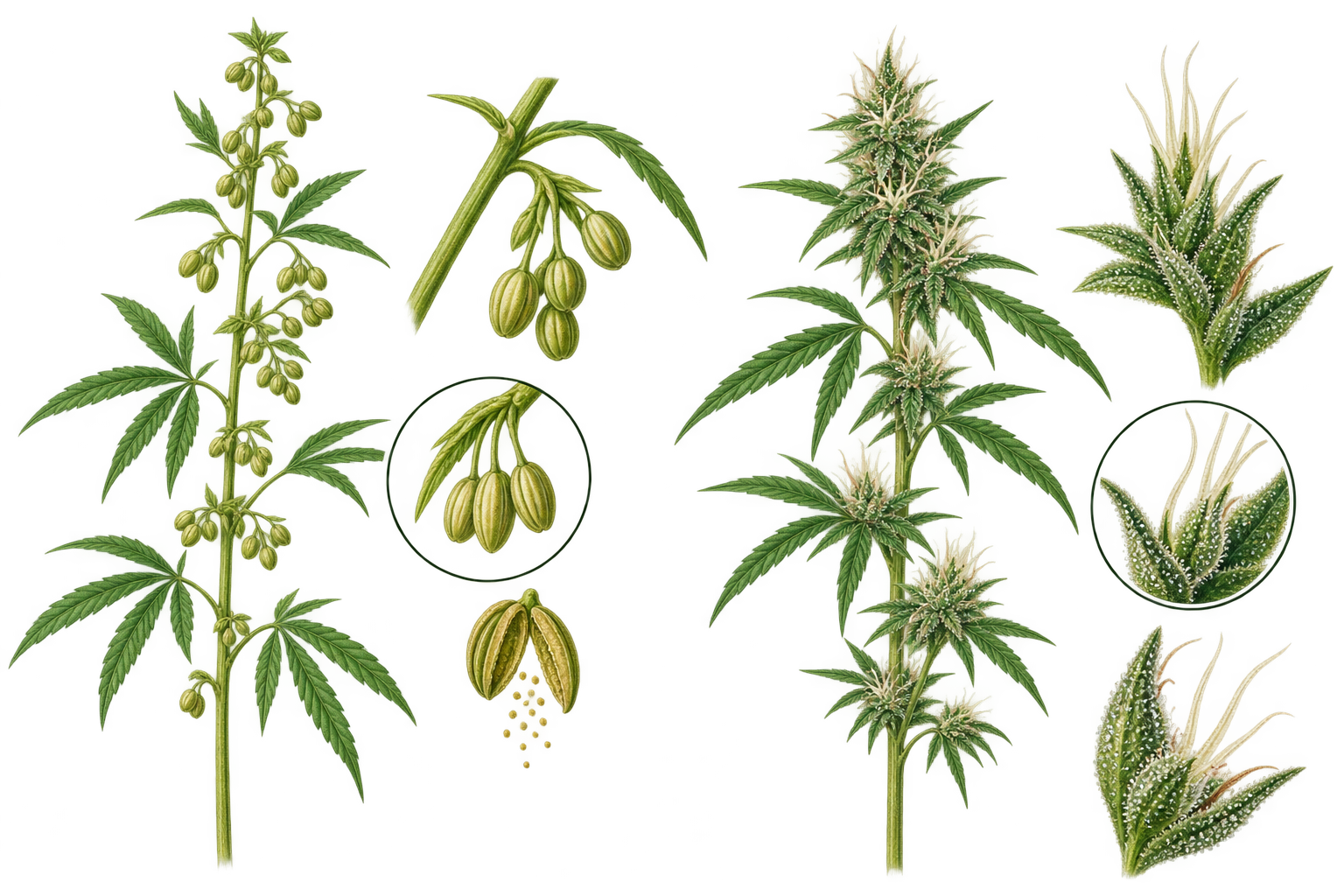
Flowering is the reproductive stage of the cannabis plant.
As cannabis matures, its growth begins to change.
Instead of concentrating mainly on producing new stems and leaves, the plant increasingly directs its energy toward reproduction.
For photoperiod-sensitive cannabis, longer uninterrupted periods of darkness can trigger this transition.
MALE AND FEMALE PLANTS DEVELOP DIFFERENTLY
Cannabis commonly produces separate male and female plants.
MALE PLANTS
Develop clusters of pollen-producing structures.
When mature, these release pollen that can fertilize female flowers.
FEMALE PLANTS
Develop flowers containing reproductive structures including the stigmas that receive pollen.
This is why identifying plant sex is such an important basic cultivation skill.
WHAT HAPPENS AFTER POLLINATION?
When pollen reaches a receptive female flower, fertilization can occur.
The plant then begins producing seeds.
When female flowers remain unpollinated, they continue developing without producing mature seeds.
This distinction is important because cannabis may be cultivated for very different purposes.
A grower producing seed wants pollination.
A grower producing unpollinated female flowers generally does not.
FLOWERS CHANGE AS THEY DEVELOP
As female flowers mature, several visible changes occur.
Flowers increase in size and density.
Pistils and stigmas change appearance.
And tiny resin-producing structures called trichomes become increasingly visible on flowers and nearby leaves.
TRICHOMES
Trichomes are small glandular structures found on the surface of the cannabis plant.
They produce and contain many of the compounds associated with cannabis, including cannabinoids and aromatic terpenes.
Different types of trichomes occur on cannabis, and we already introduced their basic anatomy earlier in the course.
FLOWERING REQUIRES OBSERVATION
The plant's needs and vulnerabilities can change during flowering.
Environmental conditions, plant health, pests, disease and reproductive development all remain important.
The beginner's task is therefore not simply to wait for flowers.
It is to observe how the plant changes.
Vegetative growth builds the plant.
Flowering reveals its reproductive purpose.
Understanding flowering begins with understanding what the plant is trying to do.
07
Environment matters
A cannabis plant experiences its environment as a whole.
Light, temperature, humidity, air and water are often discussed separately.
But the plant experiences them at the same time.
A change in one can affect how the plant responds to another.
LIGHT
Light provides the energy for photosynthesis.
Its intensity, duration and distribution influence plant growth. For photoperiod-sensitive cannabis, the daily cycle of light and darkness also influences the transition between vegetative growth and flowering.
TEMPERATURE
Temperature affects many of the plant's biological processes.
Very high or very low temperatures can create stress, while suitable temperatures allow the plant to function efficiently.
Temperature also interacts with humidity and water use.
HUMIDITY
Humidity describes the amount of moisture in the air.
Cannabis leaves continuously exchange water with their environment through transpiration.
When humidity changes, the rate at which the plant loses water can change too.
AIR
Leaves need access to carbon dioxide for photosynthesis.
Roots need oxygen.
Air movement around the plant can also help prevent stagnant, excessively humid conditions around leaves and flowers.
WATER
Water moves through the plant from the roots toward the leaves.
It carries dissolved mineral nutrients, supports photosynthesis and helps the plant regulate itself.
But as we learned earlier:
More water does not necessarily mean better growth.
The root zone also needs oxygen.
EVERYTHING IS CONNECTED
Imagine a warm, dry day.
The plant may lose water more rapidly.
Now imagine cool, humid, stagnant air around dense flowers.
The plant experiences an entirely different environment.
That is why cultivation cannot be reduced to one perfect temperature or one perfect watering schedule.
Learn relationships, not just numbers.
LIGHT ↔ TEMPERATURE ↔ HUMIDITY ↔ AIR ↔ WATER
A grower learns to observe how these conditions interact with the plant.
The environment does not grow the plant.
It creates the conditions in which the plant grows.
Good cultivation is the management of relationships.
08
Plant health
Healthy plants communicate through change.
Cannabis plants cannot tell us what is wrong.
But they constantly provide information through their leaves, stems, roots, growth patterns and flowers.
Learning cultivation therefore means learning to observe before reacting.
NUTRITION
Plants require mineral nutrients to grow and reproduce.
Some are needed in relatively large amounts, including:
NITROGEN (N)
Important for vegetative growth and chlorophyll.
PHOSPHORUS (P)
Involved in energy transfer, roots and reproductive development.
POTASSIUM (K)
Supports many processes including water regulation and plant function.
Cannabis also requires other nutrients in smaller quantities.
But an important beginner lesson is:
More nutrients do not mean more growth.
Too little of a nutrient can cause problems.
Too much can cause problems too.
And sometimes a plant may show symptoms even when a nutrient is present because conditions around the roots affect its ability to take it up.
PESTS
Cannabis can be affected by insects, mites and other pests.
Signs may include:
spots or damage on leaves
distorted new growth
webbing
visible insects or eggs
Early observation matters because a small problem can become much harder to manage later.
DISEASE
Plants can also be affected by fungal, bacterial and other diseases.
Environment matters here too.
Dense growth, poor airflow, excessive moisture or unhealthy plant material can increase the risk of some problems.
DON'T DIAGNOSE FROM ONE LEAF
A yellow leaf does not automatically mean:
“Add nitrogen.”
A drooping plant does not automatically mean:
“Add water.”
Similar symptoms can have different causes.
Instead, look at the whole situation:
Where is the symptom?
Old growth or new growth?
How is it spreading?
What changed recently?
What is happening in the root zone?
What are the environmental conditions?
Are pests visible?
Then make a reasoned assessment.
Observe → Understand → Respond
That is one of the most valuable cultivation habits a beginner can develop.
The plant is giving you information. Learn to read it before trying to fix it.
Good growers don't just feed plants. They observe them.
09
Harvest & post-harvest
Harvest is not simply the end of cultivation.
A cannabis plant eventually reaches maturity.
But deciding when to harvest depends on what the crop is being grown for.
Cannabis cultivated for seed, fibre, industrial material or flowers may be harvested at different stages and handled differently afterward.
MATURITY
For flower production, growers observe changes in the plant as flowering progresses.
Flowers develop.
Pistils and stigmas change.
Trichomes mature.
The plant begins to show that its reproductive cycle is approaching completion.
There is no single visual sign that should be considered alone.
Just as with plant health:
Observation matters.
HARVEST
At harvest, the useful parts of the plant are collected according to the purpose of the crop.
For some crops, that may mean:
FLOWERS
For others:
SEEDS · STALKS · FIBRE · BIOMASS
This is another reason why understanding the purpose of cultivation matters from the beginning.
AFTER HARVEST
Harvested plant material is still biological material.
Its condition continues to change after it leaves the living plant.
Depending on its intended use, post-harvest handling may involve:
DRYING
Reducing moisture under controlled conditions.
STORAGE
Protecting material from excessive moisture, heat, light, contamination and physical damage.
PROCESSING
Preparing plant material for its intended product or next stage.
TESTING
Determining characteristics such as cannabinoid content, contaminants or other quality measures where required.
QUALITY CAN BE LOST AFTER A GOOD CROP
A plant can be grown successfully and still produce poor material if it is handled badly after harvest.
Excess moisture can encourage microbial growth.
Poor storage can affect quality.
Contamination can make material unsuitable for its intended use.
So cultivation quality does not stop when the plant is cut.
Grow well. Harvest appropriately. Handle carefully.
From living plant to usable material.
The basic journey is:
MATURITY → HARVEST → DRYING → STORAGE → PROCESSING / USE
We stop there in Fundamentals.
Class 08 — Cannabis Products, Processing & Testing — will take the learner beyond the harvested plant and explain what happens when cannabis becomes a product.
Harvest ends one stage of the plant's journey and begins another.
10
Cultivation is a cycle
Every stage prepares the plant for what comes next.
Cannabis cultivation is easier to understand when we stop thinking about individual tasks and see the whole life cycle.
A successful crop begins long before harvest.
THE CULTIVATION CYCLE
GENETICS
Choose the starting plant material—seed or clone.
↓
GERMINATION & ESTABLISHMENT
Roots emerge and the young plant establishes itself.
↓
VEGETATIVE GROWTH
Roots, stems, branches and leaves develop.
↓
FLOWERING
The plant enters reproductive growth and develops male or female flowers.
↓
MATURITY & HARVEST
The crop reaches the appropriate stage for its intended purpose.
↓
POST-HARVEST
Plant material is handled, dried, stored or prepared for its next use.
THROUGHOUT THE ENTIRE CYCLE
The grower continues managing the same fundamental relationships:
LIGHT · WATER · AIR · ROOTS · NUTRITION · ENVIRONMENT
And continues doing one thing above all:
OBSERVING THE PLANT
Conditions change as the plant grows.
A seedling does not have the same needs as a mature plant.
Vegetative growth is different from flowering.
A healthy environment today may need adjustment as the plant becomes larger tomorrow.
Cultivation is therefore a continuous process of:
OBSERVE → UNDERSTAND → RESPOND
PURPOSE MATTERS TOO
The cultivation cycle also depends on what the crop is intended to become.
Cannabis grown for seed, fibre, medicine, research or flower may require different genetics, cultivation decisions, harvest timing and post-harvest handling.
This connects Class 05 directly back to what we learned about regulation:
Know why you are growing before deciding how to grow.
The plant is the starting point.
Technology can help.
Equipment can help.
Experience can help.
But cultivation ultimately begins with understanding the biology of the plant and creating conditions in which it can grow successfully.
Learn the plant. Observe the environment. Understand the cycle.
YOU NOW UNDERSTAND CULTIVATION
Cultivation begins with understanding the plant.
You do not need to memorize a grow manual to understand cultivation.
You need to understand the plant's life cycle, basic needs and responses to its environment.
SIX IDEAS TO REMEMBER
STARTING MATERIAL
Cannabis commonly begins from a seed or clone. Seeds create new genetic individuals; clones reproduce existing genetics.
ROOTS MATTER
Healthy roots need an appropriate balance of water, oxygen, nutrients and growing space.
GROWTH HAPPENS IN STAGES
Seedling → vegetative growth → flowering → maturity → harvest.
ENVIRONMENT IS CONNECTED
Light, temperature, humidity, air and water interact. Changing one condition can affect how the plant responds to others.
OBSERVATION IS A SKILL
A symptom does not automatically identify its cause. Good cultivation begins by observing the whole plant and its environment before responding.
PURPOSE GUIDES CULTIVATION
Cannabis grown for seed, fibre, medicine, research or flowers may require different decisions throughout the cultivation cycle.
THE BIG IDEA
GENETICS → ROOTS → GROWTH → FLOWERING → HARVEST → POST-HARVEST
And throughout the entire cycle:
OBSERVE → UNDERSTAND → RESPOND
Learn the plant first. The techniques come later.
Now let's see what you remember.
CLASS 05
KNOWLEDGE CHECK
You know the cultivation fundamentals. Let's check.
10 questions · About 3 minutes · Retake anytime
1. What are two common ways to start a cannabis plant?
A. Root and flower
B. Seed and clone
C. Soil and water
D. Male and female
2. What is a clone?
A. A special type of seed
B. A male cannabis plant
C. A cutting taken from an existing plant and rooted to produce another plant with the same genetics
D. A plant grown without soil
3. What is the first root emerging from a germinating seed called?
A. Stigma
B. Cotyledon
C. Radicle
D. Trichome
4. Besides water and nutrients, what do healthy roots also need?
A. Pollen
B. Oxygen
C. Flowers
D. Darkness at all times
5. What happens primarily during vegetative growth?
A. Seeds mature
B. Roots, stems, branches and leaves develop
C. Flowers are harvested
D. Plant material is dried
6. What can trigger flowering in photoperiod-sensitive cannabis?
A. Changing the soil every week
B. Adding more water
C. Changes in the daily light/dark cycle, particularly longer uninterrupted darkness
D. Removing the roots
7. What happens when a female cannabis flower is successfully pollinated?
A. It becomes a male plant
B. Seed production begins
C. Its roots stop growing immediately
D. It becomes a clone
8. Why should light, temperature, humidity, air and water be considered together?
A. They are all nutrients
B. They never change
C. They interact and influence how the plant functions
D. They matter only during flowering
9. A cannabis leaf turns yellow. What should a grower do first?
A. Immediately add nitrogen
B. Immediately add more water
C. Remove the entire plant
D. Observe the plant and its environment before deciding on the cause
10. Why does the purpose of the crop matter?
A. Every cannabis crop is cultivated identically
B. Different intended uses can require different cultivation, harvest and post-harvest decisions
C. Purpose matters only after harvest
D. It determines whether the plant needs water
Results
8-10 : EXCELLENT
You understand the basic biology and principles behind cannabis cultivation.
5-7 : ALMOST THERE
You understand the main ideas. Review the areas you missed and try again.
0-4 : TAKE ANOTHER LOOK
Return to Class 05 and review the cultivation cycle. There is no penalty and no limit on attempts.
CHECK YOUR ANSWERS
1 B · 2 C · 3 C · 4 B · 5 B · 6 C · 7 B · 8 C · 9 D · 10 B
NEXT → CLASS 06
CANNABIS MEDICINE & THE HUMAN BODY
This is a good halfway point for the entire Fundamentals course: 5 of 10 classes complete.