English | नेपाली
CLASS 06
CANNABIS MEDICINE & THE HUMAN BODY
01
Cannabis interacts with the body
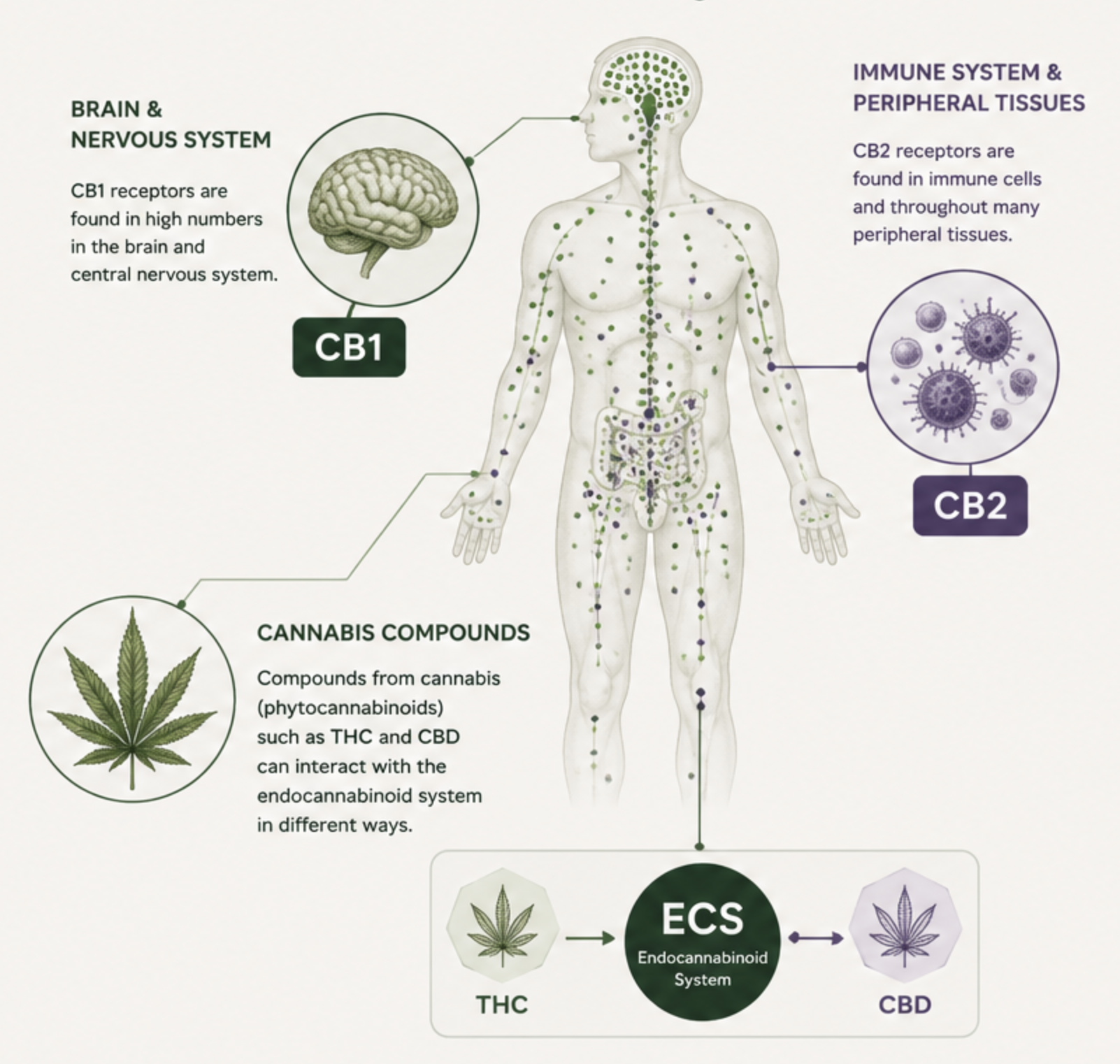
Cannabis affects us because its compounds interact with biological systems in the human body.
The cannabis plant produces many chemical compounds.
Among the best known are a group called:
CANNABINOIDS
Two you will encounter frequently are:
THC — Δ9-tetrahydrocannabinol
and
CBD — cannabidiol
But cannabis contains many other cannabinoids as well.
WHY DO THEY AFFECT US?
The human body already has a biological signaling system known as the:
ENDOCANNABINOID SYSTEM
The body did not develop this system because cannabis exists.
It produces its own signaling molecules—called endocannabinoids—that interact with receptors found throughout the body.
Plant-derived cannabinoids can interact with this system and with other biological targets.
THREE TERMS TO KNOW
ENDOCANNABINOIDS
Signaling molecules produced naturally by the body.
CANNABINOID RECEPTORS
Proteins that respond to particular chemical signals.
PHYTOCANNABINOIDS
Cannabinoids produced by the cannabis plant.
THC and CBD are phytocannabinoids.
THE IMPORTANT IDEA
Cannabis does not simply “make you high.”
Different compounds can interact with the body in different ways.
Their effects can depend on:
THE COMPOUND
THE AMOUNT
HOW IT ENTERS THE BODY
THE PERSON
OTHER MEDICINES OR SUBSTANCES
and the circumstances in which it is used.
Plant chemistry meets human biology.
Understanding that interaction is the beginning of understanding cannabis medicine.
The plant contains cannabinoids.
The body has systems with which cannabinoids can interact.
Next, we look more closely at the endocannabinoid system.
02
The endocannabinoid system
Your body produces its own cannabinoid-like signals.
The endocannabinoid system (ECS) is a biological signaling system found throughout the human body.
It helps regulate communication between cells and contributes to maintaining balance across many physiological processes.
The system has three basic components.
1. ENDOCANNABINOIDS
These are signaling molecules made naturally by the body.
Two of the best studied are:
ANANDAMIDE — AEA
2-ARACHIDONOYLGLYCEROL — 2-AG
They can bind to cannabinoid receptors and influence cellular activity.
2. CANNABINOID RECEPTORS
Two major cannabinoid receptors are:
CB1
Found especially abundantly in the brain and nervous system, although it also occurs elsewhere in the body.
CB2
Associated particularly with immune cells and tissues, although it too is distributed more broadly.
Think of receptors as places where particular chemical signals can influence what a cell does.
3. ENZYMES
The body also produces enzymes that make and break down endocannabinoids.
This allows endocannabinoid signaling to be produced when needed and then regulated.
So, at Fundamentals level:
ENDOCANNABINOIDS → RECEPTORS → RESPONSE → BREAKDOWN
WHAT DOES THE ECS DO?
Research has connected endocannabinoid signaling with many biological processes, including:
PAIN
APPETITE
MOOD
MEMORY & LEARNING
SLEEP
IMMUNE FUNCTION
STRESS RESPONSE
But this needs an important qualification.
“Involved in” does not mean “cannabis treats.”
If the endocannabinoid system participates in a biological process, that does not automatically mean cannabis will improve that process or treat every medical condition associated with it.
That leap is responsible for many exaggerated cannabis-health claims.
WHERE DOES CANNABIS ENTER THE PICTURE?
Plant cannabinoids can interact with this biological system.
THC, for example, can activate cannabinoid receptors, particularly CB1.
CBD behaves very differently and has a more complex pharmacology; it should not simply be described as another molecule that activates CB1 and CB2 in the same way.
We'll look at each separately.
The body already has an endocannabinoid system. Cannabis can influence it.
Understanding that difference is the foundation of cannabis pharmacology.
03
THC
THC is the cannabinoid most associated with the cannabis “high.”
THC stands for delta-9-tetrahydrocannabinol (Δ9-THC).
It is one of the best-studied cannabinoids produced by cannabis.
THC can interact strongly with CB1 receptors, which are abundant in the brain and nervous system.
This helps explain why THC can affect how a person feels, thinks, perceives and moves.
WHAT CAN THC DO?
Depending on the dose, product, person and circumstances, THC may produce effects such as:
EUPHORIA
Changes in mood or feelings of pleasure.
RELAXATION
Some people experience reduced tension or increased calm.
ALTERED PERCEPTION
Time, sensory experiences and surroundings may feel different.
APPETITE
THC can increase appetite.
PAIN & NAUSEA
THC and THC-related medicines have been studied and used for particular medical symptoms, including some forms of pain and nausea.
THC CAN ALSO PRODUCE UNWANTED EFFECTS
Effects are not always pleasant.
THC can also cause:
anxiety or panic
impaired attention and memory
slower reaction time and impaired coordination
dizziness
increased heart rate
and, particularly at higher exposures or in susceptible individuals, more significant psychological effects.
DOSE MATTERS
A small amount and a large amount of THC can produce very different experiences.
The way THC enters the body also matters.
Inhaled cannabis can produce effects relatively quickly.
Orally consumed THC generally takes longer to produce effects and can last considerably longer.
We'll explore those differences in Section 06.
MEDICAL DOES NOT MEAN RISK-FREE
THC can have legitimate therapeutic applications.
But calling cannabis “medical” does not remove THC's psychoactive effects or automatically make every dose appropriate.
That gives us an important principle:
Therapeutic effect and unwanted effect can come from the same compound.
Understanding cannabis medicine therefore requires understanding benefit, dose and risk together.
THC changes how the body and brain function.
That can be therapeutically useful in some circumstances—and undesirable in others.
04
CBD
CBD is a cannabinoid—but it behaves very differently from THC.
CBD stands for cannabidiol.
Like THC, it is a phytocannabinoid produced by cannabis. But CBD does not produce the characteristic intoxication or “high” associated with THC.
That does not mean CBD is inactive.
CBD WORKS DIFFERENTLY
THC produces many of its characteristic effects through direct activity at CB1 cannabinoid receptors.
CBD has more complex pharmacology.
It can influence several biological signaling systems and can also affect how the body's endocannabinoid system functions.
For Fundamentals, the important point is simply:
THC and CBD are both cannabinoids, but they do not affect the body in the same way.
DOES CBD HAVE MEDICAL USES?
Yes—but this is an area where careful language matters.
There is strong clinical evidence for purified CBD in the treatment of seizures associated with certain specific epilepsy syndromes. A prescription form of purified CBD has been approved for these indications.
Research is also investigating CBD for many other conditions.
But:
Research is not the same as proof.
CBD is widely promoted for pain, anxiety, sleep, inflammation and many other conditions.
The strength of evidence is not the same for every claim.
A product containing CBD should therefore not automatically be assumed to treat a disease simply because CBD is present.
NON-INTOXICATING DOES NOT MEAN RISK-FREE
CBD can still produce unwanted effects.
It may cause effects such as drowsiness, gastrointestinal symptoms or changes in appetite, and importantly, CBD can interact with some medicines.
Product quality matters too.
A commercial product labelled “CBD” may not necessarily contain exactly what the label claims unless it is produced and tested under appropriate standards.
THC vs. CBD
THC
Intoxicating
Strongly associated with CB1 activity
Can produce the cannabis “high”
Has therapeutic uses and potential adverse effects
CBD
Not intoxicating in the same way as THC
Different and more complex biological actions
Has established medical use in particular circumstances
Can still cause adverse effects and drug interactions
Different compound. Different effects. Different evidence.
Understanding that distinction is much more useful than thinking:
THC = recreational
CBD = medical
Both are pharmacologically active compounds, and both need to be understood through evidence.
Next, we look beyond THC and CBD—because cannabis chemistry does not stop with these two molecules.
05
More than THC and CBD
Cannabis chemistry is much more complex than two cannabinoids.
THC and CBD receive most of the attention, but they are only part of the chemical picture.
Cannabis produces many other cannabinoids, along with terpenes, flavonoids and other compounds.
OTHER CANNABINOIDS
Researchers have identified many cannabinoids in cannabis.
Some occur in larger amounts.
Others appear only in small concentrations.
Examples include compounds such as:
CBG — cannabigerol
CBC — cannabichromene
CBN — cannabinol
These compounds are being studied, but the amount and quality of evidence differ considerably.
So we should resist a common mistake:
The existence of a cannabinoid does not automatically mean it has a proven medical use.
TERPENES
Terpenes are aromatic compounds found throughout the plant kingdom.
They contribute to the smell and flavor of cannabis varieties.
You may encounter familiar terpene names such as:
MYRCENE
LIMONENE
PINENE
LINALOOL
Terpenes are also found in many other plants and foods.
Researchers are studying whether they may influence the effects of cannabis preparations, but many popular claims go beyond what has been firmly demonstrated in people.
WHAT ABOUT THE “ENTOURAGE EFFECT”?
You may hear the term entourage effect used to suggest that cannabinoids, terpenes and other cannabis compounds work together to produce effects different from isolated compounds.
It is an interesting scientific hypothesis.
But it should not be treated as a simple proven rule that every “whole plant” product is automatically better or more effective.
PLANT CHEMISTRY VARIES
Different cannabis plants can contain different combinations and concentrations of compounds.
Chemistry can also vary because of:
GENETICS
GROWING CONDITIONS
PLANT MATURITY
PROCESSING
STORAGE
This helps explain why two cannabis products may look similar but behave differently.
Names are not enough.
A cultivar name or marketing description does not tell us everything about what a product contains.
For medicine and research, the more useful questions are:
What compounds are present?
At what concentrations?
How consistent is the product?
What evidence exists for the intended use?
Cannabis is chemically complex. Our claims should remain simpler than the evidence allows.
Next, we look at another factor that changes the experience: how cannabis enters the body.
06
How cannabis enters the body
How cannabis is used changes how it affects the body.
The same cannabinoid can produce a different experience depending on how it enters the body.
This is called the route of administration.
Route affects important things such as:
HOW QUICKLY effects begin
HOW STRONG they may feel
HOW LONG they may last
and how predictable the experience may be.
INHALATION
Cannabis may be inhaled through smoking or vaporization.
Cannabinoids pass through the lungs and enter the bloodstream relatively quickly.
ONSET: usually rapid
DURATION: generally shorter than oral cannabis
The rapid onset can make effects easier to notice quickly, but inhalation also has risks. Smoking exposes the lungs to combustion products, while vaping carries its own respiratory and product-safety considerations.
ORAL
Cannabis cannabinoids can be consumed in foods, drinks, capsules or other swallowed products.
They travel through the digestive system and liver before reaching systemic circulation.
This means:
ONSET IS SLOWER
and
EFFECTS CAN LAST LONGER
THC is particularly important here. When THC passes through the liver, some is converted into a metabolite called 11-hydroxy-THC, which is also psychoactive.
This helps explain why an edible can feel quite different from inhaled cannabis.
SUBLINGUAL & BUCCAL
Some products are designed to be held:
UNDER THE TONGUE — sublingual
or
AGAINST THE INSIDE OF THE CHEEK — buccal
Some compounds may be absorbed through tissues in the mouth, while material that is swallowed follows the oral pathway.
TOPICAL
Topical products are applied to the skin.
Creams, lotions and balms are examples.
Their intended effects are generally local, although absorption depends heavily on the formulation.
A transdermal product is different: it is specifically designed to deliver compounds across the skin and into systemic circulation.
WHY ROUTE MATTERS
Consider the same amount of THC.
If inhaled, effects may appear quickly.
If swallowed, the person may feel little initially and then experience stronger effects later.
That delay is particularly important with edible products because taking more before the first amount has taken effect can result in unexpectedly high exposure.
So cannabis medicine involves more than asking:
“How much THC or CBD is in this?”
We also need to ask:
“How is it being delivered?”
Compound + amount + route = part of the effect.
How cannabis enters the body changes what happens next.
07
Dose, potency & response
The same cannabis product can affect different people differently.
Cannabis effects depend on more than simply whether a product contains THC or CBD.
Three ideas are especially important:
DOSE · POTENCY · INDIVIDUAL RESPONSE
They are related—but they are not the same thing.
DOSE
Dose is the amount of a substance a person receives.
For example, two products might contain the same concentration of THC, but someone consuming a larger quantity of one product receives a larger dose.
With cannabis, understanding dose can sometimes be difficult when products are not accurately measured or labelled.
POTENCY
Potency describes the concentration or strength of active compounds in a product.
A cannabis flower containing a higher percentage of THC is more potent in THC than one containing a lower percentage.
For manufactured products, potency may instead be expressed as an amount such as milligrams of THC or CBD per unit or serving.
This gives us an important distinction:
Potency tells us how concentrated something is.
Dose tells us how much is actually taken.
RESPONSE
Then comes the human being.
Two people receiving the same dose may not experience exactly the same effects.
Response can be influenced by factors including:
PREVIOUS CANNABIS EXPOSURE & TOLERANCE
BODY AND METABOLISM
ROUTE OF ADMINISTRATION
OTHER MEDICINES OR SUBSTANCES
HEALTH CONDITIONS
THE PRODUCT'S CHEMICAL COMPOSITION
SETTING AND EXPECTATIONS
TOLERANCE CAN CHANGE
With repeated exposure to THC, some people develop tolerance, meaning the same amount may produce less noticeable effects than it previously did.
Tolerance can also change when cannabis use changes or stops.
This is another reason why someone's previous experience does not guarantee the same response later.
MORE IS NOT ALWAYS BETTER
This is particularly important when discussing cannabis as medicine.
A stronger product or larger dose does not automatically produce a greater therapeutic benefit.
Increasing exposure can also increase the likelihood of unwanted effects.
So responsible cannabis medicine does not begin with:
“What is the strongest product?”
It begins with understanding the compound, dose, potency, route, individual and intended purpose.
Cannabis response is individual.
PRODUCT + DOSE + ROUTE + PERSON = RESPONSE
That equation is deliberately simple—but it captures an important principle.
The label describes the product. It cannot completely predict the person.
Understanding potency is important. Understanding response is even more important.
08
Where is the medical evidence?
Not every cannabis health claim has the same scientific support.
Cannabis has been used medicinally for a long time.
Modern medicine, however, asks another question:
What does the evidence show?
That distinction matters because cannabis is promoted for a very large number of symptoms and medical conditions.
Some uses have meaningful clinical evidence.
Others are still being investigated.
And some claims have little reliable evidence behind them.
ESTABLISHED OR STRONGER EVIDENCE
Cannabis-derived or cannabinoid medicines have established roles in certain specific circumstances.
Examples include cannabinoid medicines used for:
CERTAIN RARE EPILEPSY SYNDROMES
CHEMOTHERAPY-RELATED NAUSEA AND VOMITING
and some other symptoms or conditions where particular cannabinoid preparations have demonstrated benefit.
Importantly, evidence for a particular cannabinoid product for a particular condition does not prove that every cannabis product will produce the same result.
EMERGING EVIDENCE
Cannabinoids continue to be studied for many areas, including:
PAIN
SLEEP
ANXIETY
NEUROLOGICAL CONDITIONS
INFLAMMATION
and others.
Some studies may show promising results while the overall evidence remains uncertain, mixed or dependent on the specific condition and product.
INSUFFICIENT EVIDENCE
Then there are claims for which good clinical evidence is currently limited or absent.
This does not necessarily prove that something doesn't work.
It means:
We don't yet have enough reliable evidence to say that it does.
That is an important scientific distinction.
MARKETING IS NOT EVIDENCE
A testimonial can be meaningful to the person who experienced it.
A traditional use can be important historically and culturally.
A laboratory experiment can identify an interesting biological effect.
An animal study can justify further research.
But none of these alone establishes that a product safely and effectively treats a disease in people.
ASK BETTER QUESTIONS
When you encounter a medical cannabis claim, ask:
What condition was studied?
What cannabinoid or product was used?
What dose and route were studied?
Was the research conducted in people?
How strong and consistent is the evidence?
What risks or adverse effects were found?
Evidence belongs to the claim being made.
We should avoid saying:
“Cannabis treats pain.”
when the evidence may actually support something much narrower involving a particular type of pain, patient population, cannabinoid preparation and outcome.
Possible is not the same as proven.
Promising is not the same as established.
That is one of the most important principles in cannabis medicine.
Good cannabis education should be as interested in the limits of the evidence as in its possibilities.
09
Medicines, medical cannabis & wellness products
“Contains cannabis” does not automatically mean “medicine.”
As cannabis markets develop, learners will encounter many different products carrying words such as:
medical · therapeutic · wellness · natural · CBD · hemp
These words can sound similar, but they do not necessarily mean the same thing.
Understanding the distinction is especially important for future patients, professionals and entrepreneurs.
CANNABINOID MEDICINES
Some medicines contain cannabinoids or cannabis-derived compounds and are developed as standardized pharmaceutical products.
They may have:
DEFINED ACTIVE INGREDIENTS
CONSISTENT STRENGTH
QUALITY & MANUFACTURING STANDARDS
SPECIFIC MEDICAL INDICATIONS
and evidence evaluated through a medicines regulatory process.
Examples include prescription medicines containing purified CBD or particular THC-related cannabinoid formulations.
MEDICAL CANNABIS
The term medical cannabis is broader.
Depending on the country or regulatory system, it may include cannabis flower, oils, extracts or other preparations supplied to patients through an authorized medical pathway.
The exact meaning therefore depends partly on the law.
A product being available through a medical cannabis program does not necessarily mean it has gone through the same approval process as a conventional pharmaceutical medicine.
WELLNESS PRODUCTS
Cannabis- or hemp-derived ingredients also appear in products marketed for wellness.
These might be promoted for relaxation, sleep, recovery or general wellbeing.
But:
A wellness claim is not automatically a medical claim.
If a company claims that a product treats, prevents or cures a disease, that is very different from simply marketing a general wellness product—and can trigger different regulatory requirements.
QUALITY STILL MATTERS
Whatever category a product belongs to, important questions remain:
What does it actually contain?
How much THC or CBD is present?
Has it been tested?
Is the label accurate?
Could contaminants be present?
What evidence supports the claims being made?
This is where medicine, consumer protection and regulation begin to overlap.
FOR FUTURE ENTREPRENEURS
This distinction is particularly important.
A cannabis business cannot responsibly turn scientific possibility into a medical promise.
Statements such as:
“contains CBD”
and
“treats anxiety”
are fundamentally different claims.
The second requires evidence and may carry significant regulatory consequences depending on the jurisdiction.
A product is not a medicine simply because someone markets it as one.
Product · Evidence · Claim · Regulation
These four things should remain connected.
What you say a cannabis product does matters almost as much as what is inside it.
10
Cannabis medicine requires evidence
Understanding cannabis medicine means understanding both possibility and limitation.
We began this class with a simple idea:
Cannabis affects the human body because compounds produced by the plant can interact with biological systems.
But that is only the beginning.
Understanding that interaction does not tell us automatically whether cannabis will treat a particular medical condition.
PUTTING THE PIECES TOGETHER
THE COMPOUND
THC, CBD and other cannabinoids do not all behave in the same way.
THE PRODUCT
Different cannabis products can contain very different concentrations and combinations of compounds.
THE DOSE
The amount received influences both potential benefits and unwanted effects.
THE ROUTE
Inhaling, swallowing or otherwise administering cannabinoids changes how they enter and behave in the body.
THE PERSON
People can respond differently to the same cannabis product.
THE EVIDENCE
Medical claims should be supported by evidence appropriate to the product, condition and intended use.
BENEFIT AND RISK BELONG TOGETHER
Medicines are not defined by having benefits without risks.
The important question is whether a particular treatment provides an appropriate balance of potential benefit and potential harm for its intended use.
Cannabis should be considered in the same way.
Calling something natural, traditional or cannabis-based does not remove the need to understand its effects and risks.
CURIOSITY WITHOUT EXAGGERATION
Cannabis science continues to develop.
There are legitimate medical applications.
There are promising areas of research.
There are unanswered questions.
And there are claims that run far ahead of the evidence.
A good cannabis learner should be comfortable recognizing all four.
Respect the possibilities.
Understand the risks.
Follow the evidence.
That is the foundation of responsible cannabis medicine.
Good science does not require us to be for or against cannabis. It requires us to ask what the evidence actually shows.
YOU NOW UNDERSTAND CANNABIS MEDICINE
Cannabis medicine begins with biology—and depends on evidence.
Cannabis contains compounds that can influence the human body.
But understanding cannabis medicine requires more than knowing that THC and CBD exist.
It requires understanding what compound is being used, how much, how it enters the body, who is using it, and what evidence supports the intended use.
SIX IDEAS TO REMEMBER
THE ENDOCANNABINOID SYSTEM
The human body produces its own endocannabinoids and has cannabinoid receptors and enzymes involved in biological signaling.
THC & CBD ARE DIFFERENT
THC can produce intoxication and has therapeutic applications. CBD does not produce the characteristic THC high, but it is still biologically active and can have effects, risks and drug interactions.
CANNABIS IS CHEMICALLY COMPLEX
The plant contains many cannabinoids, terpenes and other compounds. The evidence surrounding them varies.
ROUTE MATTERS
Inhaled, oral, sublingual/buccal and topical products do not necessarily behave the same way in the body.
RESPONSE IS INDIVIDUAL
Product, dose, potency, route and the individual all influence the resulting effects.
CLAIMS REQUIRE EVIDENCE
Promising research, traditional use, testimonials and marketing claims are not the same as established clinical evidence.
THE BIG IDEA
COMPOUND + PRODUCT + DOSE + ROUTE + PERSON + EVIDENCE
↓
POTENTIAL BENEFIT ↔ POTENTIAL RISK
Respect the possibilities. Understand the risks. Follow the evidence.
Now let's see what you remember.
CLASS 06
KNOWLEDGE CHECK
You understand the fundamentals of cannabis medicine. Let's check.
10 questions · About 3 minutes · Retake anytime
1. What are cannabinoids produced by the cannabis plant called?
A. Endocannabinoids
B. Phytocannabinoids
C. Enzymes
D. Receptors
2. Which two are well-studied endocannabinoids produced by the human body?
A. THC and CBD
B. CBG and CBN
C. Anandamide (AEA) and 2-AG
D. Myrcene and limonene
3. Which cannabinoid is most associated with the characteristic cannabis “high”?
A. CBD
B. THC
C. CBG
D. CBC
4. Which statement about CBD is most accurate?
A. CBD has no biological effects
B. CBD treats every condition for which it is marketed
C. CBD is not intoxicating like THC but is biologically active and can have adverse effects and drug interactions
D. CBD and THC affect the body identically
5. What are terpenes?
A. Cannabinoid receptors
B. Aromatic compounds found in cannabis and many other plants
C. Human hormones
D. Cannabis seeds
6. Why does route of administration matter?
A. It only changes the taste
B. It determines the plant's genetics
C. It can affect how quickly effects begin and how long they last
D. It makes every dose equivalent
7. Why can oral THC feel different from inhaled THC?
A. Oral products contain no cannabinoids
B. Oral THC is processed through digestion and the liver, including formation of psychoactive 11-hydroxy-THC
C. Inhaled THC becomes CBD
D. Oral THC works immediately
8. What is the difference between potency and dose?
A. There is no difference
B. Potency describes concentration; dose describes the amount received
C. Potency applies only to CBD
D. Dose applies only to medicines
9. Does evidence that one cannabinoid preparation helps a particular condition prove that every cannabis product treats that condition?
A. Yes
B. No
10. Which is the best approach to a cannabis medical claim?
A. Believe it if many customers repeat it
B. Assume natural products are safe
C. Reject all cannabis research
D. Ask what product was studied, for which condition, at what dose and route, and how strong the evidence is
RESULTS
8-10 : EXCELLENT
You understand the fundamental principles behind cannabis medicine and the importance of evidence.
CLASS 06 COMPLETE
NEXT → CLASS 07
CANNABIS, PUBLIC HEALTH & RESPONSIBLE USE
5-7 : ALMOST THERE
You have the main concepts. Review the sections you missed and try again.
0–4 — TAKE ANOTHER LOOK
Return to Class 06 and review the fundamentals. There is no penalty and no limit on attempts.
CHECK YOUR ANSWERS
1 B · 2 C · 3 B · 4 C · 5 B · 6 C · 7 B · 8 B · 9 B · 10 D