English | नेपाली
CLASS 04
The Gandaki
Cannabis Framework
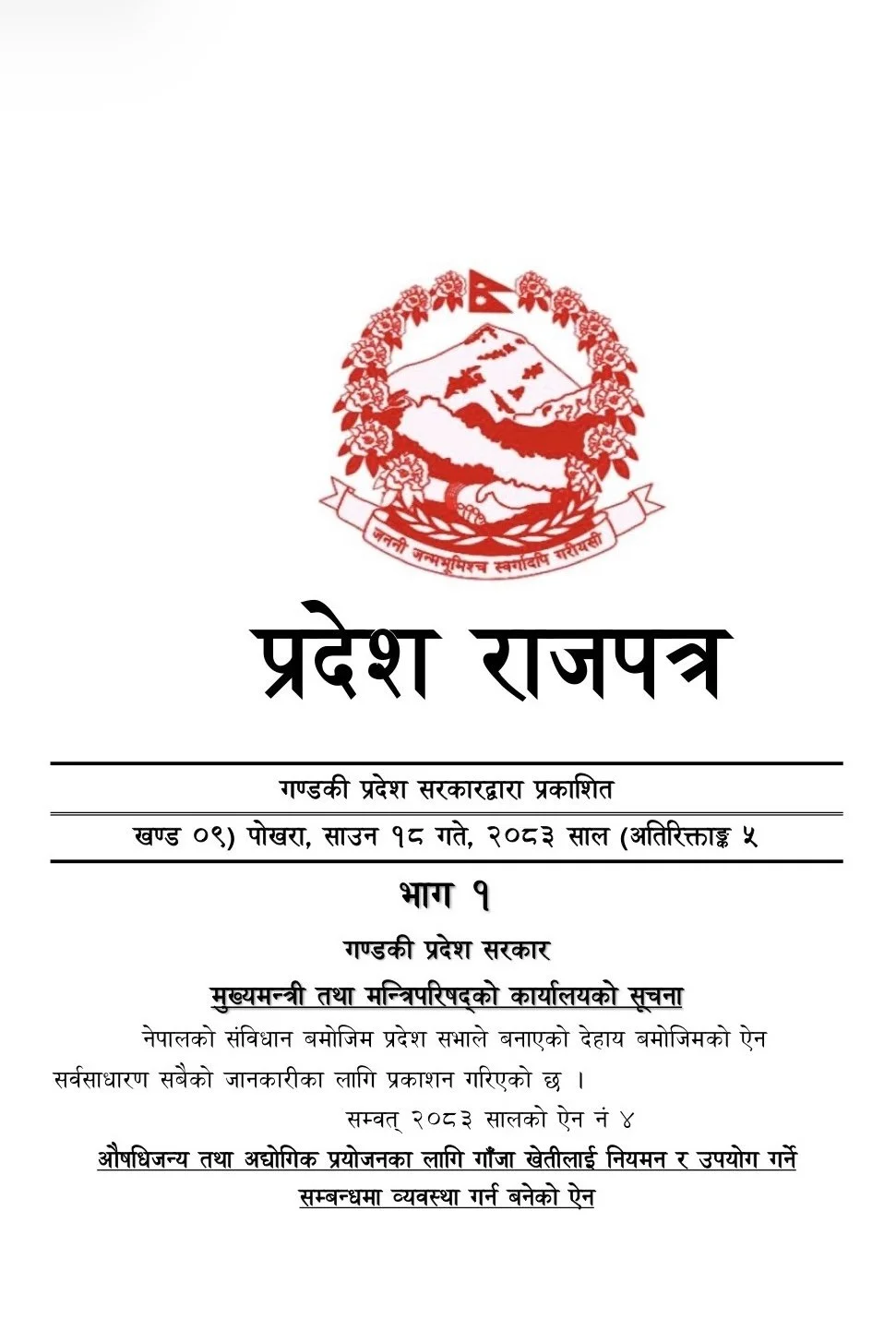
From theory to a real-world case.
In Class 03, we learned that cannabis regulation is not simply a choice between “legal” and “illegal.”
Now we look at Gandaki Province, Nepal, where a regulatory framework has been developed for cannabis cultivation and use for specified purposes.
This class examines what the framework permits, how it attempts to control cultivation and production, who can participate, and what responsibilities come with permission.
Approx. 15–20 minutes · Beginner · Free
04 / 10
01
Why Gandaki?
A global cannabis question became a local policy question.
Cannabis is not new to Nepal.
The plant has longstanding connections with the country's agriculture, culture, traditional practices and Himalayan environment.
But modern Nepal also operates under national drug-control laws that prohibit many cannabis-related activities.
That creates the central question behind the Gandaki case:
How can a province create a regulated pathway for cannabis within a country where national prohibition still exists?
GANDAKI CHOSE A SPECIFIC PATH
The framework is not simply a declaration that:
“Cannabis is legal.”
Its focus is much narrower.
It creates a framework around cannabis cultivation and use for medicinal and industrial purposes, with permission, monitoring and controls rather than unrestricted cultivation. Contemporary reporting on the enacted framework confirms that official permission and government monitoring are central features.
That makes Gandaki useful for this course.
We can take the ideas from Class 03—
permission · purpose · regulation · responsibility
—and see what happens when policymakers try to turn them into an actual system.
FROM THEORY TO PRACTICE
Gandaki therefore gives us something more useful than a hypothetical example.
It lets us ask:
What is permitted?
For what purpose?
Who can participate?
What controls are required?
Who is responsible for oversight?
This is where regulation stops being an idea and becomes a framework.
02
What is the framework trying to do?
The Gandaki framework does not create unrestricted cannabis legalization.
Its purpose is much more specific.
The framework is designed to bring cannabis cultivation for medicinal and industrial purposes into a controlled system of permission, monitoring and accountability. The legislation passed by the Provincial Assembly also contemplated research and export-related activity under provincial supervision.
TWO MAIN PATHWAYS
MEDICINAL
Cannabis may be cultivated and supplied for authorized medicinal purposes.
This pathway requires controls because the plant or its products may contain significant levels of psychoactive cannabinoids and are intended to enter a medical or pharmaceutical system.
INDUSTRIAL
Cannabis may also be cultivated for industrial purposes.
The framework distinguishes this pathway partly through plant chemistry: cannabis grown for industrial purposes is required to remain below the specified 0.3% THC threshold.
PERMISSION COMES FIRST
The framework does not say:
Grow cannabis first and find a market later.
Cultivation is intended to occur in designated areas, under authorization, with information about the land and the intended purchaser forming part of the application process. Reporting on the passed text describes requirements including land ownership or a lease of at least five years, local-government recommendation, and an agreement with an established medicinal or manufacturing industry that will purchase the crop.
That is a fundamental design choice.
The framework tries to connect:
PURPOSE → PERMISSION → CULTIVATION → TESTING → BUYER
rather than simply opening cultivation to an uncontrolled market.
This is regulation, not general legalization.
Recreational or unrestricted personal cannabis use is not what this framework was designed to authorize.
Gandaki's approach begins by defining why cannabis may be grown before deciding who may grow it.
03
What is permitted?
Permission is tied to purpose.
The Gandaki framework does not open every cannabis activity to everyone.
Its central legal pathway is cultivation for specified medicinal and industrial purposes, under authorization and government oversight. The passed bill also contemplated cultivation connected with research and export, subject to the wider legal framework.
CULTIVATION
Cannabis cultivation is contemplated only within areas designated by the provincial government and through an authorization process.
This is important:
The framework regulates cultivation rather than simply declaring cultivation legal.
MEDICINAL PURPOSES
Cannabis may enter an authorized pathway for medicinal production.
That does not mean cannabis automatically becomes an ordinary medicine or that anyone may produce or sell it. The medicinal pathway remains subject to controls over cultivation, production and use.
INDUSTRIAL PURPOSES
The framework also creates an industrial pathway.
For cannabis grown for industrial purposes, the legislation uses a 0.3% THC threshold and identifies non-intoxicating plant materials for industrial uses.
RESEARCH
Research is also contemplated within the framework, allowing cannabis to be studied within an authorized system rather than outside it.
WHAT IS NOT BEING CREATED?
The framework does not create a general recreational retail market.
It does not mean anyone can simply grow cannabis, sell it to anyone, or use a medicinal authorization for another purpose.
That brings us back to one of the most important lessons from Class 03:
Legal for what purpose?
In Gandaki, the answer determines what pathway—and what rules—apply.
Permission is specific. It does not automatically extend to every cannabis activity.
04
Who can participate?
Permission begins before the first seed is planted.
The Gandaki framework does not create an open system in which anyone may begin cultivating cannabis.
Participation is organized through registered businesses or farms and a formal permission process. Reporting on the enacted framework describes a five-year cultivation licence, renewable under prescribed procedures.
THE PLACE
Cultivation cannot simply occur anywhere.
The provincial government can designate specific districts, local levels or areas where authorized cannabis cultivation may take place.
THE LAND
An applicant must show that it has access to land within the designated area.
That may be:
OWNED LAND
or
LEASED LAND
with a lease of at least five years.
THE LOCAL CONNECTION
The application also requires a recommendation from the relevant local government.
This gives the local level a role before provincial authorization is granted.
THE BUYER
One of the most interesting features is that the applicant is expected to know where the crop is going before it is grown.
The application must include an agreement with an established medicinal or manufacturing industry providing assurance that it will purchase the cannabis produced.
So the basic pathway looks like:
DESIGNATED AREA → LAND → LOCAL RECOMMENDATION → BUYER AGREEMENT → APPLICATION
APPROVAL IS NOT YET THE END
After the required infrastructure is prepared, the regulatory unit can inspect the cultivation site before issuing the final licence.
This is an important regulatory idea for beginners:
Permission to prepare for cultivation is different from permission to begin cultivation.
The framework tries to establish the grower, the place, the purpose and the market before production begins.
05
Permission before production
A licence comes after preparation—not before it.
One of the clearest features of the Gandaki framework is its two-stage approach.
A prospective cultivator first obtains prior consent. That gives the applicant time to prepare the site and required infrastructure. The framework provides a one-year period for this stage; if the requirements are not completed and the cultivation licence obtained within that period, the prior consent lapses.
FIRST — PRIOR CONSENT
Before cultivation begins, the applicant establishes the basic plan:
WHO will cultivate
WHERE cultivation will take place
WHY the cannabis is being grown
WHO is expected to purchase the crop
Only then does the applicant prepare the site.
THEN — PREPARE THE INFRASTRUCTURE
The cultivation area must be secured against unauthorized access.
The framework provides for measures such as:
FENCING OR WALLS
The cultivation site must be physically secured.
SECURITY & MONITORING
Security personnel or monitoring arrangements are required; reporting on the passed legislation also describes CCTV requirements.
PROCESSING AREA
If permitted processing will occur at the cultivation site, appropriate infrastructure must be prepared.
SECURE STORAGE
There must be a secure place for storing the harvested crop.
THEN — INSPECTION
Preparing the site does not automatically authorize cultivation.
The regulatory unit can conduct a physical inspection to determine whether the site and infrastructure meet the requirements.
Only after those requirements are satisfied can the final cultivation licence be issued. The cultivation licence is valid for five years, subject to renewal requirements.
So the beginner's version of the process is:
PRIOR CONSENT → PREPARE → INSPECT → LICENSE → CULTIVATE
Permission is a process.
This is an important distinction from simply registering a farm or business.
The framework attempts to make sure the regulatory controls exist before cannabis enters production.
Build the system first. Then grow within it.
06
From cultivation to market
Regulation continues after the plant is grown.
Receiving a cultivation licence is not the end of the Gandaki system.
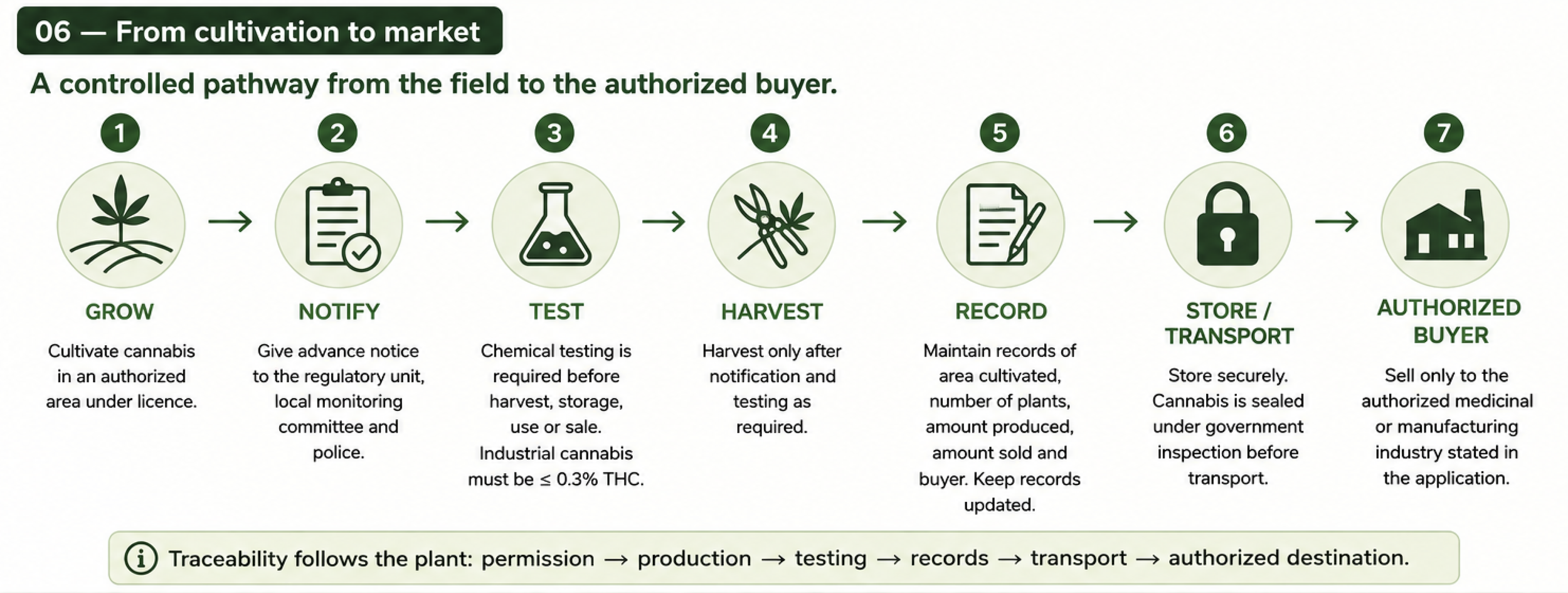
Once the crop is ready, the framework places controls around harvesting, testing, storage, transport, record keeping and sale.
BEFORE HARVEST
When cannabis is ready to be harvested, advance notice must be given to the relevant regulatory unit, local monitoring committee and nearby police office.
This allows the crop to remain within the regulated system as it moves out of cultivation.
TEST
Before harvesting, storing, using or selling the crop, the framework requires chemical testing, including measurement of THC.
For cannabis cultivated for industrial purposes, the THC limit is 0.3%.
RECORD
The cultivator must maintain records including information about the:
AREA CULTIVATED
NUMBER OF MATURE PLANTS, where possible
AMOUNT PRODUCED
AMOUNT SOLD
BUYER
Those records must be kept updated and made available to the regulatory unit.
STORE & TRANSPORT
The harvested crop cannot simply move into ordinary commerce.
Storage is controlled, and reporting on the framework describes cannabis being sealed under government inspection before transportation from one place to another.
SELL TO THE AUTHORIZED BUYER
The grower cannot harvest first and then look for anyone willing to buy the crop.
As we learned earlier, the intended buyer is part of the regulatory pathway before cultivation begins. The framework therefore attempts to connect production with an identified medicinal or manufacturing market.
So the simplified chain is:
GROW → NOTIFY → TEST → HARVEST → RECORD → STORE / TRANSPORT → AUTHORIZED BUYER
Traceability follows the plant.
The important lesson for Fundamentals is not to memorize every procedure.
It is to understand the regulatory principle:
A controlled cannabis system follows the crop from permission to production to its final authorized destination.
Regulation does not stop at the farm gate.
07
Medicine, industry and research
The same plant can enter very different pathways.
The Gandaki framework does not treat every cannabis crop as though it has the same purpose.
What the cannabis is being grown for helps determine how it is regulated, where it can go and what can happen to it next.
MEDICINAL
Cannabis may be cultivated for medicinal purposes within the regulated system.
This creates a pathway connecting authorized cultivation with medicinal production and healthcare-related uses.
But medicinal cannabis is not simply ordinary cannabis given a different label.
It requires controls over the plant, production, processing, quality and eventual use.
We will explore the science of cannabis medicine separately in Class 06 — Cannabis Medicine & the Human Body.
INDUSTRIAL
Cannabis can also be grown for industrial purposes.
Here the objective is not intoxication.
Different parts of the plant can potentially become:
FIBRE — textiles, rope and other materials
SEED — food and oil
BIOMASS — industrial materials and processing inputs
Under the Gandaki framework, cannabis cultivated for industrial purposes is subject to the 0.3% THC threshold we encountered earlier.
This distinction matters because industrial cannabis can create an agricultural economy very different from a medicinal cannabis industry.
RESEARCH
There is another important pathway:
research.
Universities, research institutions and other authorized bodies can have a role in studying cannabis within a regulated system.
Research can help answer questions that Nepal will increasingly need evidence for:
How do local cannabis varieties differ?
What cannabinoids and other compounds do they contain?
Which varieties may have agricultural, medicinal or industrial value?
How can cultivation and processing standards be improved?
And what are the actual public-health effects of different policies?
Different purpose. Different pathway.
This is the central lesson of this section.
MEDICINE → health and pharmaceutical pathway
INDUSTRY → agriculture and manufacturing pathway
RESEARCH → evidence and knowledge pathway
The categories may sometimes intersect, but they should not simply be treated as interchangeable.
Purpose determines the pathway.
Pathway determines the rules.
Regulation begins by asking what the plant is being grown for.
08
Regulation happens locally too.
The framework connects provincial regulation with local oversight.
The Gandaki system is not designed to operate entirely from the provincial capital.
The Act creates a Local Monitoring Committee and gives local government a place within the regulatory structure. The Act itself defines the Local Monitoring Committee by reference to Section 21.
At the provincial level, the regulatory unit coordinates with local governments and security agencies to make cannabis regulation effective.
This creates an important principle:
PROVINCE
sets and administers the regulatory framework.
LOCAL GOVERNMENT
participates in oversight where cultivation actually occurs.
REGULATORY UNIT
coordinates implementation.
SECURITY AGENCIES
support control and compliance.
FROM POLICY TO PLACE
Cannabis regulation ultimately happens somewhere.
On a farm.
In a municipality.
In a community.
That is why the Act allows the provincial government to designate particular districts or locations within local levels as areas where cannabis cultivation may be permitted for medicinal purposes, industrial purposes, or both.
A provincial framework needs local implementation.
The important lesson isn't the names of every committee.
It is the structure:
PROVINCE → REGULATOR → LOCAL GOVERNMENT → CULTIVATION AREA
The rules may be provincial. Their implementation happens locally.
09
From law to implementation.
Passing a law is only the beginning.
The Gandaki framework establishes the legal structure for regulated cannabis cultivation.
But a framework does not automatically create a functioning cannabis program.
The Act gives the provincial government authority to develop the rules, directives, procedures and standards necessary to implement it.
That means implementation requires the machinery behind the law to become operational.
RULES & STANDARDS
Detailed requirements must be established.
REGULATORY SYSTEM
The responsible institutions must be able to administer and monitor the program.
LICENSING
Applicants need a functioning process for approvals and permits.
TESTING & COMPLIANCE
Standards for cultivation, security, testing, records and oversight must work in practice.
THE IMPORTANT DISTINCTION
A law creates authority.
Implementation turns that authority into a working system.
This distinction is especially important in Gandaki because cannabis remains regulated under Nepal's federal narcotics law. That federal–provincial relationship has been one of the central legal questions surrounding implementation of the Gandaki framework. Recent reporting confirms that this remains a significant issue.
The framework is a beginning, not the finished system.
For someone entering the emerging cannabis sector, this is an important lesson:
Do not confuse what the law allows with what can be done immediately.
Regulation develops through laws, rules, institutions and implementation.
Understanding the framework means understanding both its possibilities and its limits.
10
Understanding the Gandaki Framework
The framework creates a pathway—not an open market.
We have now seen the central idea behind Gandaki's approach.
Cannabis is not simply being treated as a crop that anyone can grow and sell.
The framework creates a controlled pathway for medicinal and industrial purposes, built around permission, designated cultivation areas, monitoring, testing and controlled movement of the crop.
SIX IDEAS TO REMEMBER
PURPOSE
The framework begins with defined medicinal and industrial purposes.
PERMISSION
Cultivation operates through authorization rather than an unrestricted right to grow.
PLACE
Cultivation can be connected to areas designated by the provincial government.
CONTROL
The system follows cannabis through cultivation, harvest, storage, transport and sale.
EVIDENCE
Testing, records, inspection and research become part of regulation.
LOCAL IMPLEMENTATION
Provincial regulation connects with local government, monitoring bodies and the communities where cultivation occurs.
WHAT THE FRAMEWORK DOES NOT MEAN
This is equally important.
It does not mean:
Anyone can grow cannabis.
Cannabis can be sold anywhere.
Every form of cannabis use has been legalized.
A provincial law removes every question involving federal law.
The framework is much narrower than that.
From prohibition toward regulation.
Class 03 showed us that cannabis policy does not have only two choices:
PROHIBITED or LEGAL.
Regulation creates another question:
If cannabis is permitted for a particular purpose, what rules should govern it?
Gandaki is attempting to answer that question through a provincial regulatory system.
And that makes Gandaki particularly useful for this course—not because the framework answers every question, but because we can watch a cannabis regulatory system being built in Nepal, in real time.
THE BIG PICTURE
PURPOSE → PERMISSION → CULTIVATION → MONITORING → TESTING → CONTROLLED MARKET
The law establishes the framework. Implementation will determine what it becomes.
YOU NOW UNDERSTAND THE FRAMEWORK
Gandaki turns the idea of regulation into a system.
The Act allows the provincial government to designate areas for cannabis cultivation for medicinal purposes, industrial purposes, or both.
It then builds controls around that permission.
SIX IDEAS TO REMEMBER
PURPOSE
Cannabis cultivation begins with an identified medicinal or industrial purpose.
PLACE
Cultivation is connected to areas designated by the provincial government.
PERMISSION
Participation requires authorization. Growing cannabis is not simply opened to everyone.
CONTROL
Security, infrastructure and secure storage are built into the cultivation system. The Act specifically provides for barriers/fencing, surveillance including CCTV, processing infrastructure where applicable, and secure storage.
TESTING & EVIDENCE
The Act incorporates chemical standards, record keeping, inspection and research. For the industrial pathway, the Act specifies the relevant 0.3% THC limit.
IMPLEMENTATION
The Act is only the framework. It expressly authorizes further rules, directives, procedures and standards for implementation.
THE BIG IDEA
PURPOSE → PERMISSION → PRODUCTION → OVERSIGHT → AUTHORIZED USE
The Gandaki framework is not simply about making cannabis legal. It is about creating rules for when, where, why and how cannabis may enter a regulated system.
Now let's see what you remember.
CLASS 04 — KNOWLEDGE CHECK
You understand the framework. Let's check.
10 questions · About 3 minutes · Retake anytime
1. What is the central purpose of the Gandaki cannabis framework?
A. Unrestricted cannabis cultivation
B. Regulating cannabis cultivation for medicinal and industrial purposes
C. Creating recreational cannabis shops
D. Allowing cannabis cultivation everywhere
2. Can cannabis cultivation automatically take place anywhere in Gandaki?
A. Yes
B. No — cultivation areas can be designated by the provincial government
3. What comes before authorized cultivation?
A. Harvest
B. Retail sale
C. Permission and required preparation ✓
D. Export
4. Why are security measures required at cultivation sites?
A. To make farms more attractive
B. To prevent unauthorized access and support controlled cultivation ✓
C. To increase THC
D. To advertise the farm
5. What THC threshold does the Act use in the relevant industrial context?
A. 3%
B. 1%
C. 0.3% ✓
D. 10%
6. Does the framework create a general recreational cannabis market?
A. Yes
B. No ✓
7. Which activity is also contemplated by the Act?
A. Uncontrolled street sales
B. Cannabis tourism
C. Study and research ✓
D. Cannabis use without restrictions
8. Does regulation end when a cultivation licence is issued?
A. Yes
B. No — oversight continues through production and movement of cannabis
9. Why are further rules and standards important?
A. They replace the Act entirely
B. They help turn the legal framework into an operational system ✓
C. They remove government oversight
D. They make every cannabis activity legal
10. What is the main lesson from the Gandaki case?
A. Legalization means removing rules
B. Every jurisdiction should use exactly the same model
C. Cannabis regulation only concerns farmers
D. Regulation defines permitted purposes, participants and conditions
Results
8-10: EXCELLENT
You understand the basic structure of the Gandaki Cannabis Framework.
CLASS 04 COMPLETE
5-7 : ALMOST THERE
You have the main ideas. Review the sections you missed and try again.
0-4 : TAKE ANOTHER LOOK
Return to Class 04 and review the framework. There is no penalty and no limit on attempts.
CHECK YOUR ANSWERS
1 B · 2 B · 3 C · 4 B · 5 C · 6 B · 7 C · 8 B · 9 B · 10 D